The TYT Tri Ball Mount review centers on a useful 5-in-1 hitch accessory for vehicles with a standardized 2-inch receiver.
Its three ball sizes, tow hook and shackle make it appealing to drivers who want one adjustable-looking setup for several towing and recovery situations.
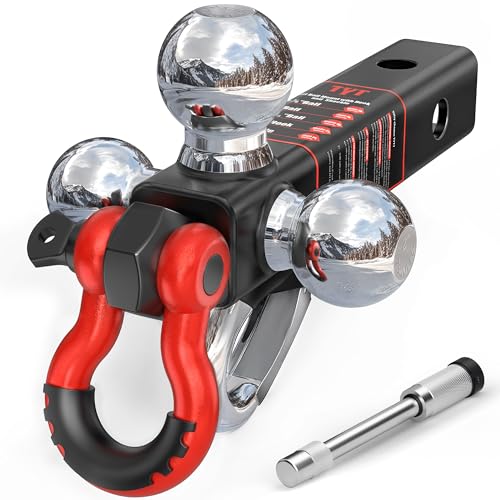
Table of Contents
TYT Tri Ball Mount Review Summary
The TYT Tri Ball Mount is best suited to owners who regularly switch between trailers or want more flexibility than a single fixed hitch ball provides.
It combines 1-7/8-inch, 2-inch, and 2-5/16-inch trailer balls with a D-shaped shackle, so the same mount can cover several common trailer-coupler sizes and a basic recovery use case.
The included 5/8-inch hitch-pin lock also addresses a practical concern: keeping the accessory secured to the vehicle when it is installed.
The main reason to buy it is convenience.
Instead of carrying separate ball mounts for every compatible trailer, you can select the ball size that matches the trailer you are towing.
However, the listing does not provide adjustable-height measurements, receiver length, or a detailed fit chart.
Buyers should therefore confirm the vehicle’s 2-inch receiver, required rise or drop, and trailer-coupler requirements before ordering.
This is a versatile hardware choice, but compatibility still depends on the complete towing setup.
Review Scorecard
| Category | Editorial score | Buyer-focused rationale |
|---|---|---|
| Ball-size versatility | 9/10 | Three common sizes cover a broad range of trailer couplers. |
| Receiver compatibility | 8/10 | Designed for most standardized 2-inch receivers, subject to vehicle fit. |
| Towing capacity range | 8/10 | The listed capacities reach 10,000 pounds GTW, with ratings varying by ball. |
| Recovery flexibility | 8/10 | The D-shaped shackle adds a useful non-trailer attachment point. |
| Security | 8/10 | A 5/8-inch lock and weatherproof cover are included. |
| Corrosion resistance | 8/10 | Chrome finish and black powder coating are intended to resist corrosion. |
| Documentation confidence | 6/10 | The available listing facts do not specify dimensions, weight, or height adjustment. |
These are editorial buyer assessments based on the supplied product information, not laboratory measurements or a hands-on test.
The strongest scores reflect the breadth of the included hardware; the lower documentation score reflects the limited published specifications.
Key Features and Specifications of TYT Tri Ball Mount
The product’s central feature is its multi-ball configuration.
It includes three trailer hitch ball sizes:
- 1-7/8 inches, listed for up to 6,000 pounds of gross trailer weight.
- 2 inches, listed for up to 7,500 pounds of gross trailer weight.
- 2-5/16 inches, listed for up to 10,000 pounds of gross trailer weight.
Those numbers are manufacturer or listing claims and should not be treated as permission to exceed the rating of the vehicle, receiver, trailer, coupler, ball mount, or other towing component.
The lowest-rated part in the complete system controls the safe limit.
Buyers should match the ball to the trailer coupler and verify the vehicle’s towing specifications before use.
The TYT Tri Ball Mount is designed for most standardized 2-inch receivers.
That is a common receiver size, but “most” does not mean every vehicle or every hitch installation.
Receiver opening size is only one part of fit.
The mount’s height, clearance, pin-hole alignment, and the trailer’s level position can all affect whether it is appropriate for a particular vehicle.
Since the supplied evidence does not give the mount’s rise, drop, shank length, or overall dimensions, those details should be confirmed on the product page before purchase when a precise fit matters.
Beyond the three balls, the mount includes a D-shaped shackle listed for 7,500 pounds.
This broadens its use from ordinary trailer towing to certain towing or recovery connections.
The shackle is a convenience feature, not a reason to ignore recovery-specific safety practices.
The connection point, recovery strap or other attachment, vehicle frame, and surrounding hardware all need to be suitable for the load and situation.
The finish combines chrome on the hitch-receiver components with black powder coating.
The listing describes the surfaces as corrosion resistant and intended to support a longer service life.
That is useful for equipment exposed to road spray and outdoor storage, although coating is not a substitute for inspection and maintenance.
Dirt, salt, moisture, damaged finish, and seized hardware can still affect towing equipment over time.
Security is another practical inclusion.
The package includes a 5/8-inch hitch-pin lock with a weatherproof cover.
The lock cylinder uses a unique key according to the listing, and the manufacturer advises keeping that key safe.
This can make the mount less convenient to remove for an opportunistic thief, while the cover is intended to help protect the lock for all-season use.
It should be viewed as theft deterrence rather than an absolute guarantee of security.
Pros and Cons of TYT Tri Ball Mount
Pros
- Three common ball sizes: The 1-7/8-inch, 2-inch, and 2-5/16-inch options cover many everyday trailer-coupler formats.
- One accessory for more than towing: The included D-shaped shackle adds recovery-oriented versatility.
- Useful listed capacity range: The ball ratings run from 6,000 to 10,000 pounds GTW, depending on size.
- Built-in theft deterrence: The included 5/8-inch lock means a separate hitch-pin lock is not immediately necessary.
- Outdoor-minded finish: Chrome and black powder coating are specified for corrosion resistance.
- Warranty and service promise: The listing states a one-year warranty and a commitment to address after-sales issues within 24 hours.
Cons
- Limited published dimensions: The supplied information does not identify rise, drop, shank length, or mount weight.
- Receiver fit is not universal: It is intended for standardized 2-inch receivers, so vehicles with another receiver size need a different solution.
- Capacity is not one blanket rating: Each ball has its own listed limit, and the entire towing system may be rated lower.
- No hands-on evidence here: This review is based on listing information, not an independent fit, corrosion, or load test.
- The lock key must be protected: Losing the unique key can turn a convenience feature into an ownership nuisance.
Who Should Buy TYT Tri Ball Mount?
The TYT Tri Ball Mount makes the most sense for a driver with a 2-inch receiver who uses trailers with different coupler sizes.
It is particularly convenient for households, contractors, or recreational users who may tow more than one compatible trailer and prefer carrying one multi-ball accessory instead of swapping several fixed mounts.
The shackle also adds value for someone who occasionally needs a suitable attachment point for recovery equipment.
It may also suit buyers who leave a hitch accessory installed and want a supplied lock rather than purchasing one separately.
The weatherproof cover and corrosion-resistant finish are sensible details for equipment that sees outdoor exposure.
Skip it, or pause for additional measurements, if your receiver is not 2 inches, if your trailer needs a particular rise or drop, or if you need a precisely documented heavy-duty setup.
Buyers towing near the vehicle or hitch limit should verify every rating and dimension directly.
The 10,000-pound figure attached to the largest ball does not automatically make the whole assembly or vehicle suitable for a 10,000-pound trailer.
Choosing a Multi-Ball Hitch for Real-World Towing
Match the coupler before the capacity
The correct ball diameter is the first decision.
A ball that fits the receiver but does not match the trailer coupler is not a safe substitute.
The three sizes make the TYT Tri Ball Mount flexible, but they do not eliminate the need to identify the coupler on each trailer.
Check height and clearance
Trailer level is affected by the vehicle, receiver, and mount geometry.
Because the supplied evidence does not include rise or drop measurements, confirm those dimensions before purchase.
Also check tailgate, bumper, safety-chain, and wiring clearance for the specific vehicle.
Treat the shackle as a separate use case
The D-shaped shackle is a useful addition, but recovery loads can be dynamic and severe.
Use compatible recovery gear and follow the ratings of every connection.
Do not assume the ball rating, shackle rating, or receiver rating can be combined into one larger capacity.
Inspect the finish and lock
The chrome and powder-coated surfaces are intended to resist corrosion, but towing hardware still benefits from routine inspection.
Keep the lock covered, retain its unique key, and check for damage, looseness, unusual wear, or corrosion before towing.
Alternatives to TYT Tri Ball Mount
The TYT is a sensible choice when three ball sizes and an included shackle matter most.
Buyers who need a different geometry or a more established product line can compare it with other credible Amazon-sold options:
- CURT multi-ball adjustable ball mounts are worth considering when brand familiarity and adjustable towing hardware are priorities.
- B&W Tow & Stow multi-ball mounts are alternatives for buyers focused on a premium multi-ball design and different height configurations.
- Reese adjustable multi-ball mounts may suit shoppers comparing adjustable formats from a well-known towing-equipment line.
- Draw-Tite multi-ball hitch mounts provide another product-line comparison for standard receiver applications.
Compare receiver size, ball diameters, height range, shank dimensions, included pin hardware, and the rating of the complete towing system.
The best alternative is the one that fits the trailer and vehicle precisely, not simply the one with the largest advertised number.
Is TYT Tri Ball Mount Worth It?
The TYT Tri Ball Mount is worth considering if you want one 2-inch-receiver accessory with three common trailer ball sizes, a 7,500-pound-listed shackle, corrosion-resistant finishes, and an included hitch-pin lock.
Its strongest advantage is practical versatility: it can reduce the need to carry multiple ball mounts when your trailers use different couplers.
The buying decision is less clear when exact dimensions matter, because the supplied product evidence does not specify rise, drop, shank length, or overall fit details.
Buy it when those measurements match your vehicle and trailer needs; skip it or verify further when you need a precisely documented towing geometry or when your setup approaches its limits.