Table of Contents
- SUV fuel economy statistics at a glance
- Table of contents
- Key takeaways
- SUV fuel economy statistics overview
- Car SUV vs truck SUV fuel economy statistics
- SUV market share and production statistics
- Hybrid, PHEV, and EV SUV fuel economy statistics
- Historical SUV fuel economy trends
- SUV fuel economy benchmarks by model
- Manufacturer SUV fuel economy statistics
- CAFE and regulatory SUV fuel economy benchmarks
SUV fuel economy statistics at a glance
SUVs are now the center of the U.S. auto market, but the fuel economy story is no longer one-size-fits-all.
The latest numbers show a sharp divide between highly efficient electrified car SUVs and the bigger truck SUVs that now make up almost half of all new vehicles.
Big number: SUVs accounted for 60% of all U.S. new vehicles produced in model year 2024.
Big number: Truck SUVs alone reached 49.6% of model year 2024 U.S. new-vehicle production, while car SUVs accounted for 10.6%.
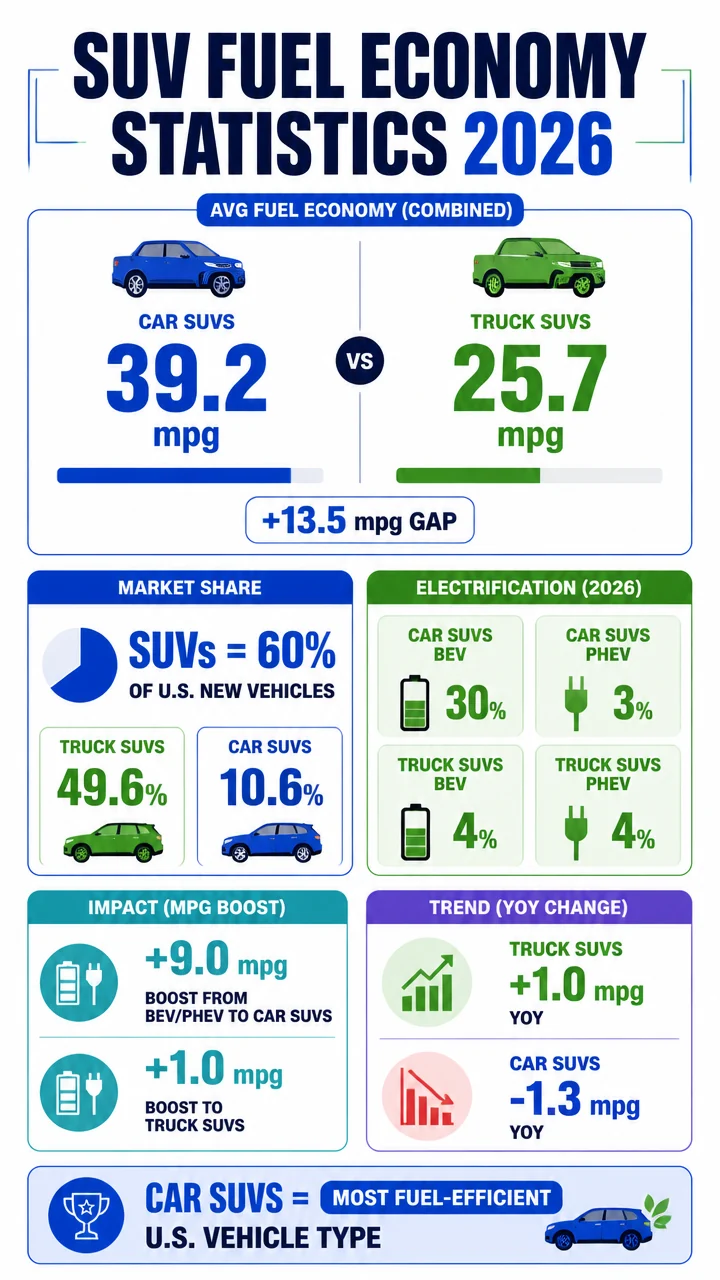
Big number: Car SUVs averaged 39.2 mpg in model year 2024, versus 25.7 mpg for truck SUVs.
Table of contents
- Key takeaways
- SUV fuel economy statistics overview
- Car SUV vs truck SUV fuel economy statistics
- SUV market share and production statistics
- Hybrid, PHEV, and EV SUV fuel economy statistics
- Historical SUV fuel economy trends
- SUV fuel economy benchmarks by model
- Manufacturer SUV fuel economy statistics
- CAFE and regulatory benchmarks
Key takeaways
Fast facts
- 39.2 mpg: Average real-world fuel economy for car SUVs in model year 2024.
- 25.7 mpg: Average real-world fuel economy for truck SUVs in model year 2024, a record high for that type.
- 1.0 mpg: Year-over-year gain for truck SUVs from 2023 to 2024.
- 1.3 mpg: Year-over-year decline for car SUVs, the largest drop among vehicle types.
- 30%: Share of car SUVs that were battery electric in model year 2024.
- 4%: Share of truck SUVs that were battery electric in model year 2024.
- 9.0 mpg: Estimated boost BEVs and PHEVs added to the 2024 car SUV fleet average.
- 1.0 mpg: Estimated boost electrification added to the 2024 truck SUV fleet average.
- 27.2 mpg: Record overall U.S. new-vehicle real-world fuel economy in model year 2024.
SUV fuel economy statistics overview
Car SUVs were the most fuel-efficient U.S. new-vehicle type in model year 2024, averaging an estimated 39.2 mpg.
That put them well ahead of the overall new-vehicle average of 27.2 mpg and above sedans and wagons, which averaged 33.5 mpg.
Truck SUVs averaged 25.7 mpg in model year 2024.
While that is far below the car SUV average, it still marked a record high for truck SUVs and a 1.0 mpg improvement over the 24.7 mpg recorded in 2023.
Why it matters: The SUV category now contains two very different fuel economy realities.
One branch is being pulled up by EVs and plug-in hybrids, while the other remains the market-volume heavyweight with more modest efficiency gains.
| Vehicle type | Model year 2024 fuel economy | Model year 2023 fuel economy | Year-over-year change |
|---|---|---|---|
| Car SUVs | 39.2 mpg | 40.5 mpg | -1.3 mpg |
| Truck SUVs | 25.7 mpg | 24.7 mpg | +1.0 mpg |
| Sedan/Wagon | 33.5 mpg | Not provided | Not provided |
| Overall U.S. new vehicles | 27.2 mpg | Not provided | Record high |
Car SUV vs truck SUV fuel economy statistics
The gap between car SUVs and truck SUVs was 13.5 mpg in model year 2024. Car SUVs averaged 39.2 mpg, compared with 25.7 mpg for truck SUVs.
That spread is especially notable because both categories sit under the SUV label, yet they are defined differently.
SUVs above 6,000 pounds gross vehicle weight or with four-wheel drive are generally classified as truck SUVs, while remaining two-wheel-drive SUVs below the threshold are classified as car SUVs.
Pull quote: Car SUVs were not just more efficient than truck SUVs in 2024.
They were the most fuel-efficient new-vehicle type in the U.S. market.
The 2024 decline in car SUV fuel economy was still historically unusual. Car SUV mpg fell by 1.3 mpg from 40.5 mpg in 2023 to 39.2 mpg in 2024, the largest drop among vehicle types.
Even so, the segment remained the market leader in efficiency.
Truck SUVs moved in the opposite direction. Their average climbed from 24.7 mpg in 2023 to 25.7 mpg in 2024.
That may sound small, but for a segment this large, a one-mpg gain is meaningful.
- Car SUV average without BEVs or PHEVs: about 24.7 mpg in 2024.
- Car SUV average with electrified models included: 39.2 mpg.
- Truck SUV average with electrification included: 25.7 mpg.
The biggest insight here is that headline SUV fuel economy averages can be misleading without looking at the drivetrain mix underneath them.
SUVs represented 60% of all U.S. new vehicles produced in model year 2024. That means SUV fuel economy is no longer a niche issue; it effectively shapes the national fleet average.
Truck SUVs dominated the market. They represented 49.6% of all model year 2024 U.S. new-vehicle production, up from 45.4% in 2023 and far above their 20.7% share in 2010.
Car SUVs were much smaller in volume. They accounted for 10.6% of production in 2024, down from 12.5% in 2023.
Earlier, car SUV market share had risen from 8.2% in 2010 to 13.0% in 2020, but recent data shows that truck SUVs now absorb most of the segment’s growth.
| SUV segment | 2010 share | 2020 share | 2023 share | 2024 share | 2025 projected share |
|---|---|---|---|---|---|
| Car SUVs | 8.2% | 13.0% | 12.5% | 10.6% | Not provided |
| Truck SUVs | 20.7% | Not provided | 45.4% | 49.6% | 48.3% |
At a glance
- Nearly 1 in 2 new U.S. vehicles in 2024 was a truck SUV.
- 66% of new U.S. light-duty vehicles were regulated as trucks under NHTSA definitions.
- The market has shifted decisively toward larger utility vehicles, making truck SUV efficiency gains increasingly important.
Hybrid, PHEV, and EV SUV fuel economy statistics
Electrification is the main reason car SUV fuel economy looks so strong. In model year 2024, 30% of car SUVs were battery electric vehicles and another 3% were plug-in hybrid electric vehicles.
Those BEVs and PHEVs added an estimated 9.0 mpg to the car SUV fleet average. Without them, car SUVs would have averaged only about 24.7 mpg instead of 39.2 mpg.
Truck SUVs are far less electrified. In model year 2024, only 4% of truck SUVs were BEVs and 4% were PHEVs.
As a result, electrification added just 1.0 mpg to the truck SUV fleet average.
Pull quote: Electrified models added 9.0 mpg to car SUV averages, but only 1.0 mpg to truck SUVs.
This also helps explain the national picture.
Without BEVs and PHEVs, overall model year 2024 fuel economy would have been 1.7 mpg lower than the record 27.2 mpg achieved.
- Car SUVs: 30% BEV, 3% PHEV.
- Truck SUVs: 4% BEV, 4% PHEV.
- Car SUV electrification effect: +9.0 mpg.
- Truck SUV electrification effect: +1.0 mpg.
Hybrid production in truck SUVs surpassed car SUVs starting in model year 2020, an important sign that efficiency gains in larger SUVs increasingly depend on hybridization rather than full battery-electric adoption alone.
Historical SUV fuel economy trends
Car SUV fuel economy improved from 27.5 mpg in model year 2019 to 39.2 mpg in model year 2024. That is an increase of 11.7 mpg in just five model years.
Truck SUVs improved much more gradually, rising from 23.5 mpg in 2019 to 25.7 mpg in 2024, a gain of 2.2 mpg.
| Model year | Car SUV mpg | Truck SUV mpg |
|---|---|---|
| 2019 | 27.5 | 23.5 |
| 2020 | 28.4 | 23.8 |
| 2022 | 33.4 | 24.2 |
| 2023 | 40.5 | 24.7 |
| 2024 | 39.2 | 25.7 |
| 2025 projected | 37.6 | 26.3 |
Preliminary 2025 data suggests the split continues. Car SUVs are projected at 37.6 mpg, while truck SUVs are projected at 26.3 mpg.
Longer-term history shows just how dramatic the change has been.
U.S. car SUVs averaged 11.1 mpg in model year 1975 and 25.6 mpg by 2016.
That amounted to a 131% improvement, the largest gain of any U.S. vehicle class.
Truck SUVs followed a similar but slightly smaller arc. They averaged 11.0 mpg in 1975 and 22.6 mpg in 2016.
Why it matters: All U.S. vehicle types except pickups more than doubled fuel economy since 1975.
SUVs went from gas guzzlers to mainstream family vehicles with increasingly competitive efficiency, especially in electrified trims.
Even as efficiency rose, vehicle capability also climbed.
Car SUV horsepower increased 118% from 1975 to 2024, while truck SUV horsepower rose 77%.
Footprints grew too, with average car SUV footprint up 3.7% from 2008 to 2024 and truck SUV footprint up 3.3%.
In other words, fuel economy gains happened despite bigger, more powerful vehicles.
SUV fuel economy benchmarks by model
Real-world and EPA data show how wide the efficiency spread is within the SUV market. The most efficient hybrid and electric SUVs now post numbers far above segment averages, while large SUVs still top out in the mid-20s on gasoline.
Top efficient SUV benchmarks from the dataset
| Model | Powertrain | Fuel economy figure |
|---|---|---|
| 2026 Toyota bZ | Electric SUV | 131 combined MPGe |
| 2026 Tesla Model Y Standard RWD | Electric SUV | 127 combined MPGe |
| 2025 Kia Niro Plug-in Hybrid | PHEV SUV | 108 MPGe combined |
| 2025 Ford Escape Plug-in Hybrid | PHEV SUV | 101 MPGe combined |
| 2025 Toyota RAV4 Plug-in Hybrid | PHEV SUV | 94 MPGe combined |
| 2026 Kia Niro Hybrid | Hybrid SUV | 49 to 53 combined mpg |
| 2025 Kia Niro Plug-in Hybrid | Gas-only operation | 48 mpg combined |
| 2025 Lexus UX 300h | Hybrid SUV | 43 combined mpg |
| 2025 Toyota Corolla Cross Hybrid AWD | Hybrid SUV | 42 combined mpg |
| 2025 Honda CR-V Hybrid | Hybrid SUV | 40 combined mpg |
The 2026 Kia Niro Hybrid stands out among non-plug SUVs with an EPA rating of 49 to 53 combined mpg, including 53 city mpg and 45 highway mpg.
Among electric SUVs in the supplied data, the 2026 Toyota bZ reaches 131 combined MPGe, while the 2026 Tesla Model Y Standard RWD is rated at 127 combined MPGe.
Gas and hybrid comparison points
- 2025 Nissan Kicks Play: 33 combined mpg, first among subcompact SUVs in the cited ranking.
- 2025 Nissan Rogue FWD: 33 combined mpg.
- 2025 Chevrolet Tahoe: 24 combined mpg, leading large SUVs in the cited ranking.
- 2025 Volkswagen Tiguan: 28 combined mpg, leading three-row SUVs in the cited ranking.
These examples reinforce the market split: small or hybrid SUVs can push into the 40s and even low 50s mpg, while larger gasoline SUVs remain far lower.
Real-world test results
| Model | Test source | Observed fuel economy |
|---|---|---|
| Toyota Corolla Cross Hybrid | Consumer Reports | 41 mpg overall |
| Lexus NX Hybrid | Consumer Reports | 38 mpg overall |
| Toyota RAV4 Hybrid | Consumer Reports | 37 mpg overall |
| Toyota Highlander Hybrid | Consumer Reports | 35 mpg overall |
| 2024 Honda CR-V Hybrid | Consumer Reports | 35 mpg overall |
| 2024 Honda CR-V AWD gas | Consumer Reports | 26 mpg overall |
The hybrid advantage shows up clearly in real-world testing. Consumer Reports measured the 2024 Honda CR-V hybrid at 35 mpg overall, versus 26 mpg for the AWD gas model.
That is a 9 mpg observed gap in the same nameplate family.
Manufacturer SUV fuel economy statistics
Manufacturer mixes help explain why some brands post stronger SUV efficiency than others.
- Honda: 38.2% of its model year 2024 fleet was truck SUVs averaging 30.1 mpg in that segment.
- Hyundai: 51.6% of its 2024 fleet was truck SUVs averaging 25.7 mpg.
- Mazda: had the highest truck SUV production share among major manufacturers at 90% in model year 2024.
Honda’s truck SUV average of 30.1 mpg is notable because it sits well above the overall truck SUV average of 25.7 mpg.
Hyundai matched the segment average at 25.7 mpg, but with a heavier mix toward truck SUVs.
At a glance
- Brands with a larger share of truck SUVs face a tougher fuel economy challenge.
- Higher truck SUV concentration can pull down fleet averages unless offset by hybrids, PHEVs, or EVs.
- A manufacturer with efficient truck SUVs can still outperform the segment even in a utility-heavy lineup.
CAFE and regulatory SUV fuel economy benchmarks
Fuel economy regulation is tightening as SUVs dominate the market. NHTSA’s 2022 final rule requires CAFE standards to rise 8% per year for model years 2024 and 2025.
NHTSA projected the model year 2026 industry fleet would need roughly 49 mpg under that 2022 final rule.
For context, overall U.S. new-vehicle real-world fuel economy reached 27.2 mpg in model year 2024, underscoring how much pressure remains on automakers to improve efficiency or expand electrification.
The agency also estimated model year 2026 light-truck CAFE targets near 34 mpg under the no-action alternative.
Since SUVs are now such a large share of the market and 66% of new light-duty vehicles are regulated as trucks, light-truck efficiency is becoming the central battleground.
Pull quote: When nearly half of all new vehicles are truck SUVs, even small mpg gains have outsized impact on the national fleet.
The bottom-line regulatory takeaway is simple: the future of U.S. fuel economy increasingly depends on what happens in SUVs, especially truck SUVs.
Car SUVs already show what electrification can do to fleet averages, but the biggest market-share gains are happening in the segment that still averages just 25.7 mpg.