If you want a practical OBD2 V321 Scanner review, this wired diagnostic tool focuses on core check-engine diagnosis, battery testing, live data, and report sharing.
It is aimed at DIY owners and technicians who want more information than a basic code reader provides.
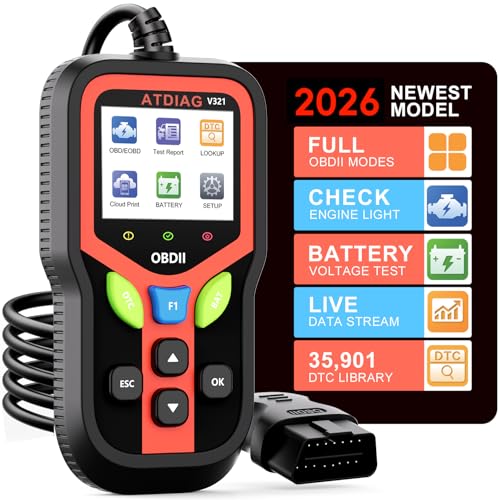
Table of Contents
OBD2 V321 Scanner Review Summary
The OBD2 V321 Scanner is a strong fit for car owners who want to read and clear trouble codes without relying on a phone app or separate battery pack.
According to the listing, it works with most compatible OBDII vehicles, covers more than 35,901 fault-code definitions, and adds useful checks such as I/M readiness, EVAP testing, freeze-frame data, and battery health.
That combination makes it more useful for troubleshooting than a simple “code displayed” device, while its plug-and-play design keeps the learning curve manageable.
It is not the obvious choice for someone seeking brand-specific programming, advanced bidirectional controls, or a wireless scanner.
The available evidence describes a broad diagnostic reader rather than a manufacturer-level service platform.
For home mechanics, first-time scanner buyers, and multi-car households with compatible vehicles, the feature set is compelling; buyers with specialist needs should verify coverage first.
Review Scorecard
| Category | Score | Buyer assessment |
|---|---|---|
| Code reading and clearing | 9/10 | Reads and clears trouble codes, with a stated library of over 35,901 definitions. |
| Diagnostic depth | 8/10 | Live sensor data, freeze-frame information, I/M readiness, and EVAP tests go beyond basic readers. |
| Battery testing | 8/10 | A dedicated battery-health check and BAT shortcut add useful maintenance value. |
| Ease of use | 9/10 | Plug-and-play operation, keyboard shortcuts, a color display, and a supplied manual suit beginners. |
| Vehicle coverage | 8/10 | Broad stated compatibility, but buyers still need to confirm the exact vehicle and port. |
| Report sharing | 8/10 | Cloud-based QR-code printing can save or share vehicle-health reports. |
| Physical durability | 8/10 | Insulated 3-foot cable and silicone case are designed for demanding workshop conditions. |
Key Features and Specifications of OBD2 V321 Scanner
The OBD2 V321 Scanner connects through a standard 16-pin OBD2 port and draws power from the vehicle, so there are no scanner batteries to charge.
The listing says it supports most cars made after 1996 in the United States, after 2000 in Europe, and after 2008 in Asia when they have the required port.
Those dates are useful starting points, but they are not a substitute for checking compatibility with a particular make, model, engine, and market.
Its main diagnostic functions include reading and clearing diagnostic trouble codes, checking I/M readiness, viewing real-time sensor information, running EVAP tests, checking battery health, and accessing freeze-frame data.
Live values such as RPM, coolant temperature, and fuel pressure can provide context around a warning light instead of leaving the owner with only an error number.
That makes this scanner valuable for deciding whether a problem deserves immediate professional attention or further DIY investigation.
The built-in library is advertised as containing more than 35,901 fault-code definitions.
More definitions can make code interpretation easier, although the scanner should still be treated as a diagnostic aid: a code normally identifies a system or condition, not automatically the failed component.
The 2.4-inch color display is designed for direct use at the vehicle.
The manufacturer also highlights shortcuts: F1 opens the testing report, DTC quickly reads fault codes, and BAT opens battery testing.
Ten language options, including English, Spanish, French, and Portuguese, broaden its appeal for households or workshops with different language preferences.
One of the more distinctive features is cloud-based QR-code printing for vehicle-health reports.
This can help an owner save or share findings, provided the reporting workflow and connection requirements are convenient in the intended use case.
It is a helpful documentation feature for keeping maintenance records or communicating results to a repair shop.
For physical protection, the listing describes a heat-resistant 3-foot insulated cable, a rugged silicone case, and operation across temperatures from -22°F to 158°F.
It also claims drop protection from a workbench height of up to 5.2 feet.
These are manufacturer-provided specifications, not independent test results, but they suggest the scanner was designed to live in a garage rather than a desk drawer.
Pros and Cons of OBD2 V321 Scanner
Pros
- More than a basic code reader: It combines code reading and clearing with live data, freeze-frame information, I/M readiness, EVAP testing, and battery checks.
- Beginner-friendly operation: Plug-and-play connection, a color screen, shortcuts, and a manual reduce the friction of a first diagnostic session.
- Useful for several vehicles: The stated support for compatible vehicles across major regional model years makes it practical for a household or small garage.
- Workshop-minded construction: The insulated cable and silicone case add protection for repeated everyday handling.
- Report convenience: Cloud-based QR-code printing can make results easier to save and share.
Cons
- Compatibility still matters: “Most” OBDII vehicles does not guarantee every function on every model, so verification is important before purchase.
- Wired rather than wireless: The cable provides power and a direct connection, but it is less convenient than a Bluetooth scanner for users who prefer a phone-based workflow.
- Not presented as an advanced service tool: The evidence does not indicate coding, programming, bidirectional actuation, or other manufacturer-level features.
- Interpretation remains the buyer’s job: A larger code library helps, but diagnosing the root cause still requires mechanical judgment.
Who Should Buy OBD2 V321 Scanner?
The best buyer is a DIY car owner who wants to understand a check-engine light before visiting a repair shop.
The scanner’s ability to read and clear codes, inspect live data, view freeze-frame details, and check readiness status gives a more complete starting point than a minimal reader.
It also suits people preparing a vehicle for emissions-related checks, because I/M readiness is directly included among the stated functions.
It makes sense for multi-car households and small independent garages as well.
The broad compatibility claim, multilingual interface, rugged case, and support for diagnostics across multiple vehicles for up to 24 hours make it versatile on paper.
A beginner may appreciate the direct screen and no-battery design, while a more experienced user may value the shortcuts and report capability.
Skip it if you specifically need wireless phone integration, manufacturer-specific programming, advanced module access, or guaranteed coverage for a specialized vehicle.
Buyers should also confirm that their car uses the relevant 16-pin OBD2 connection and falls within the supported regional model-year guidance.
How OBD2 V321 Scanner Helps With Real Diagnostic Decisions
Codes are a starting point, not a verdict
Reading a code is most useful when paired with freeze-frame and live-data context.
The OBD2 V321 Scanner is positioned to help the owner see what the vehicle recorded when a fault appeared and compare that with current values.
Readiness checks add pre-inspection value
The I/M readiness function can show whether required monitoring systems have completed their checks.
That is useful before an emissions inspection, especially after maintenance or a code-clear operation.
Battery testing expands its usefulness
The dedicated battery-health check means the scanner is not limited to warning-light diagnosis.
The BAT shortcut should make that maintenance check quicker when starting or charging concerns arise.
Reports support clearer conversations
Cloud-based QR-code report printing gives owners a way to preserve findings or share them with a technician.
That can reduce guesswork when a repair decision depends on several observed values rather than one code.
Alternatives to OBD2 V321 Scanner
If you prefer a phone-based setup, compare the BlueDriver Bluetooth Pro OBD2 Scanner for a mobile diagnostic workflow.
Its appeal is the Bluetooth format and app-centered experience, while the OBD2 V321 Scanner keeps the display and controls on the handheld unit.
For a familiar wired consumer option, consider the ANCEL AD410 OBD2 Scanner.
It is worth comparing if straightforward code reading and a compact dedicated reader matter more than the V321’s broader advertised testing and reporting features.
The Autel MaxiLink ML629 is another line to investigate when buyers want a recognized diagnostic-tool brand and broader feature comparisons.
Check the exact model’s vehicle coverage and functions, since capabilities vary across Autel products.
Is OBD2 V321 Scanner Worth It?
The OBD2 V321 Scanner is worth considering when your priority is a self-contained, wired tool that can do more than retrieve a single trouble code.
Its strongest value comes from the combination of code clearing, live data, freeze-frame access, readiness and EVAP checks, battery testing, multilingual operation, and report sharing.
It is a sensible buy for compatible vehicles and routine DIY diagnosis, especially for beginners and owners of more than one car.
The decision is less clear for advanced technicians who need confirmed manufacturer-specific functions or for drivers who strongly prefer wireless phone apps.
Verify vehicle compatibility and match the feature set to your diagnostic goals.
If those requirements line up, the V321 offers a practical balance of accessibility, diagnostic breadth, and garage-ready design.