If you want a simple way to investigate a dashboard warning, this OBD2 Car Code Reader combines engine-code scanning with a built-in voltage test.
This OBD2 Car Code Reader review looks at its capabilities, compatibility limits, and value for DIY troubleshooting.
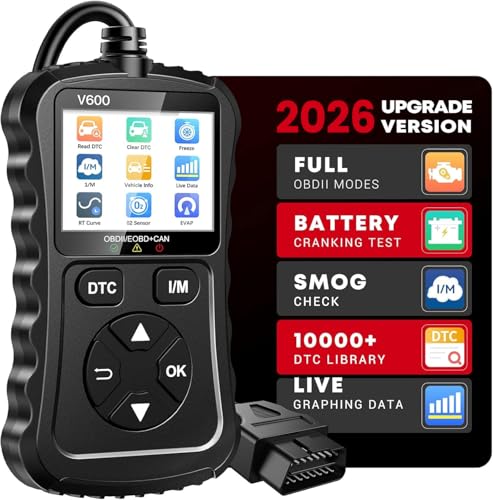
Table of Contents
OBD2 Car Code Reader Review Summary
The OBD2 Car Code Reader is aimed at drivers and home mechanics who want more information before deciding whether a vehicle needs professional service.
Its strongest case is convenience: the plug-and-play reader is designed to read and clear engine fault codes, show live data, display freeze-frame information, check MIL status, and monitor I/M readiness from one compact tool.
The added voltage test is useful when an electrical issue may be contributing to a warning light.
It is best suited to owners of compatible 1996-and-newer OBDII cars, SUVs, and light trucks who are comfortable following on-screen information.
The listing also says it cannot detect trucks or motorcycles, and notes that only Japanese cars manufactured after 2005 have OBD diagnostic capabilities.
Those qualifications matter, so compatibility should be confirmed before buying.
For the right vehicle, this looks like a practical first-line diagnostic tool rather than a replacement for a professional scan system.
Review Scorecard
| Category | Score | Editorial assessment |
|---|---|---|
| Basic code reading | 9/10 | Built to read engine fault codes with a stated database of more than 30,000 codes. |
| DIY usability | 8/10 | Six buttons, shortcut keys, a color screen, and plug-and-play operation favor beginners. |
| Diagnostic functions | 8/10 | Live data, graphical analysis, freeze frame, MIL status, and I/M readiness add useful context. |
| Vehicle coverage | 8/10 | Supports all OBDII protocols and many 1996+ US, EU, and Asian vehicles, with notable exclusions. |
| Electrical troubleshooting | 8/10 | The built-in real-time voltage test is a helpful extra for checking vehicle electrical health. |
| Portability and build | 8/10 | Compact, lightweight construction, impact-resistant housing, and a long flexible cable suit storage in a vehicle. |
| Service confidence | 7/10 | A stated 90-day warranty and customer support are reassuring, though this is still an entry-level reader. |
Key Features and Specifications of OBD2 Car Code Reader
Reads and clears engine codes
The central job of this scanner is to read and clear engine fault codes.
The manufacturer listing describes a database exceeding 30,000 fault codes, which should help users identify likely problem areas instead of guessing from a warning lamp alone.
Clearing a code can be convenient after a repair, but it does not repair the underlying fault.
The listing specifically warns that if the vehicle has not been repaired, the code may only be cleared by a computer at a 4S shop.
Live data and graphical analysis
A code is only part of a diagnosis.
This reader is also described as supporting real-time data streaming and graphical analysis, so users can review changing vehicle information rather than relying on a single stored error.
Freeze-frame viewing can preserve the operating conditions recorded when a fault occurred.
Together with MIL status and I/M readiness checks, these functions make the tool more useful for troubleshooting and inspection preparation.
Built-in voltage test
The upgraded feature that most distinguishes this model from a basic code reader is its real-time voltage test.
Monitoring voltage can provide an early indication that the battery, charging system, or another part of the electrical system deserves attention.
It should be treated as a screening function, not a complete electrical diagnosis, but it adds relevant information when a vehicle has intermittent starting or warning-light symptoms.
Broad OBDII support with important caveats
The listing says the scanner supports all OBDII protocols and most 1996-and-newer US vehicles, along with more than 2,000 European and Asian models.
It is also presented as compatible with SUVs and light trucks.
However, the same evidence says it cannot detect trucks or motorcycles, creating an ambiguity around vehicle categories.
Buyers should check the exact vehicle and model year before ordering, especially owners of Japanese cars, where the listing identifies post-2005 vehicles as the relevant group.
Beginner-oriented physical design
The reader has a bright color screen intended to remain readable in low-light conditions, six intuitive operation buttons, and dedicated I/M and DTC shortcut keys.
A long, flexible cable should make it easier to position the display while connected.
The housing is described as impact-resistant with a non-slip finish, while the compact, lightweight form should fit conveniently in a glove box or tool case.
A built-in power indicator shows that the scanner is operating and connected to vehicle power.
Languages and support
The product supports 10 languages, including English, German, Spanish, and French.
That can make menu navigation more approachable for households or workshops with different language preferences.
The listing also states that the product includes a 90-day warranty and customer support, which provides a basic safety net if setup or operation raises questions.
Pros and Cons of OBD2 Car Code Reader
Pros
- More than a basic code reader: Live data, graphical analysis, freeze frame, MIL status, and I/M readiness checks broaden its usefulness.
- Helpful voltage monitoring: The real-time voltage test adds a practical electrical check without requiring a separate first-look tool.
- Beginner-friendly controls: A color screen, six buttons, shortcut keys, and plug-and-play design reduce the learning curve.
- Wide stated coverage: Support for all OBDII protocols and many US, European, and Asian vehicles makes it versatile when compatibility is confirmed.
- Easy to carry: The compact body, flexible cable, and non-slip impact-resistant housing suit regular vehicle storage.
- Multilingual operation: Ten supported languages improve accessibility.
Cons
- Compatibility needs checking: The listing includes exclusions and special notes for Japanese vehicles, trucks, and motorcycles.
- Not a repair tool: Clearing an error does not solve the fault, and unresolved codes may return.
- No hands-on evidence supplied: The assessment here is based on the product listing, not independent testing.
- Entry-level scope: The described functions focus on OBDII engine diagnostics, so buyers needing advanced manufacturer-specific systems should look higher in the category.
Who Should Buy OBD2 Car Code Reader?
This reader makes sense for a DIY car owner who wants to understand an illuminated check-engine light before visiting a repair shop.
It can also suit a small home garage, a used-car owner who wants a basic screening tool, or a driver who values readiness monitoring and a quick voltage check in one device.
The dedicated shortcuts and clear display are especially relevant to beginners who do not want to start with a complicated professional scanner.
It may be useful for someone who performs routine troubleshooting and wants live information alongside stored codes.
The long cable and portable design also make it convenient to keep available rather than unpacking a larger workshop setup.
Skip it if you need motorcycle diagnostics, confirmed coverage for a heavy-duty truck, or advanced functions beyond the stated OBDII engine features.
It is also a poor fit for anyone expecting a scanner to identify a failed component with certainty or fix a vehicle automatically.
The right expectation is informed troubleshooting: the reader can point you toward a problem, while repair and verification still require judgment or professional equipment.
Using OBD2 Car Code Reader for Smarter Troubleshooting
Start with compatibility
Before connecting the reader, verify that the vehicle matches the stated OBDII coverage and year guidance.
This is particularly important for Japanese vehicles and for buyers whose vehicle is described as a truck or motorcycle.
Combine codes with context
Read the stored code, then review freeze-frame and live data where available.
A code should guide further checks, not be treated as proof that one specific part must be replaced.
I/M readiness and MIL status can also help explain whether the vehicle is ready for an inspection or still has unresolved monitoring conditions.
Use voltage as a supporting check
The real-time voltage function can help identify whether the electrical system deserves attention while investigating a fault.
It is most useful as one piece of the troubleshooting picture, alongside the code and the vehicle’s symptoms.
Alternatives to OBD2 Car Code Reader
If you want a different balance of features or brand familiarity, consider these credible product lines sold through Amazon:
- ANCEL OBD2 scanners are worth comparing for straightforward code-reading tools and broader model choices.
- Autel AutoLink scanners are a strong alternative for buyers who prioritize an established diagnostic-tool range.
- FOXWELL OBD2 scanners offer another category-focused option for comparing display and diagnostic features.
- BlueDriver Bluetooth scan tool may appeal to buyers who prefer a phone-connected diagnostic workflow instead of a dedicated handheld screen.
Compare each option’s exact vehicle coverage and function list.
A more expensive-looking scanner is not automatically better for a particular car; compatibility and the diagnostic depth you actually need should drive the decision.
Is OBD2 Car Code Reader Worth It?
The OBD2 Car Code Reader is worth considering when you need an approachable handheld tool for compatible OBDII vehicles.
Its combination of engine-code reading, live data, freeze-frame information, readiness checks, and real-time voltage testing gives it more everyday value than a code-only reader, while the screen, shortcut buttons, cable, and compact housing support occasional DIY use.
The purchase makes the most sense after confirming compatibility and accepting its limits.
Buy it if you want a practical first diagnostic step for a car, SUV, or supported light truck; skip it if you need motorcycle, heavy-duty, or advanced manufacturer-specific coverage.