If you want one compact device for emergency starting and long-term battery care, this LOKITHOR JC400 review examines a 2500A jump starter with selectable charging and maintenance modes.
The LOKITHOR JC400 is aimed at drivers, seasonal-vehicle owners, and anyone who wants more than a basic jump box.
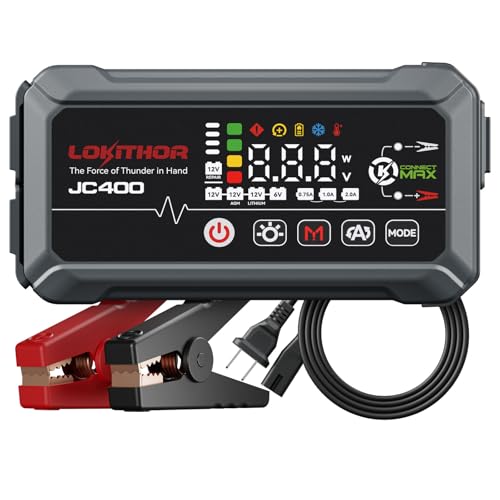
Table of Contents
LOKITHOR JC400 Review Summary
The LOKITHOR JC400 makes the strongest case for itself by combining several battery tools in one portable unit: a 12V jump starter, 6V/12V charger, maintainer, trickle charger, desulfator, voltage detector, power bank, LED light, and compass.
That breadth suits households with more than one vehicle type, especially when a battery may need either an emergency boost or careful charging over time.
It is also relevant for cars, trucks, SUVs, motorcycles, lawnmowers, and boats, according to the product listing.
Buy it if you want one palm-sized battery device that can cover roadside starting and off-season maintenance. Skip it if you only need a simple charger, need a jump function for a 6V vehicle, or prefer a dedicated workshop charger with no extra features.
Review Scorecard
| Category | Score | Editorial assessment |
|---|---|---|
| Jump-starting capability | 9/10 | A claimed 2500A peak current supports 12V engines up to 8.5L gas or 6.5L diesel. |
| Charging flexibility | 9/10 | Selectable 0.75A, 1A, and 2A outputs cover slower charging and maintenance needs. |
| Battery compatibility | 8/10 | Supports 6V regular batteries plus 12V regular and AGM batteries; jump starting remains 12V only. |
| Battery maintenance | 9/10 | Seven-stage charging, float/trickle maintenance, and pulse desulfation make it useful beyond emergencies. |
| Safety features | 8/10 | Smart clips, automatic voltage detection, Boost, and ten listed protections add reassurance. |
| Portability | 8/10 | The compact design is intended to fit comfortably in a hand and store easily. |
Key Features and Specifications of LOKITHOR JC400
The JC400 is best understood as a battery-management multitool rather than a jump starter with a charger added as an afterthought.
Its feature set is broad, but each function addresses a different ownership problem.
- 2500A peak jump-start output: LOKITHOR says the unit can start 12V vehicles with engines up to 8.5L gas or 6.5L diesel. The listed operating temperature range is -4°F to 140°F.
- Three selectable charging currents: Choose 0.75A, 1A, or 2A depending on the battery and the desired charging pace. The lower settings are particularly relevant for maintenance and smaller batteries.
- 6V and 12V charging: The charger supports 6V regular batteries, 12V regular batteries, and 12V AGM batteries. This makes it useful across automotive and powersports equipment.
- Force charging: The listing says the JC400 can manually charge batteries as low as 1 volt, including batteries described as dead. That is a specialized function, so it should be used with care and with the correct battery type.
- Seven-stage charging program: The charger is designed to move through multiple stages for controlled charging, then shift into trickle or float maintenance after the battery is full.
- Desulfation mode: Pulse-current technology is intended to address sulfation and stratification in old or idle batteries. This is a maintenance feature, not a guarantee that a failed battery can be restored.
- Automatic voltage detection and Boost: These features are intended to help identify the connected system and provide starting assistance when the battery is very low.
- ConnectMax technology: LOKITHOR says the clamp system detects impedance between the clamps and terminals, with enhanced starting performance claimed by the manufacturer. Treat that percentage claim as a listing assertion rather than an independent test result.
- Roadside extras: The device also includes a portable power-bank function, six-mode LED lighting, and a compass.
The distinction between charging and jumping matters.
The unit can charge 6V and 12V batteries, but the listing specifically limits the jump-start function to 12V vehicles.
Buyers with a 6V application should therefore evaluate the charger function separately and should not assume the jump box works on that system.
Pros and Cons of LOKITHOR JC400
Pros
- Broad functionality: One device covers starting, charging, maintaining, desulfating, voltage detection, lighting, and portable power.
- Useful current selection: The 0.75A, 1A, and 2A choices are more adaptable than a single-output maintainer.
- Good vehicle range on paper: Support for large 12V gas and diesel engines gives it appeal beyond small commuter cars.
- Works across several battery situations: Seven-stage charging, float maintenance, and force charging address routine, seasonal, and low-voltage scenarios.
- Compact storage: Its palm-oriented design should make it easier to keep in a vehicle or garage than a larger workshop charger.
- Safety-oriented controls: Automatic detection, smart clips, Boost, and ten advertised protections are meaningful features for occasional users.
Cons
- Jumping is 12V only: The 6V charging capability does not make it a 6V jump starter.
- Feature density may increase the learning curve: A device with nine functions and multiple charging modes requires more attention than a basic charger.
- Manufacturer claims are not independent test results: The stated 2500A peak, starting capacity, temperature range, and ConnectMax improvement should be read as rated specifications.
- Not a replacement for diagnosis: Desulfation or force charging may help some low or aged batteries, but neither feature can make a damaged battery reliable.
- Charging is deliberately moderate: A maximum selectable charging current of 2A favors controlled charging and maintenance over rapid workshop charging.
Who Should Buy LOKITHOR JC400?
The best match is a driver who wants emergency capability without giving up battery-care functions.
It can make sense for a household with a car, SUV, truck, motorcycle, lawnmower, or boat because the supported battery formats extend beyond one daily driver.
The selectable current is also useful for people who leave vehicles parked for long periods and want a maintainer rather than a one-time rescue tool.
It is a sensible consideration for seasonal-vehicle owners.
A battery that sits through winter or long storage can benefit from a charger that transitions to float or trickle maintenance, while the desulfation mode gives the owner an additional maintenance option.
The LED modes and power-bank function add value when the unit is stored for roadside use.
However, this is not the right choice for every buyer.
Skip it if your only need is fast charging at a professional garage, if you need to jump a 6V vehicle, or if you want the simplest possible interface.
Also skip the assumption that force charging makes every dead battery recoverable; a battery with internal damage still needs replacement or professional diagnosis.
How the LOKITHOR JC400 Fits Real Battery-Use Scenarios
Emergency starting
The JC400’s headline role is starting a 12V vehicle when the battery is too weak to crank normally.
Its advertised 2500A peak current and stated engine coverage make it a candidate for larger vehicles, while automatic voltage detection and Boost are intended to help in low-voltage situations.
The important buying boundary is that this function is for 12V vehicles only.
Long-term maintenance
The seven-stage program and automatic shift to trickle or float charging give the JC400 a more practical role in a garage than a jump starter alone.
Owners can use the lower current settings for a battery that is sitting, rather than treating every battery problem as an emergency.
Older or deeply discharged batteries
Force charging down to a listed 1-volt level and pulse desulfation are the features most likely to interest owners of older or idle batteries.
They expand the situations the device can address, but they should be treated as recovery attempts, not promises.
Battery condition, chemistry, and safety still determine whether recovery is appropriate.
Storage and roadside readiness
The compact form, six-mode LED light, compass, and power-bank function make the JC400 easier to justify as part of a vehicle emergency kit.
These extras do not replace a dedicated flashlight or power station, but they reduce the number of separate items needed for basic roadside preparedness.
Alternatives to LOKITHOR JC400
If you want a similar all-in-one emergency device, compare the NOCO Boost jump starter line for a jump-focused design from a widely recognized battery-accessory brand.
Buyers who prioritize ongoing charging and maintenance can look at the Battery Tender charger and maintainer line, which is more narrowly focused on keeping batteries charged.
For a compact charger with smart charging as the main priority, the CTEK battery charger line is another category comparison.
If your needs center on a motorcycle or powersports battery, search the Schumacher battery charger and jump starter range for models spanning smaller and automotive applications.
Check each alternative’s voltage, battery chemistry, engine-size guidance, and included cables before choosing; the JC400’s combination of 6V/12V charging and 12V jumping is not universal.
Is LOKITHOR JC400 Worth It?
The LOKITHOR JC400 is worth considering when versatility is the priority.
Its combination of 2500A-rated 12V jump starting, three charging currents, 6V/12V charging, seven-stage maintenance, desulfation, lighting, and power-bank functions gives it a wider role than a basic jump box or maintainer.
Buy the LOKITHOR JC400 if you want one compact device for emergency starts and routine battery care across several vehicle types. Choose a simpler dedicated charger if you do not need the jump-start and roadside features, and choose another product if 6V jump starting is essential.