The JSAUX USB C to 3.5mm Audio Aux Jack Cable is a practical wired-audio option for connecting newer USB-C devices to headphones, car stereos, speakers, and other AUX equipment.
This JSAUX USB C to 3.5mm cable review focuses on its built-in DAC, 3.3-foot format, claimed durability, and unusually broad compatibility list.
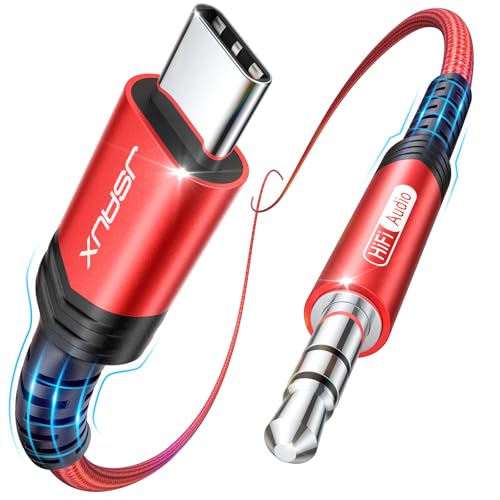
Table of Contents
JSAUX USB C to 3.5mm Cable Review Summary
Buy the JSAUX cable if you want a simple, driver-free connection between a USB-C phone, tablet, or compatible game device and older 3.5mm audio equipment.
It suits commuters, drivers, desk listeners, and anyone who prefers a short, flexible cable over a separate adapter and another loose connection to manage.
The listing identifies a built-in DAC, support up to 16-bit/48 kHz, a nylon-braided lead, aluminum housing, and a 3.3-foot length.
The main buying decision is compatibility.
The cable is marketed for many iPhone, Samsung Galaxy, iPad, Pixel, Huawei, MacBook, and Nintendo Switch models, but the listing specifically warns that it is not compatible with all OnePlus models.
Since USB-C audio implementation can vary by device, buyers should confirm their exact model before ordering.
**Is the JSAUX USB C to 3.5mm cable worth it?
For a compatible device and a straightforward AUX setup, its feature mix is compelling; for uncertain or unusual USB-C hardware, compatibility deserves more attention than the cable’s construction.**
Review Scorecard
| Category | Score | Editorial assessment |
|---|---|---|
| Plug-and-play convenience | 9/10 | The listing says no software, drivers, or complex installation are required. |
| Device compatibility | 8/10 | The supported list is broad, though not universal and specifically excludes some OnePlus models. |
| Wired audio support | 8/10 | A built-in DAC and stated support up to 16-bit/48 kHz fit everyday listening and AUX use. |
| Cable durability | 8/10 | Nylon braiding, aluminum housing, strain relief, and a stated 10,000+ bend-test claim are useful design choices. |
| Portability | 8/10 | The 3.3-foot length is long enough for a car or desk while remaining relatively easy to store. |
| Setup flexibility | 8/10 | It can connect USB-C devices to headphones, speakers, car stereos, or other 3.5mm inputs. |
Key Features and Specifications of JSAUX USB C Cable
The product is a male USB-C to male 3.5mm audio cable from JSAUX.
Its purpose is direct conversion from a USB-C audio source to a traditional analog-style headphone or AUX connection.
That makes it particularly relevant for newer devices that omit a built-in 3.5mm jack.
- Audio hardware: The listing describes a built-in DAC decoding chip with low power consumption and stable decoding performance.
- Supported audio ceiling: The stated maximum is up to 16-bit/48 kHz, although the listing notes that actual maximum output depends on the headphone device.
- Connection style: USB-C on one end and a 3.5mm male audio plug on the other, with no separate dongle required.
- Length: 3.3 feet, or about 1.0 meter.
- Construction: A nylon-braided cable, premium aluminum housing, strong fiber reinforcement, and strain-relief design.
- Durability claim: The manufacturer states that the cable accepts more than 10,000 bend tests and that the fiber increases tensile strength by 200 percent.
- Use cases: Headphones, car stereos, speakers, and other equipment with a 3.5mm audio jack or AUX-in port.
The DAC is important because this is not simply a passive piece of wire for every USB-C device.
The cable’s electronics are intended to handle the digital-to-analog conversion needed to send audio to a 3.5mm input.
In practical terms, the design aims to keep the setup compact: connect the USB-C plug to the source and the 3.5mm plug to the listening or vehicle equipment.
The 3.3-foot length is a sensible middle ground.
It should provide enough reach from a phone to a car console, speaker, or nearby headphones without creating as much slack as a much longer lead.
Buyers who need a connection across a large room or from a distant dashboard location may prefer a longer cable, but that is a question of layout rather than a flaw in this stated format.
Compatibility requires a careful read.
The listing names recent iPhone generations, Samsung Galaxy S-series and Note-series phones, iPad Pro, iPad mini 6, MacBook, Pixel 2 through Pixel 10 families as listed, Huawei models, and Nintendo Switch 2.
The product title and bullet text include model references that span several device generations, so the safest approach is to match the exact phone, tablet, or console model against the current listing before purchase.
The explicit OnePlus limitation is the most important caveat.
Pros and Cons of JSAUX USB C Cable
Pros
- Simple installation: The advertised plug-and-play design does not require software, drivers, or a complicated setup.
- Useful DAC integration: A built-in decoding chip supports the intended USB-C-to-3.5mm conversion in one cable.
- Good everyday length: At 3.3 feet, it is suitable for common car, desk, and personal-listening arrangements.
- Reinforced construction: Nylon braiding, aluminum housing, strong fiber, and strain relief address common cable wear points.
- Broad target compatibility: The listing covers many popular Apple, Samsung, Google, Huawei, and Nintendo devices.
- Multiple destinations: One cable can serve headphones, powered speakers, a car stereo, or another AUX-in device.
Cons
- Compatibility is not universal: The listing warns that not all OnePlus models work, and USB-C audio support can differ between devices.
- No hands-on evidence is provided: The durability and bend-resistance figures are manufacturer claims rather than independent test results.
- Audio output depends on the connected equipment: The listing qualifies the maximum output based on the headphone device.
- Fixed length: The 3.3-foot design may be short for some vehicle layouts or remote speaker placements.
- Single-purpose connection: It is designed for audio, so buyers seeking charging, data transfer, or microphone-specific functionality should verify those needs separately.
Who Should Buy JSAUX USB C Cable?
This cable is a strong fit for anyone replacing a missing headphone jack without wanting a separate adapter dangling from the device.
It should appeal to drivers connecting a USB-C phone to an older car stereo, listeners using wired headphones with a modern phone, and desk users connecting a tablet or laptop to powered speakers.
Its braided exterior and aluminum ends also make sense for people who expect to plug and unplug the cable frequently.
It is especially attractive when convenience matters.
A single integrated cable reduces the chance of losing a tiny dongle, and the stated plug-and-play design keeps the connection process simple.
The broad device list makes it useful for households with several compatible USB-C products, provided each exact model is checked.
Skip it if your device is an unsupported OnePlus model, if you need charging through the same connection, or if your setup requires a much longer lead.
Also be cautious if you need guaranteed microphone controls or specialized headset functions; the supplied evidence describes audio output and AUX connectivity, not every possible headset feature.
The JSAUX USB C to 3.5mm cable pros and cons come down to convenient integrated audio versus the need to verify device-specific compatibility.
USB-C to 3.5mm Cable Performance Factors
DAC design and listening use
The built-in DAC is the core functional feature.
The stated 16-bit/48 kHz support is appropriate to the everyday wired-audio role described here, while the listing’s qualification about actual output keeps expectations tied to the connected headphones or audio equipment.
Car and desk connectivity
The 3.3-foot cable is tailored to short-range connections.
It can connect a phone to an AUX port, a tablet to speakers, or another compatible source to headphones without the extra joint created by a separate adapter and cable.
Strain relief and repeated handling
The aluminum housing, braided jacket, reinforcement, and strain relief target the points that commonly see stress near plugs.
The advertised 10,000-plus bend testing is useful context, but it remains a manufacturer claim rather than a guarantee of performance in every environment.
Compatibility before sound quality
For this category, a perfect audio specification is irrelevant if the source device does not support the connection.
Check the exact model first, with special care for OnePlus products and any device not explicitly named in the listing.
Alternatives to JSAUX USB C Cable
If you want to compare designs before buying, consider these credible Amazon-sold alternatives:
- Anker USB-C to 3.5mm Audio Adapter is a compact adapter-style option for buyers who already own a preferred AUX cable.
- Apple USB-C to 3.5mm Headphone Jack Adapter is worth comparing for Apple-device owners who prefer a first-party adapter format.
- UGREEN USB-C to 3.5mm Audio Cable offers another established accessory line to check against the JSAUX cable’s integrated format.
- Belkin USB-C to 3.5mm Audio Adapter is a sensible comparison when a short adapter is more convenient than a fixed-length cable.
The right alternative depends on whether you want an all-in-one cable, a replaceable adapter-plus-cable setup, or a brand-specific accessory.
In every case, confirm device compatibility and the functions you need before ordering.
Is JSAUX USB C Cable Worth It?
The JSAUX USB C to 3.5mm Audio Aux Jack Cable is worth considering for buyers who need a compact, direct wired-audio connection and whose device appears on the compatibility list.
Its built-in DAC, plug-and-play design, 3.3-foot length, and reinforced construction address the main practical concerns of USB-C-to-AUX use.
The recommendation is conditional rather than universal.
Verify the exact source device first, especially if it is a OnePlus model, and do not assume the cable provides charging or every headset control function.
For a confirmed-compatible phone, tablet, laptop, or console, this is a well-targeted everyday audio cable; for uncertain compatibility, choose only after checking the device details.