Table of Contents
- Hybrid SUV statistics at a glance
- Table of contents
- Hybrid SUV market growth statistics
- Why SUVs dominate hybrid demand
- U.S. hybrid SUV sales and adoption statistics
- Top hybrid SUV model statistics and benchmarks
- Hybrid SUV MPG and efficiency statistics
- Hybrid SUV pricing and premium statistics
- Hybrid SUV emissions and sustainability statistics
- Plug-in hybrid SUV market statistics
- Regional hybrid vehicle statistics shaping hybrid SUV demand
Hybrid SUV statistics at a glance
Hybrid SUVs are no longer a niche bridge technology.
They are rapidly becoming one of the most important growth engines in the global auto market, combining mainstream SUV demand with better fuel economy, lower emissions, and widening model availability.
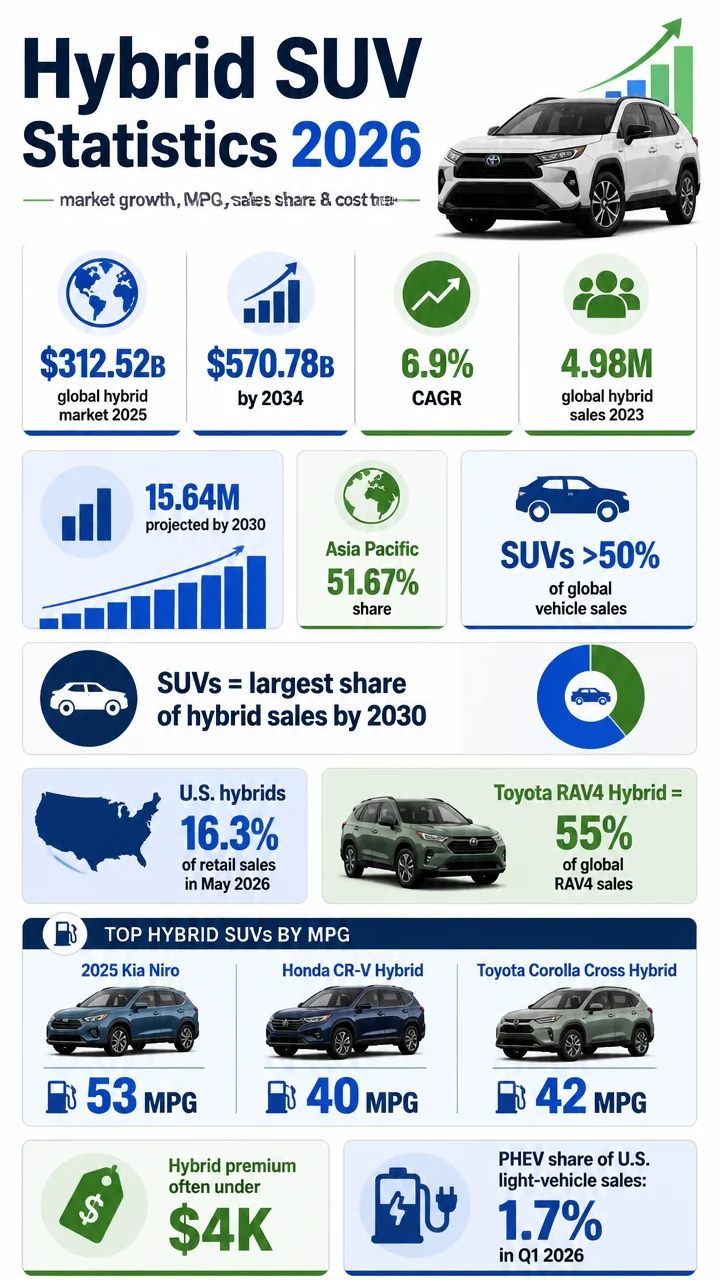
The biggest signal: SUVs already represent more than 50% of global vehicle sales, and researchers expect SUVs to account for the largest share of global hybrid sales by 2030.
At a glance
- USD 312.52 billion: global hybrid vehicle market value in 2025
- USD 570.78 billion: projected global hybrid vehicle market by 2034
- 4.98 million: global hybrid vehicle sales volume in 2023
- 15.64 million: projected global hybrid vehicle sales volume by 2030
- 51.67%: Asia Pacific share of the global hybrid vehicle market in 2025
- 16.3%: share of U.S. retail sales taken by hybrids in May 2026
- 55%: share of global Toyota RAV4 sales coming from the hybrid version in 2024
- 53 mpg: combined fuel economy for the 2025 Kia Niro, the most efficient hybrid SUV in the U.S.
Table of contents
- Hybrid SUV market growth statistics
- Why SUVs dominate hybrid demand
- U.S. hybrid SUV sales and adoption statistics
- Top hybrid SUV model statistics and benchmarks
- Hybrid SUV MPG and efficiency statistics
- Hybrid SUV pricing and premium statistics
- Hybrid SUV emissions and sustainability statistics
- Plug-in hybrid SUV market statistics
Hybrid SUV market growth statistics
The global hybrid vehicle market was valued at USD 312.52 billion in 2025, and it is projected to reach USD 570.78 billion by 2034.
That implies a 6.90% CAGR from 2026 to 2034, showing that hybrid demand is expected to keep expanding even as the broader vehicle market transitions in multiple directions.
Another projection is even more aggressive.
MarketsandMarkets forecasts the global hybrid vehicle market will grow at a 10.0% CAGR through 2030, while global hybrid vehicle OEM portfolios are expected to exceed 26.3 million units by 2030.
Volume forecasts tell the same story.
Global hybrid vehicle sales volume reached 4.98 million units in 2023 and is projected to hit 15.64 million units by 2030, representing a steep 18.5% CAGR from 2024 to 2030.
Big number
15.64 million hybrid vehicles projected globally by 2030 is one of the clearest signs that hybrids are scaling from transitional technology to mass-market mainstream.
The hybrid powertrain market is growing even faster than the broader hybrid vehicle market.
It was worth USD 130.98 billion in 2025 and is projected to rise to USD 483.33 billion by 2034, at a 15.6% CAGR.
That matters for hybrid SUVs because powertrain growth reflects continued investment in the systems that make these vehicles more efficient and more competitive.
The hybrid cars market also shows strong momentum.
It was estimated at USD 203.09 billion in 2023 and is projected to reach USD 457.27 billion by 2030, growing at an 11.7% CAGR from 2024 to 2030.
| Market metric | Value | Projection | Growth rate |
|---|---|---|---|
| Global hybrid vehicle market | USD 312.52B (2025) | USD 570.78B (2034) | 6.90% CAGR (2026–2034) |
| Global hybrid vehicle sales volume | 4.98M units (2023) | 15.64M units (2030) | 18.5% CAGR (2024–2030) |
| Global hybrid powertrain market | USD 130.98B (2025) | USD 483.33B (2034) | 15.6% CAGR (2025–2034) |
| Global hybrid cars market | USD 203.09B (2023) | USD 457.27B (2030) | 11.7% CAGR (2024–2030) |
Why SUVs dominate hybrid demand
SUVs are projected to account for the largest share of global hybrid sales by 2030.
That forecast lines up with the broader vehicle market, where SUVs represent more than 50% of global vehicle sales.
This is not just a future trend.
In the global hybrid cars market, the SUV segment held the largest revenue share in 2023.
In other words, hybrid SUVs are already leading in revenue and are expected to keep strengthening their position.
Why it matters
- SUVs are where mainstream consumer demand already sits.
- Hybrid technology helps offset the fuel economy penalty associated with larger vehicles.
- Automakers can scale hybrid systems faster when they apply them to high-volume SUV nameplates.
- Popular compact and midsize SUVs are becoming the gateway into electrified driving for many buyers.
U.S. production data reinforces the point.
Truck SUVs accounted for 50% of all new U.S. vehicle production in model year 2024.
That means half the market is already concentrated in the body style most likely to benefit from hybridization at scale.
U.S. hybrid SUV sales and adoption statistics
Hybrids accounted for 16.3% of U.S. retail sales in May 2026, a striking figure for a powertrain type that not long ago was concentrated in a handful of sedan models.
The U.S.
Energy Information Administration also showed momentum building in 2024.
U.S. hybrid electric vehicle sales share rose from 8.6% in 1Q24 to 9.6% in 2Q24, while hybrid electric vehicle sales increased 30.7% year over year in 2Q24.
Electrified adoption more broadly is also moving up.
Combined HEV, PHEV, and BEV sales made up 18.7% of U.S. light-duty vehicle sales in 2Q24.
Key takeaways
- 16.3% U.S. retail hybrid share in May 2026 shows hybrids are now a major retail category.
- 30.7% year-over-year HEV growth in 2Q24 points to strong consumer traction.
- The jump from 8.6% to 9.6% in one quarter suggests hybrid adoption was accelerating, not merely stable.
Brand-level sales reinforce how much of this momentum is being driven by SUV-heavy portfolios.
- Toyota North America sold 1,006,461 electrified vehicles in 2024, equal to 43.1% of total sales.
- Toyota North America sold 1,183,248 electrified vehicles in 2025, reaching 47.0% of total sales.
- Toyota division hybrid and electrified models exceeded 1.05 million U.S. units in 2025, or 49% of division volume.
- Ford sold a record 228,072 hybrid vehicles in the U.S. in 2025, up 21.7% year over year.
Hyundai also posted meaningful hybrid SUV growth in 2025:
- 15,991 Tucson Hybrid units sold in the U.S. in Q2 2025, up 19% year over year
- 1,424 Tucson plug-in hybrid units in Q2 2025, up 24%
- 13,601 Santa Fe Hybrid units in Q2 2025, up 56%
Top hybrid SUV model statistics and benchmarks
The clearest proof of hybrid SUV traction is what is happening with high-volume nameplates, especially the Toyota RAV4 and Honda CR-V.
Pull quote
Hybrid versions made up 55% of global Toyota RAV4 sales in 2024. For one of the world’s biggest SUV models, hybrid is no longer the side option.
Global Toyota RAV4 sales reached 1,187,000 units in 2024, up 10.4% from 2023.
Of those, the Toyota RAV4 Hybrid sold 653,000 units globally, equal to 55% of total RAV4 sales.
The RAV4 plug-in hybrid sold 119,000 units, about 10% of total RAV4 sales.
In the U.S., Toyota RAV4 sales totaled 479,288 units in 2025.
Toyota also reported that RAV4 hybrid U.S. sales rose 29.3% in 2024, while RAV4 plug-in hybrid U.S. sales rose 19.3%.
Honda’s flagship SUV tells a similar story.
U.S.
Honda CR-V sales totaled 403,768 units in 2025, and hybrid models accounted for roughly 54% of U.S.
CR-V sales.
| Hybrid SUV model statistic | Figure |
|---|---|
| Global Toyota RAV4 sales (2024) | 1,187,000 |
| Global RAV4 Hybrid sales (2024) | 653,000 — 55% of total RAV4 sales |
| Global RAV4 plug-in hybrid sales (2024) | 119,000 — about 10% of total |
| U.S. Toyota RAV4 sales (2025) |
479,288 |
| U.S. Honda CR-V sales (2025) |
403,768 |
| Hybrid share of U.S. CR-V sales (2025) |
~54% |
These are especially notable statistics because the RAV4 and CR-V are two of the most mainstream SUVs in North America.
When more than half of sales in those kinds of vehicles come from hybrid trims, the segment has clearly crossed into the mass market.
Hybrid SUV MPG and efficiency statistics
Fuel economy is still one of the most persuasive reasons buyers choose a hybrid SUV, and the current numbers are strong enough to reshape buying decisions even in top-selling family models.
The 2025 Kia Niro delivers 53 mpg combined, making it the most efficient hybrid SUV in the U.S. among the figures provided.
Other standout models include the 2025 Kia Sportage Hybrid at 43 mpg combined and the 2025 Toyota Corolla Cross Hybrid AWD at 42 mpg combined.
Honda’s CR-V Hybrid remains highly competitive:
- 2025 Honda CR-V Hybrid FWD: 43 city / 36 highway / 40 combined mpg
- 2025 Honda CR-V Hybrid AWD: 40 city / 34 highway / 37 combined mpg
Toyota’s next-generation gains are especially eye-catching.
The 2026 Toyota RAV4 FWD hybrid reaches 48 mpg combined, compared with 35 mpg for the outgoing gas model.
That is a double-digit efficiency jump in one of America’s best-selling SUVs.
Fast facts
- 48 mpg: 2026 Toyota RAV4 FWD hybrid combined rating
- 35 mpg: outgoing gas RAV4 combined figure referenced in the dataset
- 226 hp: 2026 Toyota RAV4 hybrid in FWD form
- 236 hp: 2026 Toyota RAV4 hybrid with AWD
Efficiency gains are also visible in broader EPA data.
Truck SUV real-world fuel economy rose 1.0 mpg to 25.7 mpg in model year 2024.
The EPA attributed a 1.0 mpg improvement in truck SUV fuel economy to the presence of 4% BEVs and 4% PHEVs in the segment.
Meanwhile, car SUV fuel economy increased 9.0 mpg in MY2024 due to 30% BEVs and 3% PHEVs in that segment.
Automaker-level improvement matters too.
Toyota increased estimated real-world fuel economy by 3.3 mpg from model years 2019 to 2024, a meaningful gain for a brand with enormous hybrid SUV volume.
| Hybrid SUV efficiency benchmark | Figure |
|---|---|
| 2025 Kia Niro | 53 mpg combined |
| 2026 Toyota RAV4 FWD hybrid | 48 mpg combined |
| 2025 Kia Sportage Hybrid | 43 mpg combined |
| 2025 Honda CR-V Hybrid FWD | 40 mpg combined |
| 2025 Toyota Corolla Cross Hybrid AWD | 42 mpg combined |
| 2025 Honda CR-V Hybrid AWD | 37 mpg combined |
One reason hybrid SUVs are scaling is that their price premium is often moderate compared with the fuel savings and resale advantages buyers expect.
Standard hybrid SUVs typically carry a USD 0 to USD 3,000 price premium over equivalent gas-only models, according to Consumer Reports.
By contrast, plug-in hybrid SUVs typically carry a USD 1,300 to USD 14,000 premium.
S&P Global Mobility found that hybrid versions of the same SUV model averaged about USD 4,300 more in list price than gas-only versions in February 2026.
JD Power data also shows the market’s transaction-price split in compact SUVs:
- Average compact SUV HEV transaction price: USD 37,700 in January–August 2024
- Average compact SUV PHEV transaction price: USD 48,700 in January–August 2024
On an individual model basis, the 2025 Honda CR-V Hybrid starts at USD 34,650, roughly USD 2,000 to USD 3,000 above a comparable gas CR-V.
Why it matters
- HEV premiums are often small enough to feel mainstream.
- PHEV pricing remains noticeably higher, which can limit mass adoption without incentives.
- Compact hybrid SUVs are increasingly positioned in the upper-$30,000 range, while compact SUV PHEVs are pushing close to $50,000 on average.
Hybrid SUV emissions and sustainability statistics
Hybrid SUVs matter not just because they sell, but because they materially reduce emissions relative to gasoline-only SUVs.
Hybrid SUV life-cycle greenhouse gas emissions are about 27% lower than conventional gasoline SUVs, according to the International Council on Clean Transportation.
An even more specific comparison comes from the University of Michigan Center for Sustainable Systems: a current-technology small hybrid SUV emits 258 g CO2e per mile, versus 429 g for a gasoline small SUV.
Pull quote
258 g CO2e per mile for a small hybrid SUV versus 429 g for a gasoline equivalent is one of the strongest quantitative cases for hybrid SUV adoption in the dataset.
Plug-in hybrid SUV market statistics
Plug-in hybrid SUVs are a distinct growth story inside the broader hybrid SUV market, and their share of plug-in demand is already dominant in multiple major regions.
Plug-in hybrid SUVs accounted for 86% of U.S. light-duty PHEV sales in 2024.
In China, they represented 61% of passenger car PHEV sales, and in Europe, 69% of passenger car PHEV sales.
The market forecast is also striking.
The global plug-in hybrid SUV market was valued at USD 34.6 billion in 2024 and is projected to reach USD 172.8 billion by 2033, growing at a rapid 19.7% CAGR.
North America accounted for 38% of the global plug-in hybrid SUV market in 2024, underscoring the region’s outsized role in this niche.
| Plug-in hybrid SUV metric | Figure |
|---|---|
| Global plug-in hybrid SUV market size (2024) | USD 34.6B |
| Projected market size (2033) | USD 172.8B |
| Forecast growth rate | 19.7% CAGR |
| North America share (2024) | 38% |
| U.S. light-duty PHEV sales that were SUVs (2024) | 86% |
| China passenger car PHEV sales that were SUVs (2024) | 61% |
| Europe passenger car PHEV sales that were SUVs (2024) | 69% |
Range remains one of the main consumer-facing differentiators for PHEV SUVs.
For example, the Ford Escape plug-in hybrid offers up to 37 miles of EPA-rated electric range, giving buyers the option to cover short commutes electrically while keeping gasoline backup for longer trips.
Regional hybrid vehicle statistics shaping hybrid SUV demand
Regional market concentration is another important piece of the hybrid SUV story.
Asia Pacific accounted for 51.67% of the global hybrid vehicle market in 2025, equal to USD 161.48 billion in revenue.
That makes the region the clear center of gravity for hybrid adoption and production.
In hybrid powertrains specifically, North America held a 39.12% share of the global market in 2024.
For plug-in hybrid SUVs, North America held 38% of the global market in 2024.
Key regional stats
- 51.67%: Asia Pacific share of global hybrid vehicle market in 2025
- USD 161.48B: Asia Pacific hybrid vehicle revenue in 2025
- 39.12%: North America share of global hybrid powertrain market in 2024
- 38%: North America share of global plug-in hybrid SUV market in 2024