Table of Contents
- Full-size SUV statistics at a glance
- Table of contents
- Full-size SUV sales growth statistics
- Full-size SUV sales rankings by model
- Full-size SUV market share statistics
- Full-size SUV pricing and transaction price statistics
- Full-size SUV insurance and ownership cost statistics
- Full-size SUV capability, efficiency, and performance statistics
- Full-size SUV safety and buyer demographic statistics
- Global full-size SUV market statistics
Full-size SUV statistics at a glance
Full-size SUVs keep getting bigger in business terms: more sales, higher prices, and deeper dominance from a handful of nameplates.
The latest numbers show a U.S. segment that grew solidly in 2025 even as the category remained concentrated, expensive, and heavily led by GM.
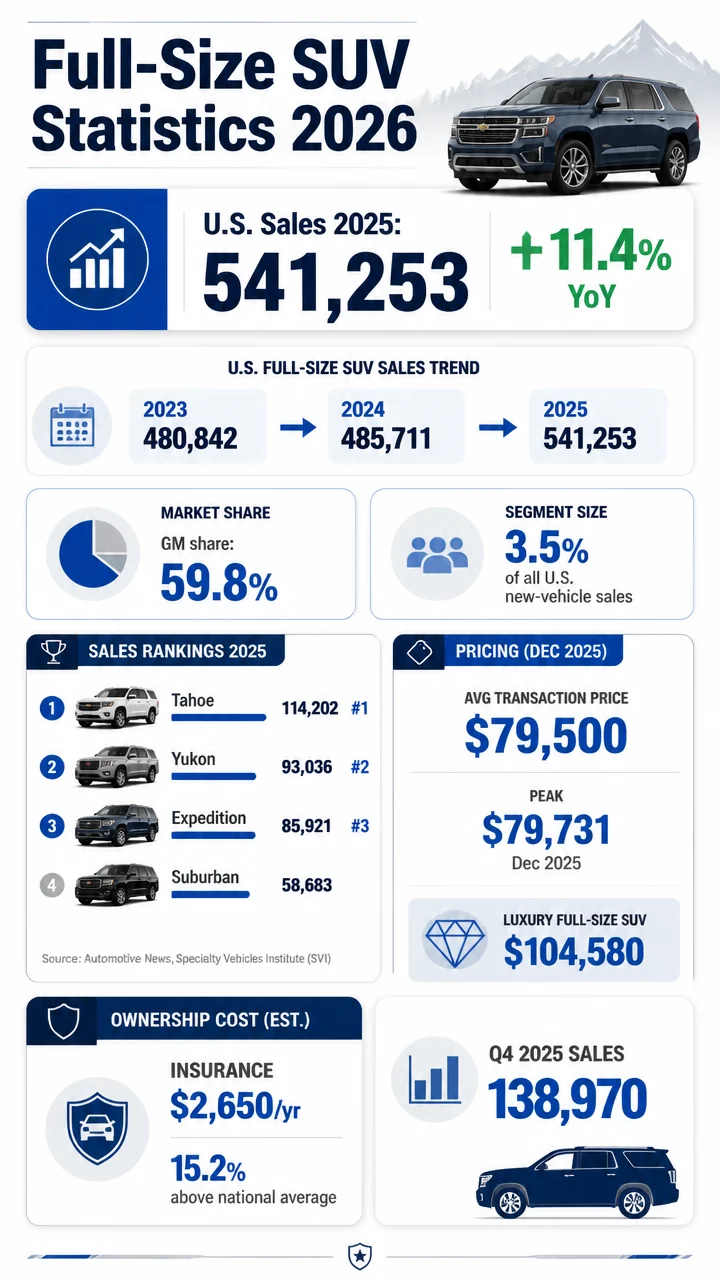
Big number: U.S. full-size SUV sales reached 541,253 units in 2025, up 11.4% from 485,711 in 2024.
Key takeaways
- 541,253 full-size SUVs were sold in the U.S. in 2025.
- The segment grew from 480,842 in 2023 to 485,711 in 2024 to 541,253 in 2025.
- GM held 59.8% of the U.S. full-size SUV market in 2025.
- The Chevrolet Tahoe was the top-selling model with 114,202 sales.
- Average transaction prices climbed to $79,500 in March 2026, with a December 2025 peak of $79,731.
- Luxury full-size SUV transaction prices hit $104,580 in March 2026.
- Large SUV insurance averages $2,650 per year, or 15.2% above the all-vehicle national average.
Table of contents
- Full-size SUV sales growth statistics
- Full-size SUV sales rankings by model
- Full-size SUV market share statistics
- Full-size SUV pricing and transaction price statistics
- Full-size SUV insurance and ownership cost statistics
- Full-size SUV capability, efficiency, and performance statistics
- Full-size SUV safety and buyer demographic statistics
- Global full-size SUV market statistics
Full-size SUV sales growth statistics
The U.S. full-size SUV segment added more than 55,000 units in 2025. Sales rose to 541,253 in calendar year 2025 from 485,711 in 2024, an 11.4% year-over-year increase.
The segment had already been inching upward before that breakout year.
U.S. full-size SUV sales totaled 480,842 units in 2023, then 485,711 in 2024, which represented a modest 1.0% increase.
That makes 2025 the real acceleration point in this dataset.
Full-size SUVs also represented 3.5% of total U.S. new-vehicle sales in 2025, nearly double their share in 2013. That is one of the clearest long-term signals in the numbers: this is no longer just a niche family-hauler segment.
Why it matters: A segment that is both growing in volume and increasing its share of the overall market is gaining strategic importance for automakers, especially because full-size SUVs are typically high-margin vehicles.
| Year / Quarter | U.S. Full-Size SUV Sales | Year-over-Year Change |
|---|---|---|
| 2023 | 480,842 | — |
| 2024 | 485,711 | +1.0% |
| 2025 | 541,253 | +11.4% |
| Q3 2024 | 104,113 | -12.4% |
| Q4 2024 | 136,039 | +20.8% |
| Q1 2025 | 120,958 | +4.6% |
| Q4 2025 | 138,970 | +2.1% |
The quarterly path was not perfectly smooth.
Q3 2024 fell 12.4% to 104,113 units from 118,890 in Q3 2023, showing that the segment did hit a mid-cycle dip.
But that weakness was quickly erased by a 20.8% jump in Q4 2024, when sales reached 136,039.
By early 2025, the momentum was still there.
Q1 2025 sales totaled 120,958, up 4.6% from 115,629 in Q1 2024.
And by the end of the year, Q4 2025 reached 138,970, another 2.1% above Q4 2024.
Quotable stat: The U.S. full-size SUV market went from 480,842 sales in 2023 to 541,253 in 2025 in just two years.
Full-size SUV sales rankings by model
The Chevrolet Tahoe remained the category king in 2025. Tahoe sales hit 114,202, up 8.6% from 105,147 in 2024.
Behind Tahoe, the rankings show a market led by a few very large players, followed by a long tail of smaller premium and niche entries.
The second-best seller was the GMC Yukon at 93,036, followed by the Ford Expedition at 85,921.
| Model | 2025 U.S. Sales | 2024 U.S. Sales | YoY Change |
|---|---|---|---|
| Chevrolet Tahoe | 114,202 | 105,147 | +8.6% |
| GMC Yukon | 93,036 | 87,312 | +6.6% |
| Ford Expedition | 85,921 | 78,035 | +10.1% |
| Chevrolet Suburban | 58,683 | 44,398 | +32.2% |
| Cadillac Escalade | 49,366 | 41,001 | +20.4% |
| Jeep Grand Wagoneer | 45,040 | 55,084 | -18.2% |
| Toyota Sequoia | 26,186 | 26,097 | +0.3% |
| Lincoln Navigator | 22,185 | 15,531 | +42.8% |
| Nissan Armada | 17,465 | 15,267 | +14.4% |
| Infiniti QX80 | 13,590 | 10,339 | +31.4% |
| Cadillac Escalade EV | 8,115 | 670 | +1,111.2% |
| Lexus LX | 7,464 | 6,830 | +9.3% |
Fast facts from the rankings
- Tahoe, Yukon, and Expedition were the only models above 85,000 sales.
- Suburban posted one of the strongest mainstream growth rates at +32.2%.
- Navigator was up 42.8%, the biggest gain among established gas full-size SUVs in the list.
- Grand Wagoneer was the standout decliner, falling 18.2%.
- Sequoia was effectively flat at +0.3%.
- Escalade EV posted the most dramatic jump, rising from 670 to 8,115 sales.
The split between winners and laggards is especially sharp.
Lincoln Navigator rose 42.8% to 22,185 units, while Chevrolet Suburban climbed 32.2% to 58,683.
At the same time, Jeep Grand Wagoneer dropped 18.2% to 45,040, giving back more than 10,000 units versus 2024.
Cadillac Escalade sales reached 49,366 in 2025, up 20.4%, and the new EV variant added 8,115 units after just 670 in 2024.
Even though the EV started from a tiny base, the scale of the increase is still notable.
GM controlled the segment in 2025. The automaker held 59.8% of the total U.S. full-size SUV market, an extraordinary level of concentration in a mainstream vehicle category.
Ford and Lincoln combined held about 20% of the segment in 2025.
That leaves the remaining automakers competing for roughly one-fifth of the market.
Big number: GM captured 67% of U.S. full-size SUV sales in Q1 2025 and grew its full-size SUV volume by 35.3% year over year in that quarter.
The dominance was already visible earlier.
In Q4 2024, GM’s four key nameplates accounted for 75,772 deliveries and a 68% segment share.
- Chevrolet Tahoe alone: 30% segment share in Q4 2024
- Chevrolet Suburban: 12% segment share in Q4 2024
- Tahoe + Suburban combined: 42% share in Q4 2024
- GMC Yukon and Yukon XL family: 26% share in Q4 2024
- Ford Expedition and Expedition Max family: 18% share in Q4 2024
On a full-year basis, GM sold 278,622 full-size SUVs in the U.S. in 2024 across the Cadillac Escalade, Chevrolet Tahoe, Chevrolet Suburban, and GMC Yukon lines.
Adding 13,994 GMC Hummer EV sales brought GM’s large-SUV total to 292,616.
Ford sold 100,235 full-size SUVs in 2024 when Expedition and Navigator are combined.
That means GM outsold Ford by more than 200,000 units in U.S. full-size truck-based SUVs that year.
Quotable stat: Nearly 6 in 10 U.S. full-size SUVs sold in 2025 came from GM.
Full-size SUV pricing and transaction price statistics
Full-size SUVs are now firmly high-ticket vehicles. The U.S. average transaction price for full-size SUV/crossover models was $79,500 in March 2026.
Across the January 2020 to March 2026 period, the median average transaction price was $75,705.
The category peaked at $79,731 in December 2025, while the record low in the same dataset was $60,780 in April 2020.
That spread shows how dramatically this market has moved upscale over the past several years.
| Pricing Metric | Figure |
|---|---|
| Average transaction price, March 2026 | $79,500 |
| Median average transaction price, Jan 2020–Mar 2026 | $75,705 |
| Peak transaction price, Dec 2025 | $79,731 |
| Record low, Apr 2020 | $60,780 |
| Luxury full-size SUV transaction price, Mar 2026 | $104,580 |
| Luxury full-size SUV all-time high, Sep 2024 | $112,381 |
Luxury full-size SUVs sit in another pricing league. Their average transaction price was $104,580 in March 2026, and they hit an all-time high of $112,381 in September 2024.
Model-level pricing examples reinforce how expensive the segment has become:
- 2025 Chevrolet Tahoe MSRP: $61,195 to $83,895 depending on trim
- Verified average paid for a 2025 Tahoe: $81,335 across 17 transactions
- Tahoe transaction range: $74,490 to $91,460.73
- Average Tahoe discount: 5.7% below MSRP
- 2025 Jeep Grand Wagoneer starting MSRP: $87,040
- Average paid for Grand Wagoneer: $84,283 across 21 recent transactions
- Average Grand Wagoneer discount: 3.2% to MSRP
- 2025 Cadillac Escalade starting price: around $88,000
The transaction data also suggests pricing discipline.
Buyers did negotiate below sticker in the examples provided, but the discounts were modest relative to the segment’s very high MSRPs.
Full-size SUV insurance and ownership cost statistics
Insurance is another major cost hurdle in this class. Average annual full-coverage insurance for large SUVs in the U.S. is $2,650, which is 15.2% above the $2,276 national all-vehicle average.
| Model / Segment | Average Annual Insurance Cost |
|---|---|
| Large SUV segment average | $2,650 |
| Chevrolet Tahoe | $2,252 |
| Chevrolet Suburban | $2,378 |
| Ford Expedition | $2,586 |
| Toyota Sequoia | $3,002 |
| Cadillac Escalade | $3,381 |
Lowest and highest insurance figures
- Chevrolet Tahoe is the least expensive large SUV to insure at $2,252 per year, or $188 per month.
- Chevrolet Suburban ranks second-lowest at $2,378 per year.
- Ford Expedition averages $2,586 per year.
- Toyota Sequoia is the highest among mainstream large SUVs listed at $3,002 per year.
- Cadillac Escalade reaches $3,381 per year, or $282 per month.
These figures matter because ownership costs in this segment are not driven by fuel alone.
Between a near-$80,000 transaction price and insurance costs above the national average, the full-size SUV buyer is entering a premium-cost category even before maintenance and financing are considered.
Full-size SUV capability, efficiency, and performance statistics
Capability is still a core reason buyers choose full-size SUVs. The 2025 Chevrolet Tahoe offers a maximum towing capacity of 8,400 pounds when properly equipped, while the 2025 Ford Expedition can tow up to 9,600 pounds with four-wheel drive.
That towing gap helps explain some customer behavior.
GM notes that Tahoe customers tow more frequently than Traverse owners, and the capability difference is big: 8,400 pounds for Tahoe versus about 5,000 pounds for the 2024 Traverse.
| Capability / Efficiency Metric | Chevrolet Tahoe | Ford Expedition | Other Notable Figure |
|---|---|---|---|
| Max towing | 8,400 lbs | 9,600 lbs | Sequoia tested at 8,977 lbs |
| Combined fuel economy | 17 mpg 2WD V8 / 16 mpg 4WD V8 | 19 mpg 2WD / 18 mpg 4WD | Tahoe diesel at 24 mpg combined |
| Cargo behind 3rd row | 25.5 cu ft | 21.6 cu ft | Expedition Max: 36.1 cu ft |
| Max cargo volume | 122.7 cu ft | 108.5 cu ft | Expedition Max: 123.1 cu ft |
Efficiency remains modest, but there are meaningful differences inside the segment:
- 2025 Tahoe 5.3-liter V8: 17 mpg combined in 2WD and 16 mpg with 4WD
- 2025 Tahoe 3.0-liter turbodiesel: 24 mpg combined, the most efficient Tahoe powertrain
- 2025 Ford Expedition: 19 mpg combined in 2WD and 18 mpg in 4WD
Cargo and family-hauling practicality also vary more than buyers may expect.
The Tahoe offers 25.5 cubic feet behind the third row and 122.7 cubic feet maximum.
The standard Expedition trails it at 21.6 and 108.5 cubic feet, but the Expedition Max expands that to 36.1 behind the third row and 123.1 cubic feet maximum.
Performance is no afterthought either.
In a six-SUV comparison test:
- Ford Expedition: 0 to 60 mph in 5.1 seconds, quickest in the group
- Toyota Sequoia hybrid: 5.7 seconds
- Nissan Armada: 6.0 seconds
These are also genuinely heavy vehicles.
Tested curb weights included 5,994 pounds for a 2025 Tahoe High Country, 5,844 pounds for a 2025 Expedition Platinum, and 6,229 pounds for a 2025 Toyota Sequoia 1794 Edition.
Full-size SUV safety and buyer demographic statistics
Rollover risk remains one of the most important safety stats in this class. NHTSA data cited for the 2025 Cadillac Escalade shows a 21.20% rollover risk, compared with 9.50% for a 2025 Honda Civic sedan.
Other 2025-2026 full-size SUVs, including the Chevrolet Tahoe, Ford Expedition, and Toyota Sequoia, carry NHTSA rollover risk figures of roughly 21.6% to 22.1%.
Why it matters: Studies cited by IIHS researchers found electronic stability control reduced lone SUV rollover fatalities by up to 88%, underlining how critical modern stability systems are in this body style.
On demographics, the dataset offers a useful look at who buys into this market:
- Cadillac Escalade standard-wheelbase buyers average in their late 40s.
- Escalade ESV buyers skew slightly younger, in their mid-40s.
- Cadillac says Escalade buyers have become 2 to 3 years younger on average in recent years.
- U.S.
SUV drivers overall are 57% male and 43% female.
The age data is especially notable because it suggests the flagship luxury end of the full-size SUV market is not aging upward.
If anything, some buyer cohorts are getting younger while still absorbing transaction prices well above $100,000 in the luxury subset.
Global full-size SUV market statistics
The global opportunity is large, but growth forecasts vary depending on how the market is defined. One report values the global full-size SUV market at approximately $60 billion in 2024 and projects it to reach about $94 billion by 2034, implying a 4.5% CAGR.
Another source estimates the broader global large SUV market at $326.38 billion in 2024, rising to $349.94 billion by 2034 at a much slower 0.70% CAGR.
| Global Market Statistic | Figure |
|---|---|
| Global full-size SUV market value, 2024 | $60 billion |
| Projected value by 2034 | $94 billion |
| Projected CAGR | 4.5% |
| Global large SUV market value, 2024 | $326.38 billion |
| Projected large SUV value by 2034 | $349.94 billion |
| Large SUV projected CAGR | 0.70% |
| North America share of global large SUV revenue, 2024 | 52% |
| Petrol-powered share of global large SUV revenue, 2024 | 53%+ |
| Projected full-size SUV CAGR within broader SUV market, 2025–2032 | 5.6% |
North America accounted for 52% of global large SUV revenue in 2024, which helps explain why U.S. sales and market-share battles carry outsized importance.
The region remains the commercial center of gravity for this type of vehicle.
Powertrain mix also still leans conventional.
Petrol-powered large SUVs generated more than 53% of global large SUV revenue in 2024, even as the U.S. market is beginning to add EV entries like the Cadillac Escalade EV.
Within the broader global SUV market, full-size SUVs are projected to grow at a 5.6% CAGR from 2025 to 2032, suggesting the segment can still outperform even while operating from a premium, mature base.