If you want to catch a weak battery or charging fault before it becomes a roadside problem, this FOXWELL BT705Plus review examines the upgraded 12V/24V tester closely.
It combines battery, cranking, and charging checks in one tool for DIYers, mechanics, fleet operators, and owners of cars, trucks, RVs, boats, and tractors.
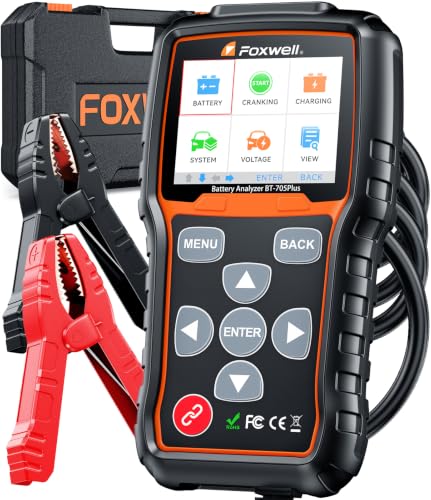
Table of Contents
FOXWELL BT705Plus Review Summary
The FOXWELL BT705Plus is a practical choice for buyers who need more than a basic battery-voltage reading.
According to the supplied product information, it tests battery health, starting performance, and charging behavior, then presents five diagnostic indicators on a high-contrast 2.8-inch color LCD.
That combination suits people who want to investigate hard starts, dim lights, unstable air conditioning, or a vehicle that has been sitting for a long time.
It is especially useful when one tester may need to cover both ordinary 12V vehicles and heavier-duty 24V systems.
The 5.9-foot cables also support solo testing from the driver’s seat.
However, this is not a universal battery analyzer: the listing excludes lithium batteries, and the operator must enter the battery’s rated CCA from its label for the test to be meaningful.
The best reason to buy it is its broad lead-acid battery and vehicle-system coverage, not a promise of completely automatic diagnosis.
Review Scorecard
| Category | Editorial score | Buyer-focused rationale |
|---|---|---|
| Battery test coverage | 9/10 | Supports flooded, AGM, spiral, and GEL batteries across 12V and 24V systems. |
| Diagnostic range | 9/10 | Covers battery, cranking, and charging tests, including SOH, SOC, CCA, cranking voltage/time, and charging ripple. |
| Vehicle versatility | 9/10 | Designed for cars, trucks, RVs, boats, heavy-duty vehicles, and tractors. |
| Ease of reading | 8/10 | The high-contrast 2.8-inch color screen and five indicators should make results easy to scan. |
| Solo operation | 8/10 | Extra-long 5.9-foot cables make testing from the driver’s seat more practical. |
| Battery compatibility | 7/10 | The range is broad for lead-acid types, but lithium batteries are specifically unsupported. |
| Setup discipline | 7/10 | Accurate use depends on entering rated CCA and following the stated in-vehicle testing precautions. |
These are editorial buyer assessments based on the listed capabilities, not laboratory measurements.
For most conventional vehicle batteries, the FOXWELL BT705Plus pros and cons balance toward useful coverage and straightforward readouts, provided the buyer understands the input and safety requirements.
Key Features and Specifications of FOXWELL BT705Plus
The BT705Plus is presented as an upgraded version of FOXWELL’s original BT705.
The manufacturer’s listing says the newer model can deliver results up to 30% faster, using a more powerful processor and refined algorithms.
The same listing emphasizes improved accuracy on low-voltage or nearly dead batteries.
Those are useful design goals for preventative checks, although the available evidence does not provide independent test results or a detailed measurement specification.
Its central advantage is that it groups three related jobs together:
- Battery testing for assessing state of health (SOH), state of charge (SOC), and rated CCA-related performance.
- Cranking testing that reports cranking voltage, cranking time, and CCA-related information.
- Charging-system testing that includes charging ripple, helping the user investigate alternator-related concerns.
The tester supports 12V and 24V vehicles.
That matters for buyers who maintain trucks, heavy-duty equipment, or other systems beyond a standard passenger car.
The stated battery formats are flooded, AGM, spiral, and GEL.
Do not choose this model for lithium batteries, because the listing explicitly says it is not compatible with them.
The display is a 2.8-inch color LCD with high-contrast readouts.
Five diagnostic indicators are intended to show key information at a glance.
A color screen will not replace understanding the result, but it can make a garage or roadside check less cumbersome than interpreting a single number.
The included cable length is 5.9 feet.
That gives the user more flexibility around a vehicle and is specifically positioned for solo testing: the listing says the operator can sit in the driver’s seat while performing battery load, cranking, and charging-system tests.
High-conductivity clamps are also listed as part of the design, with the goal of supporting accurate, professional-grade results.
The package includes one BT705Plus automotive battery tester and a storage box.
The product information also highlights repeat battery testing for reliable result tracking.
That makes the tool more relevant to maintenance routines than a one-time emergency purchase, particularly for garages and fleets checking vehicles before trips or after long idle periods.
Pros and Cons of FOXWELL BT705Plus
Pros
- Three useful test modes in one device: Battery, cranking, and charging checks cover the most common starting-system questions.
- Broad 12V/24V coverage: It can serve passenger vehicles as well as trucks, RVs, boats, tractors, and heavy-duty applications.
- Several conventional battery chemistries supported: Flooded, AGM, spiral, and GEL batteries are included.
- Clear color display: The 2.8-inch high-contrast LCD and five diagnostic indicators emphasize quick readability.
- Good reach for solo work: The 5.9-foot cables can reduce the need for a second person during in-vehicle tests.
- Useful preventative-maintenance role: Repeat testing and checks for SOH, SOC, cranking behavior, and charging ripple can help identify developing problems.
- Portable storage: The included storage box helps keep the tester and leads together in a garage or vehicle.
Cons
- No lithium-battery support: This is a significant limitation for buyers whose vehicle or auxiliary system uses lithium chemistry.
- CCA entry is manual: The user must read the battery label and enter its rated CCA, so an incorrect input can undermine the usefulness of the result.
- Testing requires procedural care: For in-vehicle checks, the listing says accessory loads must be off, the ignition key must be off, and all vehicle doors must be closed.
- Limited independent evidence here: The faster-results and high-accuracy claims come from the manufacturer’s listing; the supplied record does not include third-party validation.
- Not a repair tool: It can help point toward a weak battery, starting issue, or alternator concern, but it does not replace electrical troubleshooting or a repair decision.
Who Should Buy FOXWELL BT705Plus?
The strongest match is a DIY vehicle owner who wants a repeatable way to check a conventional battery before a long journey.
It is also a sensible fit for a mechanic’s shop, a small fleet, or anyone responsible for vehicles that may sit unused.
Long idle periods can weaken batteries, and the BT705Plus is designed around finding warning signs before hard starting or a breakdown interrupts a schedule.
Truck, RV, boat, tractor, and heavy-duty owners may benefit from the 24V support.
Buyers with mixed vehicle types can use one tester across 12V and 24V systems rather than limiting themselves to passenger-car coverage.
The storage box and long cables further support keeping it in a workshop or service vehicle.
Skip it if you specifically need lithium-battery testing, automated selection of the battery’s rated CCA, or a tool with documented independent accuracy results.
It may also be more capability than necessary if you only want to see whether a battery has voltage.
For a buyer who wants battery, cranking, and charging information together, the extra coverage is the point; for a one-number voltage check, a simpler tester may be enough.
How to Get More Useful Results from FOXWELL BT705Plus
Enter the battery’s rated CCA carefully
The product information requires the user to enter the rated CCA value shown on the battery label.
Treat that step as part of the test rather than a minor setup detail: the tester’s interpretation depends on the value supplied.
Prepare the vehicle before an in-vehicle test
The listing instructs users to switch off accessory loads, turn the ignition key to OFF, and close all vehicle doors.
Following those conditions helps create a consistent test setup and avoids confusing the measurement with an active vehicle load.
Use the three test areas together
A battery result alone may not explain a starting complaint.
Use the available battery, cranking, and charging tests as related clues: SOH and SOC describe battery condition, cranking voltage and time address starting behavior, and charging ripple helps investigate the charging system.
Recheck vehicles over time
Because repeat battery testing is part of the stated use case, recording results across trips or periods of storage can be more useful than relying on one reading.
A trend may help you decide when further inspection is warranted.
Alternatives to FOXWELL BT705Plus
If you need a different balance of simplicity, battery coverage, or brand familiarity, consider these Amazon-searchable alternatives:
- TOPDON BT200 battery tester is worth considering for buyers comparing compact automotive battery-test tools from another established diagnostic brand.
- ANCEL BA101 battery tester may suit shoppers looking at a straightforward alternative for conventional vehicle-battery checks.
- INNOVA 3721 battery and alternator tester is a reasonable comparison for buyers focused on basic battery and charging-system troubleshooting.
- Clore Automotive Solar BA9 is another product line to investigate if you want a dedicated automotive battery analyzer from a specialist brand.
Compare each candidate’s supported battery chemistry and voltage range before buying.
The FOXWELL’s combination of 12V/24V coverage and three test categories is its clearest differentiator, while lithium incompatibility and manual CCA entry are the main checks against a mismatch.
Is FOXWELL BT705Plus Worth It?
The FOXWELL BT705Plus is worth considering if you maintain conventional flooded, AGM, spiral, or GEL batteries and want one portable instrument for battery, cranking, and charging checks.
Its 12V/24V compatibility, long cables, color display, storage box, and repeat-testing orientation make it a strong fit for DIY maintenance, shops, fleets, and mixed vehicle ownership.
The buying decision is less favorable for lithium-battery users or anyone expecting a completely automatic diagnostic experience.
You need the correct rated CCA and the right vehicle setup, and the supplied evidence supports manufacturer claims rather than independent laboratory verification.
Buy the FOXWELL BT705Plus when broad lead-acid vehicle coverage matters; choose another tester when lithium support or simpler operation is non-negotiable.