If you need more than a simple voltage reading, this FOXWELL BT705 review examines a handheld tester that checks battery health, cranking performance, and charging output on 12V and 24V systems.
It is aimed at drivers, home garages, and maintenance users who want clearer battery decisions.
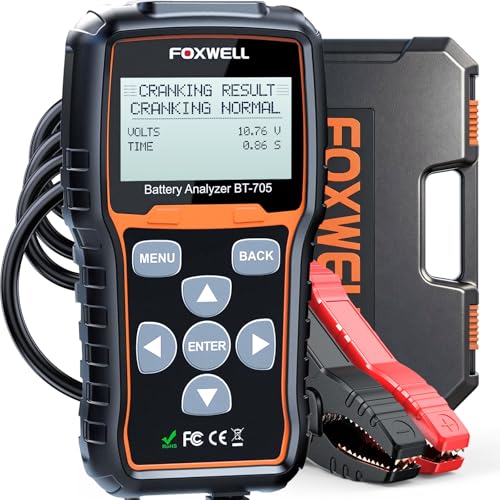
Table of Contents
FOXWELL BT705 Review Summary
The FOXWELL BT705 is worth considering when you want a single tool for cars, pickups, trucks, RVs, boats, and other vehicles using compatible lead-acid batteries.
Its strongest advantage is the combination of guided prompts, a 2.8-inch screen, and a 5.9-foot cable: you can follow the test process and watch cranking data from the driver’s seat while working alone.
The 100-2000 CCA range and support for 12V and 24V systems also make it more versatile than a basic household battery checker.
It suits owners who want to catch a weak battery before an inconvenient failure, verify a newly purchased battery, or avoid replacing a good one.
The main limitation is scope: this is a battery, cranking, and charging-system analyzer for supported lead-acid battery types, not a universal diagnostic scanner for every vehicle electrical fault.
Review Scorecard
| Category | Score | Editorial assessment |
|---|---|---|
| Battery-health testing | 9/10 | Checks CCA, voltage, internal resistance, and state of health. |
| Cranking analysis | 9/10 | Shows cranking voltage and cranking time during startup. |
| Charging-system checks | 8/10 | Designed to check charging output as well as battery condition. |
| Vehicle coverage | 9/10 | Supports 12V and 24V systems and a 100-2000 CCA range. |
| Ease of interpretation | 9/10 | Guided prompts and GOOD, RECHARGE, or REPLACE summaries help simplify results. |
| Working reach | 9/10 | The 5.9-foot cable can reach the driver’s seat from the battery. |
| Storage and durability | 8/10 | Protective housing, durable clamps, and a hard carrying case support repeated use. |
Key Features and Specifications of FOXWELL BT705
The BT705’s purpose is to turn several useful battery checks into one guided workflow.
According to the supplied product information, it measures CCA, voltage, internal resistance, and SOH, then provides a summarized condition result.
Those measurements give a more informative picture than voltage alone: a battery can show acceptable resting voltage while still struggling under starting demand.
Key details include:
- 12V and 24V support: The tester is designed for both common passenger-vehicle systems and higher-voltage applications.
- 100-2000 CCA coverage: This range is intended for a broad selection of cars, pickups, trucks, RVs, boats, and commercial vehicles.
- Multiple battery types: It supports Flooded, AGM, GEL, and EFB lead-acid batteries, including start-stop applications.
- Three useful test areas: Battery health, cranking performance, and charging output can all be checked.
- 2.8-inch display: Step-by-step prompts appear on the screen, while results are summarized as GOOD, RECHARGE, or REPLACE.
- 5.9-foot test cable: The extra reach allows the tester to be viewed from the driver’s seat during startup.
- Travel-ready hardware: A protective housing, durable battery clamps, and included hard carrying case help keep the kit organized.
The listing also identifies the BT705 as a product used in Project Farm’s 2026 battery comparison, including testing at 32°F (0°C).
That reference is useful context for the tester’s intended role, but it should not be treated as a substitute for your own vehicle’s service information or a professional diagnosis.
Pros and Cons of FOXWELL BT705
Pros
- Broad application range: 12V and 24V support, plus 100-2000 CCA coverage, gives it a practical place in a household with several vehicles or in light maintenance work.
- More informative than a voltage-only check: CCA, internal resistance, SOH, cranking behavior, and charging output address different parts of the starting system.
- Beginner-friendly result summaries: GOOD, RECHARGE, and REPLACE reduce the need to interpret every displayed number immediately.
- Useful for solo testing: The long cable lets one person start the vehicle and view the tester at the same time.
- Ready for repeat use: The case, housing, and clamps make storage and transport straightforward.
Cons
- Limited to its stated battery category: Buyers should confirm that their battery is a supported Flooded, AGM, GEL, or EFB lead-acid type.
- Not a full vehicle scanner: The supplied information describes battery, cranking, and charging checks, not engine-code reading or comprehensive electrical diagnostics.
- Potentially more tool than a single-car owner needs: Someone who only wants a quick voltage indication may not use its broader test functions.
- Results still need context: A summary such as REPLACE can guide a decision, but unusual vehicle wiring, poor connections, or charging problems may require further investigation.
Who Should Buy FOXWELL BT705?
The best match is a vehicle owner who wants preventive battery checks instead of waiting for a slow start or no-start event.
It is also a sensible fit for a multi-vehicle household because the tester covers both 12V and 24V systems and a wide CCA range.
RV, boat, pickup, and commercial-vehicle owners may appreciate having one analyzer for different supported applications.
Home mechanics and small repair operations are another natural audience.
The hard case helps keep the unit available, while the long cable can make repeat cranking checks easier when no second person is present.
Users who are new to battery testing should benefit from the guided screen and the plain-language condition summaries.
Skip it if you need a full OBD-II scanner, advanced vehicle-network diagnostics, or a tool for battery chemistries outside the listed lead-acid types.
It may also be unnecessary for a buyer who has one healthy vehicle and only wants a simple voltage measurement.
In those cases, a narrower tool could be easier to justify.
Battery Testing Decisions with FOXWELL BT705
Health versus starting ability
The BT705 is useful because it separates general battery health from what happens during startup.
CCA, internal resistance, and SOH address the battery’s condition, while cranking voltage and time show how it behaves when the engine is being started.
Checking the charging system
A battery problem is not always caused by the battery itself.
Because the BT705 also checks charging output, it can help users look at the broader starting and charging picture before buying a replacement.
Working alone at the driver’s seat
The 5.9-foot cable is a practical design choice rather than a decorative extra.
It allows the tester to remain visible while the vehicle is started, making solo observation of cranking results more manageable.
Interpreting the summary
GOOD, RECHARGE, and REPLACE provide a quick decision layer for first-time users.
The underlying readings still matter when a result is unexpected, but the summary makes routine checks less intimidating.
Alternatives to FOXWELL BT705
For a simpler battery-and-alternator check, compare the TOPDON BT200 battery tester or the ANCEL BA101 battery tester.
These are worth considering when your priority is a compact handheld workflow for common 12V vehicle maintenance.
If you want a more established professional-tool ecosystem, look at the Autel MaxiBAS battery testers.
They may appeal to repair professionals who want a broader diagnostic-tool lineup.
Buyers focused on battery conductance testing can also compare Midtronics battery testers, a familiar name in automotive service equipment.
The FOXWELL remains the more obviously suitable choice when the specific combination of 12V and 24V coverage, 100-2000 CCA range, guided summaries, and long cable matters most.
Is FOXWELL BT705 Worth It?
The FOXWELL BT705 is a strong fit for buyers who need repeatable battery, cranking, and charging checks across several supported vehicles. Its useful measurements, broad stated coverage, guided 2.8-inch display, and 5.9-foot cable give it practical advantages over a basic voltage tester.
Is FOXWELL BT705 worth it?
Yes, if you want to understand whether a battery needs charging, replacement, or closer investigation before a starting problem becomes urgent.
It is less compelling if you only need a quick voltage reading or expect a complete vehicle diagnostic scanner.
For home garages, multi-vehicle owners, and maintenance users working with compatible lead-acid batteries, the BT705 is a practical investment in clearer starting-system decisions.