Table of Contents
- Ford Explorer statistics: the headline numbers
- Table of contents
- Ford Explorer sales statistics
- Ford Explorer quarterly and monthly trends
- Ford Explorer market share and segment benchmarks
- Ford Explorer historical sales data and long-term growth statistics
- Ford Explorer pricing statistics
- Ford Explorer engine, towing, and fuel economy statistics
- Ford Explorer size, cargo, and seating statistics
- Ford Explorer safety statistics
- Ford Explorer production and recall statistics
- Ford Explorer police and fleet statistics
- Ford Explorer 2026 and Tremor statistics
Ford Explorer statistics: the headline numbers
The Ford Explorer put together a major rebound in 2025, climbing back above 222,000 U.S. sales and holding onto its position as America’s best-selling three-row SUV.
The bigger story is how broad that strength looks: annual growth, a huge Q4 surge, solid segment share, and long-run volume that now stretches into the millions.
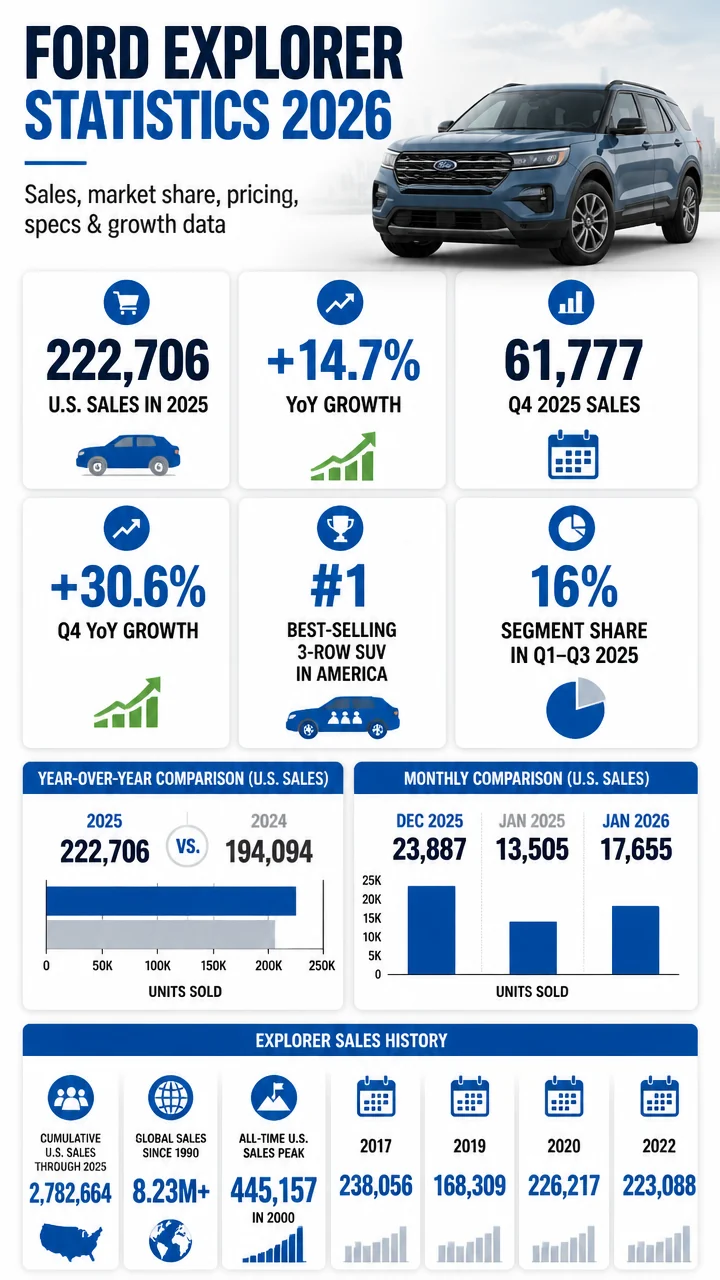
Big number: Ford sold 222,706 Explorers in the United States in 2025, up 14.7% year over year from 194,094 in 2024.
At a glance
- 222,706 U.S.
Explorer sales in 2025
- 61,777 U.S. sales in Q4 2025
- 30.6% Q4 year-over-year growth
- 16% segment share in Q1, Q2, and Q3 2025
- 2,782,664 cumulative U.S. sales through 2025
- 8,226,911+ cumulative global sales since 1990
- 445,157 U.S. sales at the all-time annual peak in 2000
Table of contents
- Ford Explorer sales statistics
- Ford Explorer quarterly and monthly trends
- Ford Explorer market share and segment benchmarks
- Ford Explorer historical sales data
- Ford Explorer pricing statistics
- Ford Explorer engine, towing, and fuel economy stats
- Ford Explorer size, cargo, and seating statistics
- Ford Explorer safety statistics
- Ford Explorer production and recall data
- Ford Explorer police and fleet statistics
- Ford Explorer 2026 and Tremor statistics
Ford Explorer sales statistics
2025 was a comeback year for the Ford Explorer. Ford moved 222,706 units in the U.S., which represented a 14.7% increase from 194,094 units in 2024.
That gain is especially notable because it pushed the Explorer back above several recent annual totals.
It also helped the nameplate remain America’s best-selling three-row SUV in 2025, which is one of the strongest positioning stats in the entire dataset.
Key takeaway: The Explorer did not just grow in 2025; it grew enough to defend category leadership in one of the most competitive family SUV classes.
| Ford Explorer U.S. Sales | Units | Change |
|---|---|---|
| 2025 | 222,706 | +14.7% vs. 2024 |
| 2024 | 194,094 | – |
| 2023 | 183,664 | – |
| 2022 | 223,088 | – |
| 2020 | 226,217 | – |
| 2019 | 168,309 | – |
| 2018 | 230,938 | – |
| 2017 | 238,056 | Peak for 2011-2019 generation |
| 2000 | 445,157 | All-time U.S. peak |
Cumulative U.S.
Explorer sales reached 2,782,664 units through 2025. That total highlights how durable the model has been over multiple decades and multiple SUV market cycles.
On a global basis, the scale is even larger.
Global cumulative Ford Explorer sales exceed 8,226,911 units since 1990, and another source in the dataset notes that more than 7 million Explorers have been sold globally since the 1991 launch.
Even using the more conservative phrasing, the Explorer clearly sits in the upper tier of long-running global SUV nameplates.
Ford Explorer quarterly and monthly trends
The strongest sales momentum showed up late in 2025. Q4 2025 U.S.
Explorer sales totaled 61,777 units, up 30.6% from 47,295 in Q4 2024.
That quarterly spike suggests the annual gain was not just the result of a single early-year lift.
Instead, the data shows momentum building as the year progressed.
| Quarter / Period | Explorer Sales | Year-over-Year Change |
|---|---|---|
| Q1 2025 | 47,314 | -19% |
| Q2 2025 | 57,615 | +24% |
| Q3 2025 | 56,000 | +33.35% |
| Q4 2025 | 61,777 | +30.6% |
| Q3 2024 | 41,996 | +25% |
| Q4 2024 | 47,295 | – |
Q1 was the outlier. Explorer deliveries in Q1 2025 were 47,314, down 19% year over year.
But the next three quarters all posted growth, and the growth rates accelerated sharply in Q2 and Q3 before staying very strong in Q4.
Through Q3 2025, year-to-date Explorer sales were 160,929 units, up 9.63% year over year. That means the final quarter added another 61,777 units and pushed the full-year gain to 14.7%.
Why it matters: A weak Q1 followed by three strong quarters is often a sign of improved availability, successful refresh momentum, or stronger trim mix demand rather than a brief one-month spike.
Monthly figures reinforce that trend.
January 2025 sales were 13,505 units, while December 2025 sales surged to 23,887 units.
Then January 2026 opened at 17,655 units, which sits well above January 2025’s pace.
- January 2025: 13,505 units
- December 2025: 23,887 units
- January 2026: 17,655 units
The December-to-January swing is large but normal seasonally. The more interesting comparison is January 2026 versus January 2025, where the Explorer starts the new year ahead by 4,150 units.
The Explorer held a 16% share of the mainstream large three-row crossover segment in Q1 2025. It matched that 16% share again in Q2 2025 and Q3 2025, which points to unusual consistency.
- Q1 2025 segment share: 16%
- Q2 2025 segment share: 16%, up 2 percentage points year over year
- Q3 2025 segment share: 16%, up 2 percentage points year over year
- Q3 2024 segment share: 15%, up 3 percentage points year over year
Q2 2025 segment volume totaled 360,132 units, up 10% year over year. So Explorer was gaining in a segment that was itself expanding, not merely benefitting from a shrinking competitive set.
Fast fact: The Explorer’s 16% segment share in multiple 2025 quarters means roughly 1 out of every 6 mainstream large three-row crossovers sold in those periods was an Explorer.
The competitive comparison supplied in the dataset also helps frame the Explorer’s position.
Ford’s 2025 result of 222,706 units beat out several major nameplates in adjacent family SUV competition sets.
| 2025 SUV Sales Comparison | Units |
|---|---|
| Ford Explorer | 222,706 |
| Jeep Grand Cherokee | 210,000+ |
| Chevrolet Traverse | 148,000+ |
| Toyota Grand Highlander | Nearly 137,000 |
There is an important caveat in the Jeep figure: Grand Cherokee volume includes both two-row and three-row variants.
Even so, the Explorer’s total remains a strong signal of market relevance.
Another standout stat: the Explorer was also noted as America’s best-selling SUV in 2020, showing that its leadership credentials are not limited to one narrow segment definition.
Ford Explorer historical sales data and long-term growth statistics
The Explorer’s U.S. sales peak remains enormous by today’s standards. In 2000, Ford sold 445,157 Explorers in the United States, the all-time annual high in the dataset.
That kind of volume is far above current levels, but the historical context still matters because it shows just how deeply rooted the nameplate is in the American SUV market.
- Production began in 1990 and the model first went on sale in 1991.
- Second-generation annual U.S. sales exceeded 400,000 units every year from 1995 through 2001.
- 2017 sales hit 238,056, the peak for the 2011-2019 generation.
- 2019 sales dropped to 168,309, one of the lower recent results.
- 2020 bounced back to 226,217, when the Explorer became America’s best-selling SUV.
The 2025 figure of 222,706 is still below the historic peak and below 2017 and 2018, but it is right in the mix with 2020 and 2022.
That makes 2025 look less like an outlier and more like a return to the Explorer’s modern volume range.
Ford sold 1,858,944 Explorers in the U.S. across the 2011-2019 model years, while U.S. production for 2011-2019 Explorers totaled 1,859,618.
Those near-matching totals show the scale and consistency of the model during that generation.
Pull quote: “The Ford Explorer has now logged 2.78 million cumulative U.S. sales and more than 8.22 million global sales, making it one of the most established SUV nameplates still competing at scale.”
Ford Explorer pricing statistics
The 2025 Explorer spans a wide pricing band. The entry-level Active starts at $39,755 MSRP, while the ST-Line starts at $44,515, the Platinum starts at $52,150, and the ST starts at $54,160.
Another price point in the dataset lists the 2025 Explorer ST top trim at $55,505 MSRP, reinforcing that the Explorer now reaches well into mid-$50,000 territory.
| 2025 Ford Explorer Trim | Starting MSRP |
|---|---|
| Active | $39,755 |
| ST-Line | $44,515 |
| Platinum | $52,150 |
| ST | $54,160 |
| ST top trim reference | $55,505 |
For 2026, the Ford Explorer price range runs from $40,260 to $56,700 depending on trim. That implies a slightly higher pricing ladder at both the lower and upper ends.
The trim-level sales trends are especially interesting.
Explorer Active and ST-Line sales rose 41.9% in Q4 2025 alone, while Explorer Platinum sales surged 76.0% in the same quarter.
That suggests strength both in the mainstream and premium ends of the lineup.
Ford Explorer engine, towing, and fuel economy statistics
The standard 2.3L EcoBoost I-4 makes 300 horsepower and 310 lb-ft of torque. Buyers stepping up to the optional 3.0L twin-turbo EcoBoost V6 get 400 horsepower and 415 lb-ft of torque.
Big number: The jump from the standard engine to the 3.0L V6 adds 100 horsepower and 105 lb-ft of torque.
Towing remains a core Explorer stat. The 2025 Explorer has a 5,000-pound maximum towing capacity on all trims, and a Class III Trailer Tow Package is standard on every 2025 model.
The prior 2024 Explorer could tow up to 5,600 pounds with the 3.0L EcoBoost V6.
Fuel economy figures show the tradeoff between capability and efficiency:
- 2025 Explorer RWD 2.3L combined: 24 mpg
- 2025 Explorer RWD 2.3L city: 20 mpg
- 2025 Explorer RWD 2.3L highway: 29 mpg
- 2025 Explorer AWD 2.3L combined: 23 mpg
- 2025 Explorer 3.0L V6 combined: 20-21 mpg
- Estimated annual fuel cost for RWD 2.3L: $2,500
- Tailpipe CO2 for RWD 2.3L: 377 grams per mile
The difference between RWD and AWD 2.3L combined economy is just 1 mpg, while moving to the V6 drops the combined estimate into the 20-21 mpg range.
Ford Explorer size, cargo, and seating statistics
The 2025 Ford Explorer seats up to 7 occupants, which helps explain why it remains a volume player in the three-row family SUV category.
| 2025 Ford Explorer Dimensions and Capacity | Figure |
|---|---|
| Seating capacity | Up to 7 |
| Wheelbase | 119.1 inches |
| Overall length | 198.8 inches |
| Width without mirrors | 78.9 inches |
| Passenger volume (Active/ST-Line) | 152.9 cubic feet |
| First-row legroom | 43 inches |
| Third-row legroom | 32.2 inches |
| Ground clearance (Active/ST-Line) | 7.6 inches |
| Ground clearance (Platinum) | 8.2 inches |
Cargo numbers are equally important for searchers comparing three-row SUVs:
- 16.3 cubic feet behind the third row
- 46.0 cubic feet behind the second row
- 85.8 cubic feet maximum cargo volume on Active
- 85.3 cubic feet maximum cargo volume on ST and Platinum
Base curb weight for the 2025 Explorer Active RWD is 4,344 pounds, while the Explorer ST with Intelligent 4WD weighs 4,766 pounds.
That creates a spread of more than 400 pounds between lighter and heavier configurations in the dataset.
Ford Explorer safety statistics
The 2025 Ford Explorer earned an overall 5-star NHTSA safety rating. It also received 5 stars for front crash and 5 stars for side crash, plus a 4-star rollover rating.
NHTSA calculated rollover risk is 15.1% on some 2025 Explorer configurations, giving shoppers a more detailed figure beyond the star ratings alone.
Why it matters: The Explorer combines a 5-star overall NHTSA rating with IIHS Top Safety Pick+ recognition, a pairing that tends to stand out in safety-focused family SUV research.
Additional crash-test context includes IIHS small overlap front crashworthiness rated Good on 2020-2026 Explorers built after May 2020.
Ford Explorer production and recall statistics
Chicago Assembly produced 206,628 Ford Explorers during calendar year 2023. In December 2023 alone, the plant built 20,120 units.
That production base helps explain how Ford supports Explorer’s consistently high U.S. sales volumes.
Recall and complaint data add another layer to the Explorer story:
- 74 U.S. recall campaigns since 1991 per one compiled data source
- 253 Ford Explorer recall campaigns spanning model years 1977-2026 per NHTSA-listed compiled data
- 2020 Explorer had 28 recall campaigns, the highest recall activity in the dataset
- 1,462 owner complaints logged for the 2020 model year
- 4,096 owner complaints for the 2002 Explorer, the complaint peak
The recall figures vary by source methodology, so the most useful interpretation is directional: the Explorer has a long and complex safety-history footprint simply because it has been sold in very large numbers across many generations.
Ford Explorer police and fleet statistics
The Explorer’s law-enforcement derivative remains a major part of its broader market footprint. The Ford Police Interceptor Utility holds roughly 65% of the U.S. law enforcement vehicle market.
- 33,839 Police Interceptor Utility units sold in the U.S. in 2018
- 32,213 units sold in 2016
- 400 horsepower and 415 lb-ft for the 2025 Police Interceptor Utility 3.0L V6
- Ford police vehicles serve more than 12,000 U.S. law enforcement agencies
The 2025 Police Interceptor Utility’s 400-hp output matches the civilian Explorer’s 3.0L V6 figure, underlining how closely linked the fleet and retail performance narratives are.
Ford Explorer 2026 and Tremor statistics
The biggest 2026 product headline is the arrival of the Explorer Tremor. It replaces the Timberline as the new off-road-oriented model in the lineup.
| 2026 Ford Explorer Statistics | Figure |
|---|---|
| Overall 2026 price range | $40,260 to $56,700 |
| Tremor starting price | About $47,100 to $50,760 |
| Tremor added ride height | Approximately 1 inch |
| Tremor estimated 0-60 mph | 5.3 to 6.0 seconds |
| Tremor 3.0L V6 package premium | About $11,850 |
The Tremor’s estimated 0-60 mph range of 5.3 to 6.0 seconds suggests Ford is trying to blend off-road branding with meaningful on-road performance.
And because January 2026 Explorer sales already reached 17,655 units, the new model-year story starts with a healthy volume base rather than a reset.