Table of Contents
- Family SUV statistics: the short version
- Table of contents
- Why family SUV statistics show SUVs still dominate household choice
- Family travel and road-trip statistics behind SUV demand
- Family SUV pricing statistics: what families are paying in 2026
- Best-selling family SUV statistics and three-row sales leaders
- Best family SUV models in 2026 lists
- Electric family SUV statistics: three-row EV demand is building
- Family SUV buyer demographics and household trends
- Family SUV safety statistics every parent should know
- Family SUV capacity and value benchmarks
- Family SUV statistics vs. minivan statistics: the overlooked comparison
Family SUV statistics: the short version
Family SUVs are still the default choice for many households, but the 2026 data shows a more nuanced picture: parents want more space and comfort, yet they are still watching fuel efficiency, pricing, and long-term value closely.
At the same time, road-trip behavior, rising three-row demand, and early interest in electric family SUVs are reshaping what “best family vehicle” means.
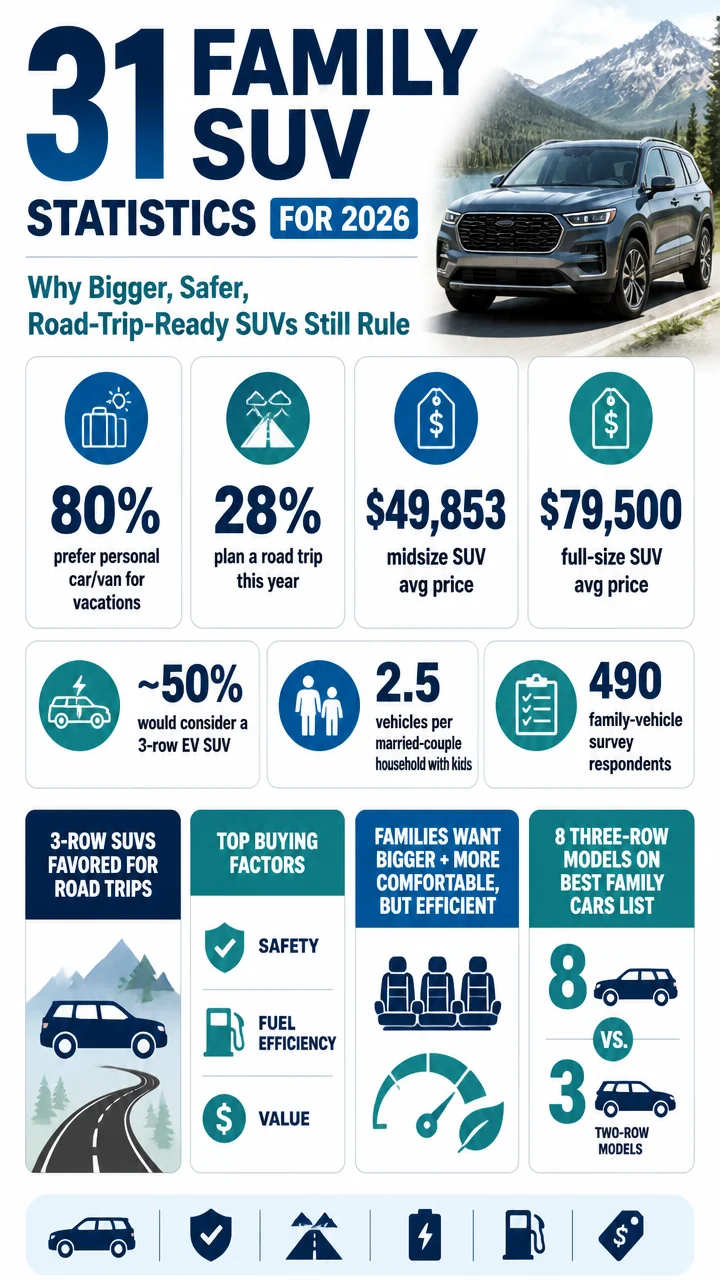
- SUVs remain the go-to family vehicle, according to Kelley Blue Book’s May 2026 survey of 490 respondents.
- Families want bigger and more comfortable vehicles, but not at the expense of fuel efficiency.
- Three-row SUVs are especially popular for family road trips, with safety, fuel efficiency, and value ranking among top purchase factors.
- 80% of families prefer a personal car or van for vacations, and 28% plan a road trip in the coming year.
- The average transaction price reached $49,853 for mid-size SUVs and $79,500 for full-size SUVs in March 2026.
- Close to 50% of shoppers planning to buy an SUV in 2025-2027 would consider a three-row battery-electric model.
- U.S. married-couple households with children ages 6 to 17 owned an average of 2.5 vehicles in 2024, up from 2.3 in 2020-2022.
Table of contents
- Why family SUVs still dominate
- Family travel and road-trip statistics
- Family SUV pricing statistics
- Best-selling family SUV statistics
- Best family SUV models in 2026 lists
- Electric family SUV statistics
- Family SUV buyer demographics
- Family SUV safety statistics
- Family SUV capacity and value benchmarks
Why family SUV statistics show SUVs still dominate household choice
Kelley Blue Book’s May 2026 family-vehicle survey of 490 respondents found SUVs remain the go-to family vehicle, driven by safety, practicality, and affordability.
That headline matters because it bundles the three factors families usually balance hardest:
- Everyday usability
- Peace of mind around children
- Budget discipline
KBB also found families want bigger, more comfortable vehicles, but not at the expense of fuel efficiency.
That creates a clear market tension: shoppers want the room of a larger SUV without giving up running-cost sanity.
For family buyers, the sweet spot is no longer simply “bigger is better.” The winning formula is space plus value plus efficiency.
Three-row SUVs are especially popular for family road trips, and KBB says safety, fuel efficiency, and value are among the top purchase considerations.
That helps explain why midsize and three-row crossover segments remain especially relevant for parents with school-age children, carpools, and frequent weekend travel.
Family travel and road-trip statistics behind SUV demand
The family SUV story makes more sense when you look at how families actually travel.
- 92% of parents are likely or very likely to travel with their children in the next 12 months.
- 80% of families prefer a personal car or van for vacations.
- 51% also plan to use a rental car or van.
- 28% plan a road trip, including RV trips, in the coming year.
- 71% have taken a multi-generational family trip in the past three years.
The Family Travel Association’s 2025 survey found 92% of parents expect to travel with their kids in the next year.
That makes vehicle comfort and storage more than a lifestyle perk; for many households, it is a recurring practical need.
Beach vacations ranked first at 62%, while visiting family and friends followed closely at 61%.
Those trip types often favor flexible cargo areas, easier second- and third-row access, and passenger space for longer drives.
28% of families plan a road trip, including RV travel.
That is a meaningful figure for three-row SUVs, which sit between smaller crossovers and larger people-haulers in both capability and comfort.
80% of families prefer their own car or van for vacation transportation.
In other words, most family travel still revolves around personally owned vehicles rather than public transit or air-plus-rental combinations.
71% of respondents have taken a multi-generational trip in the past three years, a stat that supports demand for larger family vehicles.
When grandparents, cousins, or extra gear enter the picture, a third row becomes more than a “nice to have.”
74% of parents with children over age 7 said their kids love to travel, and 84% believe involving children in planning makes them more adaptable and open to new experiences.
While those are not auto-shopping metrics directly, they reinforce a broader pattern: family travel is active, frequent, and often vehicle-centered.
Family SUV pricing statistics: what families are paying in 2026
Pricing is one of the biggest pressure points in the family SUV market, especially as shoppers move from compact to midsize or full-size models.
| Vehicle category | Average transaction price | Period |
|---|---|---|
| Compact SUV/crossover | $37,055 | March 2026 |
| Mid-size SUV/crossover | $49,853 | March 2026 |
| Full-size SUV/crossover | $79,500 | March 2026 |
| Mid-size car | $33,974 | March 2026 |
The average U.S. transaction price for a mid-size SUV/crossover was $49,853 in March 2026, according to Cox Automotive data.
That is nearly a $50,000 entry point for one of the market’s core family categories.
Full-size SUV/crossovers averaged $79,500 in March 2026, showing just how expensive maximum family space has become.
Compact SUV/crossovers averaged $37,055, which helps explain why many shoppers remain in the compact category unless they specifically need a third row.
Mid-size cars averaged $33,974, about $15,879 less than mid-size SUVs.
That price gap is one of the clearest numerical explanations for why families keep debating whether the extra height, cargo flexibility, and seating are worth the premium.
Mid-size SUV pricing peaked at $50,154 in February 2026, just one month before easing to $49,853.
Even that slight pullback leaves the category hovering around historically elevated pricing levels.
$79,500 is the average transaction price for a full-size SUV/crossover in March 2026.
For shoppers trying to stay below those averages, some family-oriented three-row options start lower.
Car and Driver lists the 2026 Kia Sorento at $33,885 and the 2026 Hyundai Santa Fe at $36,650.
On the higher end, iSeeCars lists the 2026 Toyota Grand Highlander at $43,700 and the 2026 Chevrolet Suburban at $63,700.
Best-selling family SUV statistics and three-row sales leaders
Sales data shows which family SUVs are turning broad interest into actual purchases.
| Model | U.S. sales | Year | Year-over-year change |
|---|---|---|---|
| Ford Explorer | 198,819 | 2025 | +4.02% |
| Honda Pilot | 141,245 | 2024 | +28% |
| Toyota Grand Highlander | 125,180 | 2025 | +97.79% |
| Honda Pilot | 113,686 | 2025 | — |
| Hyundai Palisade | 112,229 | 2025 | +12.50% |
| Kia Telluride | 111,123 | 2025 | +7.87% |
| Chevrolet Tahoe | 102,817 | 2025 | +10.35% |
| Hyundai Palisade | 110,055 | 2024 | +23% |
| Kia Telluride | 115,504 | 2024 | — |
Ford sold 198,819 Explorers in the U.S. in 2025, making it America’s best-selling three-row SUV according to Good Car Bad Car.
Explorer sales were up 4.02% from 191,130 in 2024, and Q2 2025 alone saw a 24% increase.
Honda Pilot led the three-row SUV segment in 2024 with 141,245 sales, up 28% from 110,298 in 2023.
In 2025, Pilot sales came in at 113,686 units.
The Toyota Grand Highlander posted one of the biggest jumps in the dataset, rising 97.79% to 125,180 units in 2025 from 63,288 in 2024.
That kind of near-doubling is a strong signal that shoppers are responding quickly to newer family-focused three-row entries.
Hyundai Palisade reached 112,229 sales in 2025, up 12.50% from 99,757 in 2024.
Kia Telluride hit 111,123, up 7.87% from 103,016.
Chevrolet Tahoe added another 102,817 sales, up 10.35%.
198,819 Ford Explorers sold in 2025 made it the top-selling three-row SUV in America.
Looking beyond three-row-only models, KBB’s early-2025 popularity tracking placed the Toyota RAV4 first with 239,451 units sold and the Honda CR-V second with 212,561.
The Ford Explorer ranked eighth at 104,929, while the Toyota Grand Highlander ranked 20th with 65,419 and the Honda Pilot 21st with 65,194 in that tracking window.
Best family SUV models in 2026 lists
Kelley Blue Book’s 2026 Best Family Cars list gives a useful snapshot of which SUVs are standing out in editorial evaluations built around family use cases.
- Eight three-row SUVs or crossovers made KBB’s 2026 Best Family Cars list.
- Three two-row SUVs also made the list.
The three-row SUVs or crossovers named by KBB were:
- Chevrolet Tahoe
- Ford Expedition
- Honda Pilot
- Hyundai Palisade
- Hyundai Santa Fe
- Kia Sorento
- Toyota Grand Highlander
The two-row SUVs named by KBB were:
- Honda CR-V
- Hyundai Ioniq 5
- Toyota RAV4
That mix underscores a clear split in family demand.
Some households prioritize easier parking, lower pricing, and everyday efficiency, pushing them toward CR-V- and RAV4-style two-row crossovers.
Others need road-trip space, more seats, or larger cargo areas, leading them to Pilot, Palisade, Sorento, Santa Fe, Tahoe, and Grand Highlander-type vehicles.
Electric family SUV statistics: three-row EV demand is building
One of the most interesting family SUV trends is how quickly three-row EV interest is forming, even while the category remains small.
AutoPacific’s 2024 Future Vehicle Planner study surveyed approximately 14,000 prospective buyers, making it one of the broadest datasets in this article.
Close to 50% of respondents planning to buy an SUV in 2025, 2026, or 2027 would consider a three-row battery-electric model.
That does not mean half will actually buy one, but it does show serious openness to electrified family hauling.
8% of near-future crossover and SUV buyers will be actively looking for an electric three-row vehicle.
That is a smaller number, but it reflects real purchase intent rather than loose curiosity.
59% of shoppers seeking multi-row electric SUVs and crossovers want a model priced under $50,000.
That price target is especially notable against the March 2026 average transaction price of $49,853 for mid-size SUVs.
| Three-row electric SUV metric | Figure |
|---|---|
| Would consider a three-row EV SUV | Close to 50% |
| Actively looking for an electric three-row model | 8% |
| Want price under $50,000 | 59% |
| Market share in 2024 | 5.8% |
| Projected market share in 2029 | 13% |
| Projected U.S. sales by 2029 | About 400,000 |
| Estimated U.S. sales in 2024 | Under 100,000 |
| Available models at study time | 7 |
AutoPacific forecast three-row electric crossovers and SUVs will reach 13% market share by 2029, up from 5.8% in 2024.
U.S. three-row electric SUV sales are projected to quadruple from under 100,000 units in 2024 to about 400,000 by 2029.
The supply side is still limited.
AutoPacific identified only seven three-row electric SUV or crossover models available at the time of its study.
That helps explain why demand interest can look stronger than near-term sales availability.
AutoPacific described the typical affordable three-row EV shopper as a married Millennial parent living in suburban single-family housing and driving less than 30 miles per day.
That profile aligns closely with the archetypal modern family SUV buyer.
Family SUV buyer demographics and household trends
Demographics offer another layer of explanation for why family SUVs keep holding their ground.
- 43% of new SUV buyers were ages 25 to 54.
- 31% were age 65 and older.
- 40% had household income of $100,000 or more.
- 57% were male and 43% were female.
- 93% owned their home.
Hedges Company’s buyer analysis found 43% of new SUV buyers were ages 25 to 54, covering many peak family-formation and child-raising years.
Another 31% were age 65 and older, showing the segment also appeals to grandparents, empty nesters, and multigenerational households.
40% of new SUV buyers had household income of $100,000 or more, which lines up with the category’s increasingly high transaction prices.
93% of new SUV buyers owned their home, a striking stat that suggests the typical SUV buyer is often financially established and likely has driveway or garage space for a larger vehicle.
Meanwhile, household vehicle counts are creeping up.
Married-couple households with children ages 6 to 17 owned an average of 2.5 vehicles in 2024, up from 2.4 in 2023 and 2.3 in 2020-2022.
More vehicles per household can make it easier to justify one dedicated family hauler alongside a commuter car or secondary vehicle.
Family SUV safety statistics every parent should know
Safety is one of the main reasons families choose SUVs, but the data shows both strengths and tradeoffs.
NHTSA’s 2022 NOPUS survey found child restraint use for children birth to 7 years old was 93.3% nationwide.
In the West, the rate reached 98.2%, the highest regional figure in the dataset.
For children ages 4 to 7 in vans and SUVs, child restraint use was 93.9%.
That suggests family-oriented vehicles are strongly associated with high restraint use, though the stat does not eliminate other crash risks.
Rear-seat belt use was 81.7% in states requiring belts in all seating positions, a reminder that policy can materially affect real-world family protection behavior.
- 263 deaths and about 10,000 injuries occur annually in U.S. backover crashes.
- 39% of passenger-vehicle backover fatalities involve children under 5.
- A 5-foot-8 driver in an average midsize SUV cannot see an area extending 18 feet behind the vehicle, versus 13 feet in an average midsize sedan.
- Child safety seats saved 408 lives in 2019 alone.
- Child safety seats saved an estimated 13,217 lives from 1968 to 2019.
- An average of 37 children under 15 die annually from vehicular heatstroke.
- More than 50% of pediatric vehicular heatstroke deaths result from a parent or caregiver forgetting a child in the car.
The visibility data is especially important for SUV shoppers.
Consumer Reports testing cited by IIHS found a 5-foot-8 driver in an average midsize SUV cannot see an area extending 18 feet behind the vehicle, compared with 13 feet in an average midsize sedan.
For families with small children in driveways or parking lots, that blind-zone difference matters.
Older Injury Prevention research also points to tradeoffs between SUVs and minivans in child injury outcomes.
The study found children in minivans had a 44% lower adjusted risk of non-fatal crash injury than children in midsize or large SUVs.
It also found rollover crashes accounted for 66% of SUV child fatalities versus 37% for minivan child fatalities in tow-away crashes, and that SUVs were in rollover crashes 21.9% of the time versus 11.0% for minivans in comparable child crashes.
Those numbers do not erase the appeal of SUVs, but they are an important counterweight in a category often discussed as the automatic family-safety winner.
Family SUV capacity and value benchmarks
Families do not just buy SUVs for image; they buy them for measurable utility.
- Typical three-row SUVs can transport at least six passengers, one more than the average sedan.
- Some full-size family SUVs offer seating for up to nine passengers.
- Highly rated three-row family SUVs can deliver up to 6,000 lbs of towing capacity.
- The Volkswagen Atlas offers 20.6 cubic feet of cargo space behind the third row.
J.D.
Power notes that today’s typical three-row SUVs can carry at least six passengers, while some full-size models can seat up to nine.
For large families or multi-generational outings, that is one of the category’s clearest advantages over sedans and many compact crossovers.
Kelley Blue Book’s midsize three-row SUV comparison lists 20.6 cubic feet of cargo space behind the third row in the Volkswagen Atlas, showing how cargo usability remains a major battleground in the segment.
On value retention, the 2026 Toyota Grand Highlander stands out with 30.4% five-year depreciation, according to iSeeCars.
That compares with 46.4% for typical mid-size SUVs, a sizable resale-value edge that can materially change ownership cost over time.
30.4% five-year depreciation for the 2026 Toyota Grand Highlander versus 46.4% for the typical mid-size SUV.
Family SUV statistics vs. minivan statistics: the overlooked comparison
Even in an SUV-dominated market, the minivan comparison is impossible to ignore.
U.S. minivan sales rose 21% to 393,812 units in 2025, while overall U.S. auto sales rose just 2%.
That is a major outperformance signal.
Even so, the U.S. minivan market share was only about 2.4%.
In other words, minivans are growing fast from a small base, while SUVs remain the mainstream answer for most families.
This tension may be the most revealing insight in the whole dataset: families say they want safety, practicality, value, and road-trip space, and SUVs are still winning most of that demand.
But on specific child-safety and injury measures, minivans still show some advantages that buyers may be underweighting.