Table of Contents
- Electric SUV statistics: a market going from mainstream to dominant
- Table of contents
- Key takeaways
- Electric SUV market size and growth statistics
- Electric SUV regional market data
- Electric SUV segment and usage statistics
- Electric SUV sales and adoption statistics
- Electric SUV pricing and battery cost statistics
- Electric SUV range and efficiency statistics
- Electric SUV charging infrastructure statistics
- Top electric SUV models and rankings
Electric SUV statistics: a market going from mainstream to dominant
Electric SUVs are no longer a niche EV subcategory.
The latest numbers show they are becoming the default shape of electric mobility across major markets, with demand driven by size preferences, falling costs, longer range, and broader model availability.
What stands out most is how quickly the segment is scaling: in some datasets the global electric SUV market is already worth hundreds of billions, while in others it is projected to climb into the trillions before the decade ends.
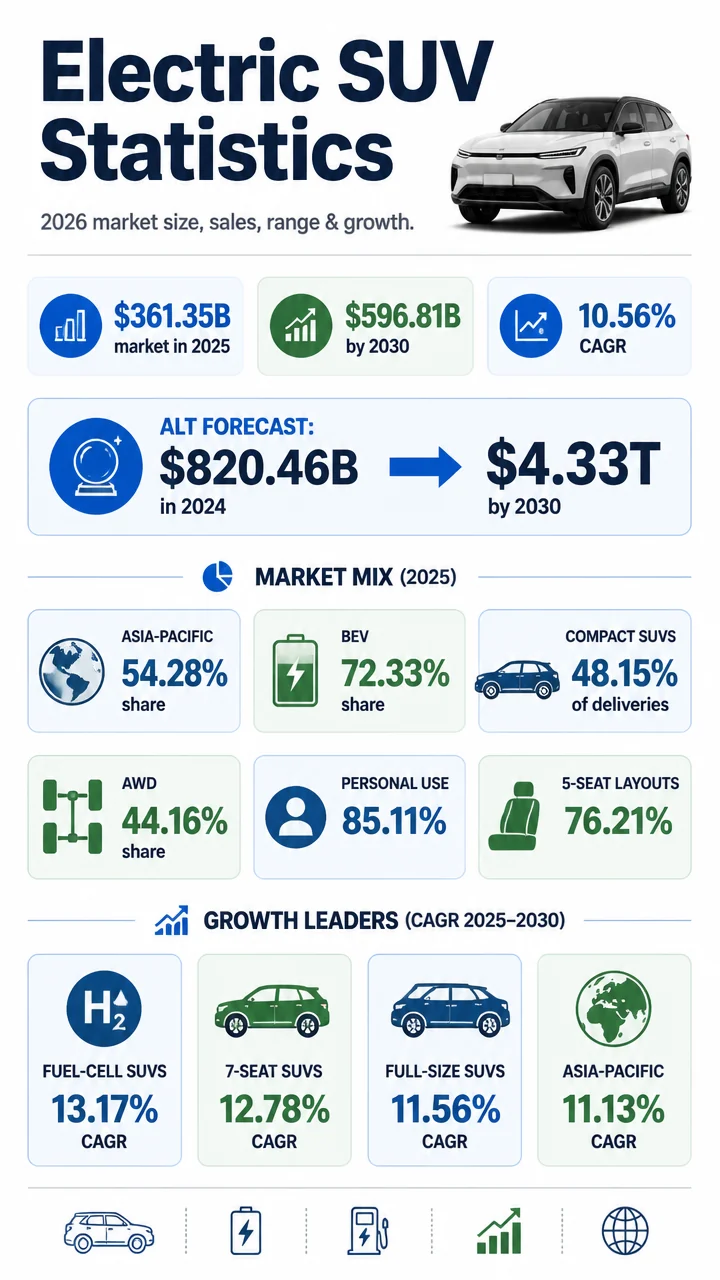
Big number: The global electric SUV market was valued at USD 361.35 billion in 2025 according to Mordor Intelligence, while Grand View Research estimated the market at USD 820.46 billion in 2024.
Table of contents
- Key takeaways
- Electric SUV market size and growth statistics
- Electric SUV regional market data
- Electric SUV segment and usage statistics
- Electric SUV sales and adoption statistics
- Electric SUV pricing and battery cost statistics
- Electric SUV range and efficiency statistics
- Electric SUV charging infrastructure statistics
- Top electric SUV models and rankings
Key takeaways
At a glance:
- USD 361.35 billion: global electric SUV market size in 2025.
- USD 596.81 billion by 2030: Mordor Intelligence forecast.
- USD 4.33 trillion by 2030: Grand View Research forecast.
- 54.28%: Asia-Pacific share of the global electric SUV market in 2024.
- 72.33%: battery electric vehicle share of the global electric SUV market in 2024.
- 48.15%: compact electric SUV share of global deliveries in 2024.
- 85.11%: personal-use share of electric SUV market size in 2024.
- 76.21%: five-seater layout market share in 2024.
- 75%: share of U.S.
BEV sales accounted for by electric SUVs in 2025.
- 1,185,000 units: global Tesla Model Y sales in 2024.
Electric SUV market size and growth statistics
The electric SUV market is already enormous, but forecasts differ sharply depending on the source. Mordor Intelligence puts the global electric SUV market at USD 361.35 billion in 2025 and expects it to reach USD 596.81 billion by 2030, implying a 10.56% CAGR.
Grand View Research is far more aggressive. It estimated the market at USD 820.46 billion in 2024 and projects it will surge to USD 4.33 trillion by 2030 at a 31.9% CAGR.
Even with different methodologies, both forecasts point in the same direction: electric SUVs are one of the biggest growth engines in the broader EV market.
| Source | Base Year Value | Forecast Year Value | CAGR |
|---|---|---|---|
| Mordor Intelligence | USD 361.35 billion (2025) | USD 596.81 billion (2030) | 10.56% |
| Grand View Research | USD 820.46 billion (2024) | USD 4.33 trillion (2030) | 31.9% |
Why it matters: When multiple analysts disagree on absolute market size but still forecast strong growth, that usually signals a category moving faster than traditional auto segments and expanding across regions, price points, and use cases.
The premium slice is scaling too. In emerging economies, the premium electric SUV market was valued at USD 40.7 billion in 2025.
Future Market Insights expects that segment to hit USD 154.5 billion by 2036, growing at a 12.90% CAGR.
Electric SUV regional market data
Asia-Pacific is the center of gravity for electric SUV demand. The region held 54.28% of the global electric SUV market share in 2024, making it the largest regional market by a wide margin.
It is also expected to grow the fastest. Mordor Intelligence forecasts Asia-Pacific will post an 11.13% CAGR through 2030, outpacing other regions.
The U.S. market is also expanding rapidly.
Grand View Research expects the U.S. electric SUV market to grow at 37.7% CAGR from 2024 to 2030.
Fast facts:
- 54.28% of global market share belonged to Asia-Pacific in 2024.
- 11.13% CAGR is forecast for Asia-Pacific through 2030.
- 37.7% CAGR is projected for the U.S. electric SUV market from 2024 to 2030.
Cross-market sales mix data also shows how deeply SUV body styles are shaping EV demand:
- China: electric SUVs and MPVs made up 45% of all BEV sales in 2025, up from 38% in 2024.
- Europe: electric SUVs and MPVs represented 66% of BEV sales in 2025, up 12 percentage points from 2022.
- United States: electric SUVs accounted for 75% of U.S.
BEV sales in 2025
, above the 62% SUV share of all light-duty vehicle sales. - India: electric SUV and MPV sales reached 80% of BEV volume in 2025, up from 60% in 2024.
| Market | Electric SUV/MPV Share of BEV Sales | Comparison Point |
|---|---|---|
| China | 45% in 2025 | Up from 38% in 2024 |
| Europe | 66% in 2025 | Up 12 percentage points from 2022 |
| United States | 75% in 2025 | Above 62% SUV share of all LDV sales |
| India | 80% in 2025 | Up from 60% in 2024 |
China’s numbers are especially notable. SUVs accounted for almost half of all car sales in 2025, and BEVs reached price parity with ICE SUVs for the first time.
Chinese SUV BEV adoption also exceeded 55% in 2025.
Electric SUV segment and usage statistics
Compact models still dominate the market. Compact electric SUVs commanded 48.15% of global electric SUV deliveries in 2024, making them the leading size class.
But larger formats are growing faster. Full-size electric SUVs are projected to post an 11.56% CAGR through 2030, the fastest rate among size segments.
That pattern suggests today’s volume is concentrated in accessible, mainstream compact vehicles, while future growth is broadening into larger family and premium models.
- 48.15% share for compact electric SUVs in 2024.
- 11.56% CAGR forecast for full-size electric SUVs through 2030.
Battery electric vehicles are the dominant powertrain. BEVs held 72.33% of the global electric SUV market share in 2024.
Fuel-cell electric SUVs remain smaller, but they are forecast to grow quickly. This category is projected to expand at a 13.17% CAGR through 2030.
Drivetrain preferences also matter. AWD electric SUVs captured 44.16% of global market share in 2024, showing how buyers still value utility and performance features even as powertrains electrify.
Electric SUVs are overwhelmingly personal vehicles. Personal-use models accounted for 85.11% of global electric SUV market size in 2024.
Cabin layout remains highly concentrated. Five-seater electric SUVs held 76.21% market share in 2024, but seven-seater electric SUVs are expanding at a faster 12.78% CAGR through 2030.
Key segment takeaway: The typical electric SUV in today’s market is still a compact, five-seat, personal-use BEV, but the fastest growth is moving toward full-size, seven-seat, and alternative powertrain niches.
Electric SUV sales and adoption statistics
Electric SUVs now shape the broader EV product mix. According to the IEA, SUV model availability accounted for about half of all available electric car models globally in 2025.
Large vehicles dominate the EV catalog. Large vehicles including SUVs made up almost 70% of all available electric car models worldwide in 2025.
The U.S. is even more SUV-heavy than the global average. More than 85% of U.S. electric car models are large cars or SUVs, the highest large-model share among major markets.
Large cars and SUVs also accounted for over 80% of all U.S. electric car sales in 2025.
SUVs are not just an EV story in the U.S.; they are the whole market story. They represented more than three-quarters of both new ICE and new electric car sales in the United States in 2025.
Globally, large cars and SUVs accounted for almost 70% of the electric car market in 2025, underscoring that electrification is largely following consumer demand for taller, larger body styles rather than replacing them with smaller vehicles.
Pull quote: 75% of U.S.
BEV sales in 2025 came from electric SUVs—a stronger SUV tilt than the overall U.S. vehicle market.
Choice is also expanding quickly in the U.S. About a quarter of all SUV models offered in the United States in 2024 were electric, a sign that EV variants are moving from edge cases into the mainstream showroom mix.
Electric SUV pricing and battery cost statistics
Battery cost declines are helping electric SUVs become more competitive. Lithium-ion battery pack prices fell 20% to USD 115 per kWh in 2024.
That matters because SUVs typically require larger battery packs than smaller cars.
Lower pack costs can have an outsized effect on electric SUV affordability.
Europe saw one of the sharpest pricing improvements. The average BEV price premium for electric SUVs in Europe declined to around 10% in 2025, down from about 20% in 2024.
The U.S. also narrowed the gap. The BEV price premium for electric SUVs stood under 25% in 2025, nearly 5 percentage points lower than in 2024.
Some U.S. electric SUVs are already beating ICE pricing. More than 30% of U.S. battery electric SUV sales undercut the average ICE SUV price in 2025, up from 20% in 2024.
| Pricing Metric | Latest Figure | Previous Figure |
|---|---|---|
| Lithium-ion battery pack price | USD 115/kWh in 2024 | Down 20% |
| Europe electric SUV BEV premium | ~10% in 2025 | ~20% in 2024 |
| U.S. electric SUV BEV premium | Under 25% in 2025 | Nearly 5 percentage points higher in 2024 |
| U.S. electric SUV sales priced below average ICE SUV | More than 30% in 2025 | 20% in 2024 |
China may be the clearest affordability milestone. In 2025, BEVs reached price parity with ICE SUVs for the first time in the Chinese market.
Electric SUV range and efficiency statistics
Range is improving across the BEV fleet. Fleet-average U.S.
BEV driving range rose from 493 km in 2022 to 529 km in 2025.
Electric SUV range varies significantly by market. In 2025, average electric SUV driving range stretched from 424 km in India to 517 km in the United States.
| Market/Vehicle | Range |
|---|---|
| Average electric SUV range in India | 424 km in 2025 |
| Average electric SUV range in United States | 517 km in 2025 |
| U.S. BEV fleet average |
529 km in 2025 |
| Rivian R1S | 400 miles |
| Mercedes-EQ EQS SUV | 339 miles |
| Tesla Model Y | 320 miles |
| Ford Mustang Mach-E | 320 miles |
| Kia EV9 | 304 miles |
Efficiency differs by region too. U.S.
BEV fleet-average energy consumption was 151 Wh/km in 2025, compared with 148 Wh/km in Europe and 119 Wh/km in China.
That gap lines up with market mix.
Regions selling a greater share of larger, heavier SUVs often see higher energy consumption, even as buyers benefit from more cabin space and utility.
Why it matters: Better range and broader access to 300-plus-mile electric SUVs are reducing one of the biggest historical purchase barriers for family vehicle buyers.
Electric SUV charging infrastructure statistics
Charging buildout is accelerating alongside SUV demand. Globally, DC fast-charger counts surged 40% to 2.1 million in 2024.
The U.S. added charging capacity at a rapid clip in 2025. More than 18,000 new DC fast-charging ports came online during the year, a 30% year-over-year increase.
By the end of 2025, total U.S. public DC fast-charging ports had surpassed 70,000.
Utilization is rising too. U.S. public fast-charging networks delivered an estimated 141 million charging sessions in 2025, up roughly 30% year over year.
Charging speeds are also improving. In Q4 2025, 51% of newly deployed non-Tesla U.S.
DC fast chargers offered at least 250 kW.
- 2.1 million global DC fast chargers in 2024.
- 18,000+ new U.S. fast-charging ports added in 2025.
- 70,000+ total U.S. public DC fast-charging ports by end of 2025.
- 141 million U.S. charging sessions in 2025.
- 51% of new non-Tesla U.S. chargers in Q4 2025 delivered 250 kW+.
Public investment remains significant. The U.S.
NEVI program earmarked USD 7.5 billion with the goal of reaching 500,000 public chargers by 2030.
Top electric SUV models and rankings
The Tesla Model Y remains the global benchmark. It sold 1,185,000 units globally in 2024, ranking second among all light vehicles worldwide, not just EVs.
It also led Europe and the U.S. In Europe, the Tesla Model Y recorded 209,214 registrations in 2024, making it the region’s best-selling electric car.
In the U.S., it was the best-selling EV with 372,613 units sold and captured 28.6% of total U.S.
EV sales.
But Europe showed signs of shifting competition.
Tesla Model Y registrations there fell 17% year over year in 2024.
| Europe Electric SUV Model | 2024 Registrations | Year-over-Year Change |
|---|---|---|
| Tesla Model Y | 209,214 | -17% |
| Skoda Enyaq | 68,874 | +4% |
| Volkswagen ID.4 | 64,756 | -24% |
| Mercedes-Benz EQB | 33,188 | +58% |
The biggest European growth figure among the listed models came from the Mercedes-Benz EQB. Its registrations jumped 58% to 33,188 units in 2024.
U.S. non-Tesla competition is taking shape, but at a much smaller scale. The Ford Mustang Mach-E was the best-selling non-Tesla EV in the U.S. in 2024 with 51,745 units.
Other notable U.S. electric SUV results in 2024 include:
- Chevrolet Equinox EV: 28,874 units.
- Cadillac Lyriq: 28,402 units, up 210.3% year over year.
- Rivian R1S: 26,934 units, up 23.4% year over year.
| U.S. Electric SUV Model | 2024 Sales | Year-over-Year Change |
|---|---|---|
| Tesla Model Y | 372,613 | — |
| Ford Mustang Mach-E | 51,745 | — |
| Chevrolet Equinox EV | 28,874 | — |
| Cadillac Lyriq | 28,402 | +210.3% |
| Rivian R1S | 26,934 | +23.4% |
BYD’s electric SUV footprint is becoming global. The BYD Yuan Plus sold 275,223 units in China in 2024, and cumulative global BYD Yuan Plus/Atto 3 sales surpassed 1 million units by June 2025.
The model has also been sold in more than 110 countries and regions worldwide, highlighting how electric SUV demand is no longer limited to a handful of mature EV markets.
BYD’s broader Yuan family also shows the scale of SUV demand inside China. The Yuan family sold 428,580 vehicles in 2023, accounting for 14.17% of BYD’s annual sales.