The right trailer brake controller can make towing feel more controlled, especially when hauling heavier loads, traveling downhill, or braking in changing weather. The models in this roundup cover proportional and time-delay designs, smartphone control, plug-and-play installation, and setups for one to four axles.
Use the comparison and buying advice below to match the controller’s braking behavior, trailer capacity, installation style, and adjustment options to your vehicle and towing routine.
Table of Contents
- Best 10 Trailer Brake Controllers Picks for 2026
- Premium Dual-Mode Control – REDARC Tow-Pro Elite
- Portable Bluetooth Convenience – CURT Echo Mobile Controller
- Clear Digital Feedback – Timilge Proportional Controller
- Occasional-Towing Value – briidea Time-Delay Controller
- Best Overall – CURT TriFlex NEXT Proportional Controller
- Best for Monitoring – Kolasina 90160 Proportional Controller
- Best Simple Setup – CURT Venturer NEXT Time-Delay Controller
- Best with Extra Features – briidea Proportional Brake Controller
- Best for Diagnostics – Lrichy 90885 Proportional Controller
- Best Low-Profile Option – CURT Discovery NEXT Brake Controller
- How We Picked These Trailer Brake Controllers
- Quick Comparison
- Key Buying Factors for Trailer Brake Controllers
- Who Should Buy Which Trailer Brake Controllers?
Best 10 Trailer Brake Controllers Picks for 2026
Premium Dual-Mode Control
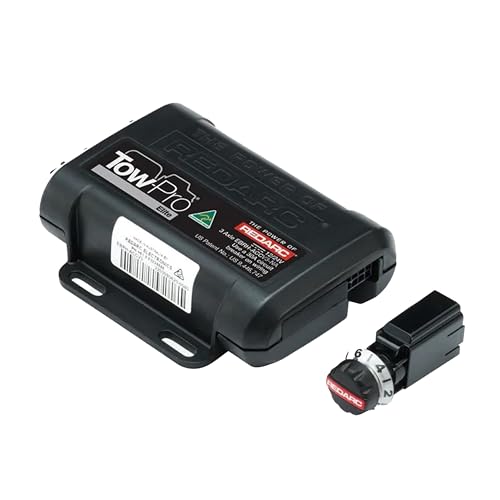
- Proportional and user-controlled braking modes
- Supports 1–3 axles and 12V/24V systems
- Compact dash dial with active calibration
Best For: Frequent towing across paved roads and off-road terrain
Portable Bluetooth Convenience

- Installs through compatible 7-way connectors
- No under-dash wiring or tools required
- Proportional braking for 1–2 axle trailers
Best For: Towers who move one controller between compatible vehicles
Clear Digital Feedback
Timilge Proportional Controller

- Proportional braking responds to vehicle deceleration
- Supports 1–4 axles and 2–8 brakes
- LED display shows voltage delivery
Best For: Drivers wanting adjustable braking and visible real-time feedback
Occasional-Towing Value

- Supports 1–4 braked axles
- Displays gain, voltage, settings, and faults
- Includes overload and short-circuit protection
Best For: Light-duty and occasional towing with diagnostic alerts
Best Overall
CURT TriFlex NEXT Proportional Controller

- Triple-axis motion sensing
- Supports 1-4 axles
- Slim, clearance-focused design
Best For: Versatile towing setups needing smooth proportional braking
Best for Monitoring
Kolasina 90160 Proportional Controller

- High-contrast LED display
- Self-diagnostic alerts
- Supports 1-3 axles
Best For: Towing with a preference for visible settings and diagnostics
Best Simple Setup
CURT Venturer NEXT Time-Delay Controller

- Adjustable power and ramp time
- No leveling required
- Supports 1-3 axles
Best For: Straightforward, adjustable braking for smaller trailer setups
Best with Extra Features
briidea Proportional Brake Controller

- Proportional motion-sensor braking
- Supports 1-4 braked axles
- LED display with safety diagnostics
Best For: Frequent and heavy-duty towing
Best for Diagnostics
Lrichy 90885 Proportional Controller
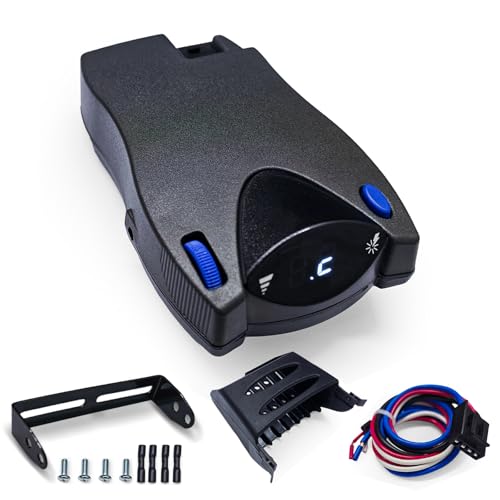
- Continuous connection diagnostics
- Proportional braking in reverse
- Two-year warranty and flexible mounting
Best For: Monitored, adjustable towing setups
Best Low-Profile Option
CURT Discovery NEXT Brake Controller
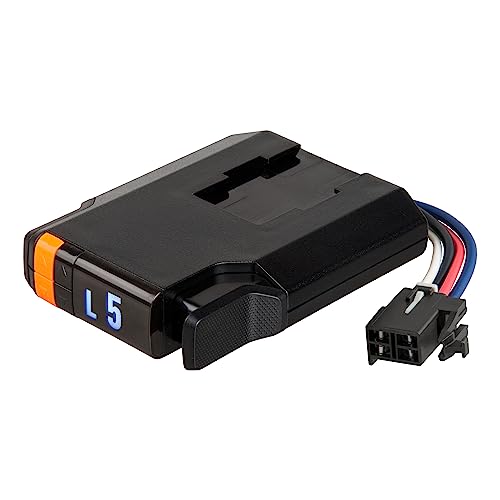
- Slim design for dashboard clearance
- Adjustable power and ramp time
- Supports 1-4 axles without leveling
Best For: Compact, straightforward time-delay control
Premium Dual-Mode Control – REDARC Tow-Pro Elite
For drivers comparing trailer brake controllers for varied towing conditions, the REDARC Tow-Pro Elite stands out with proportional braking for paved roads and a user-controlled mode for off-road use. Its compact dash dial, active calibration, and support for 1–3 axles make it a flexible choice for trucks and SUVs.
Best For: Frequent towing, mixed on-road and off-road use, and drivers who want a discreet dash-mounted control.
Pros:
- Offers proportional and user-controlled braking modes.
- Supports trailers with 1–3 axles and is compatible with 12V/24V systems.
- Compact remote dial helps avoid knee-k knocking and includes sway-control functionality.
- Includes a universal harness and mounting components for a factory-style installation.
Cons:
- Installation still involves wiring the main unit and remote head.
- Its broader capabilities may be more than occasional light-duty towers need.
The Tow-Pro Elite is a strong all-around option when smooth proportional braking and selectable off-road control matter more than the simplest plug-in setup. Its two-year limited warranty adds useful ownership reassurance.
Portable Bluetooth Convenience – CURT Echo Mobile Controller
The CURT Echo is a portable option for shoppers seeking trailer brake controllers without permanent under-dash wiring. It connects between compatible 7-way vehicle and trailer sockets, then uses the OneControl Auto app to adjust settings and provide manual control.
Best For: Owners who tow with multiple compatible vehicles and want a tool-free, transferable controller.
Pros:
- Transfers between vehicles through the 7-way connectors.
- Requires no under-dash wiring or tools when the vehicle supplies the necessary power and ground.
- Uses a triple-axis accelerometer for proportional braking on 1–2 axle trailers.
- Continues operating at the latest programmed settings if Bluetooth communication is lost.
Cons:
- Requires a compatible active 7-way power, ground, and turn-signal connection.
- App-based controls and notifications depend on Bluetooth communication.
- The phone app should remain in the foreground for prompt manual-override response.
Echo is especially convenient for shared vehicles or occasional towing, but buyers should confirm the vehicle’s 7-way power setup and be comfortable managing brake settings through a smartphone app.
Clear Digital Feedback – Timilge Proportional Controller
This Timilge unit is among the trailer brake controllers designed to match trailer braking intensity to the tow vehicle’s deceleration. Its LED display shows voltage delivery in real time, while adjustable braking power and synchronization support trailers from 1 to 4 axles.
Best For: Drivers who want proportional braking with a visible voltage readout and adjustable settings.
Pros:
- Automatically matches trailer braking to the tow vehicle’s braking intensity.
- Supports 1–4 axle trailers, or 2–8 brakes.
- LED display provides a real-time view of voltage delivery.
- Does not require leveling and includes wiring ports for vehicle-specific harnesses.
Cons:
- Requires four-wire installation for power, stop light, ground, and trailer brakes.
- Users must power it down or disconnect it when the truck is shut off or unused for extended periods.
The Timilge controller offers useful trailer coverage and straightforward monitoring at the display. It is a practical fit for buyers comfortable with a wired installation who want proportional operation without leveling.
Occasional-Towing Value – briidea Time-Delay Controller
For light-duty and occasional towing, the briidea is one of the trailer brake controllers that keeps setup and monitoring straightforward. Its time-delay braking system uses adjustable power, while the LED display reports gain, output voltage, settings, and detected faults.
Best For: Occasional towers who need coverage for larger trailers and built-in overload and short-circuit alerts.
Pros:
- Works with trailers using 1–4 braked axles, or 2–8 brakes.
- Provides overcurrent, short-circuit, and fault detection protection.
- LED display shows gain settings, output voltage, and fault information.
- Includes a mounting bracket and accessories for flexible installation angles.
Cons:
- Uses time-delay braking rather than proportional braking.
- Installation requires mounting under the dashboard or in another suitable position.
- The notes position it primarily for light-duty and occasional towing.
The briidea is a sensible value-oriented choice when diagnostic visibility and broad axle compatibility are priorities. Buyers seeking braking that automatically mirrors vehicle deceleration may prefer a proportional controller instead.
Best Overall – CURT TriFlex NEXT Proportional Controller
The CURT TriFlex NEXT is a versatile choice for drivers comparing trailer brake controllers for smooth, responsive braking across trailers with up to four axles. Its triple-axis motion sensing and adjustable design help it adapt to changing driving conditions.
Best For: Towing setups with 1-4 axles that need proportional braking and flexible installation.
Pros:
- Triple-axis accelerometer supports smooth, responsive stops.
- Dynamic power adjustments help when traveling uphill or downhill.
- Low-profile housing and a clearance-focused bracket suit modern dashboards.
- Controls 2-8 trailer brakes at a time.
Cons:
- Its proportional features may be more than needed for basic towing.
- Supports up to four axles, which may not suit larger configurations.
Choose the TriFlex NEXT if you want broad axle compatibility and motion-sensing braking in a compact controller. Its fully adjustable design makes it a strong all-around option for varied towing needs.
Best for Monitoring – Kolasina 90160 Proportional Controller
The Kolasina 90160 is a practical option for shoppers seeking trailer brake controllers with visible settings and diagnostics. Its LED display, proportional braking, and manual slider provide control for trailers with up to six electric brakes.
Best For: Drivers who want real-time status information, adjustable mounting, and compatibility with 1-3 axle trailers.
Pros:
- Proportional braking adjusts force according to vehicle braking intensity.
- High-contrast LED display shows settings and connection status.
- Self-diagnostic monitoring alerts users to detected issues.
- Includes quick-release and screw-in bracket options with 180-degree adjustment.
Cons:
- Vehicle-specific plug-and-play harness is not included.
- Compatibility should be checked carefully before purchase.
The 90160 stands out for its display-based monitoring and flexible mounting. It is a good fit when you value visible diagnostics and manual braking control, provided your vehicle and trailer match its stated compatibility.
Best Simple Setup – CURT Venturer NEXT Time-Delay Controller
The CURT Venturer NEXT offers a straightforward alternative for drivers comparing trailer brake controllers. Its time-delay operation, adjustable power and ramp time, and low-profile housing support controlled braking without requiring leveling.
Best For: Towing trailers with 1-3 axles where simple, adjustable time-delay braking is preferred.
Pros:
- Power and ramp time are fully adjustable.
- Low-profile design helps maintain a clean dashboard appearance.
- No leveling is required during installation or use.
- Operates 2-6 trailer brakes across 1-3 axles.
Cons:
- Time-delay braking is less adaptive than a proportional system.
- It does not offer the supplied TriFlex model’s triple-axis motion sensing.
The Venturer NEXT is suited to buyers who want uncomplicated adjustment and broad compatibility for smaller axle counts. Consider it when ease of setup matters more than motion-based proportional response.
Best with Extra Features – briidea Proportional Brake Controller
The briidea Proportional Brake Controller is a versatile choice for drivers comparing trailer brake controllers for frequent or heavy-duty towing. Its motion sensors match trailer braking to tow-vehicle deceleration, while boost mode lets you fine-tune braking for different trailer weights.
Best For: Frequent towing with travel, cargo, boat, or commercial trailers using up to four braked axles.
Pros:
- Proportional braking helps provide smoother stops and can reduce brake-system wear.
- Supports 1-4 braked axles, or 2-8 brakes.
- LED display shows settings, output voltage, and boost level.
- Includes overcurrent, short-circuit, and fault-detection protection.
Cons:
- The vehicle-specific installation harness is not identified in the supplied details.
- Its display and manual controls may require under-dash installation for clear visibility.
With broad axle support, adjustable boost, and built-in diagnostics, the briidea is a practical all-around option when smooth proportional control matters more than a minimal feature set.
Best for Diagnostics – Lrichy 90885 Proportional Controller
The Lrichy 90885 is a feature-rich option for shoppers comparing trailer brake controllers with detailed status monitoring. It provides proportional braking, multi-level boost, manual override, continuous diagnostics, and a bright LED display for towing feedback.
Best For: Drivers who want adjustable braking, system alerts, and flexible mounting for trailers with 2-8 electric brakes.
Pros:
- Proportional braking also works in reverse, with the option to disable it when needed.
- Supports 2, 4, 6, or 8 electric trailer brakes.
- Diagnostics check connections and brake-magnet conditions.
- Offers 360-degree vertical rotation, removable connection, and a two-year warranty.
Cons:
- A vehicle-specific plug-and-play harness is not included.
- The controller weighs more and has a larger package footprint than the briidea model listed here.
The 90885 stands out for monitoring and installation flexibility. It is a strong fit if diagnostics, reverse proportional braking, and storage-friendly removal are priorities.
Best Low-Profile Option – CURT Discovery NEXT Brake Controller
The CURT 51126 Discovery NEXT takes a straightforward approach to trailer brake controllers with time-delay operation, adjustable power and ramp time, and a slim design. Its plug-and-play format and low-profile bracket can be useful where dashboard space is limited.
Best For: Drivers seeking a compact, adjustable controller for trailers with 2-8 brakes.
Pros:
- Low-profile design and unique bracket improve dashboard clearance.
- Adjustable power and ramp time allow braking to be tuned to the trailer.
- Operates 2-8 trailer brakes across 1-4 axles.
- No leveling is required, and the unit has no internal moving parts.
Cons:
- Its time-delay design does not provide the proportional operation described for the other controllers here.
- The supplied details do not specify a manual override, boost mode, or diagnostic alerts.
The Discovery NEXT is a sensible space-saving pick for buyers who prefer simple time-delay control and easy adjustment. Its limited feature description makes it less suited to shoppers seeking advanced diagnostics.
How We Picked These Trailer Brake Controllers
We selected these models based on the features that matter most in real towing situations: braking response, compatibility with different trailer axle counts, installation requirements, adjustment range, control layout, and safety functions. The list includes proportional controllers that respond to the tow vehicle’s deceleration and time-delay models that apply a preset braking force. It also includes traditional dash-mounted units and mobile Bluetooth options.
Because vehicle wiring and trailer brake systems vary, always confirm the controller’s fit, connector requirements, voltage range, and axle rating before buying. Professional installation may be appropriate if your vehicle lacks a factory brake-controller harness.
Quick Comparison
| Type | Best For | Main Advantage | Potential Trade-Off |
|---|---|---|---|
| Proportional | Frequent or varied towing | Smoother braking that matches vehicle deceleration | May require more setup or careful mounting |
| Time-delay | Budget-conscious and occasional towing | Simple, adjustable output | Can feel less natural during changing stops |
| Bluetooth | Drivers wanting minimal dash hardware | Mobile control and flexible placement | Depends on phone access and app connectivity |
| Plug-and-play | Compatible factory-wired vehicles | Faster installation | May still require a separate vehicle-specific harness |
Key Buying Factors for Trailer Brake Controllers
Proportional Vs. Time-Delay Braking
Proportional controllers generally provide the most natural response because trailer braking increases as the tow vehicle brakes harder. They are a strong choice for frequent towing, hilly routes, and changing traffic. Time-delay controllers use a preset ramp or output level and can be practical for simpler, occasional towing.
Axle and Trailer Compatibility
Check whether the controller supports your trailer’s number of braked axles. Several options here cover one to three or one to four axles, while others begin at two axles. The controller must also be compatible with the trailer’s electric brake system and the tow vehicle’s electrical architecture.
Installation and Controls
Plug-and-play models can reduce wiring work when the correct adapter is available. Consider whether you prefer a permanently mounted dash control, a low-profile design, or smartphone-based adjustments. A visible manual override is useful for testing the trailer brakes and managing sway when necessary.
Safety and Tuning Features
Look for adjustable gain, boost or sensitivity controls, diagnostic indicators, and overload or short-circuit protection. After installation, adjust the output gradually in a safe area so the trailer brakes engage firmly without locking up.
Who Should Buy Which Trailer Brake Controllers?
Choose a proportional controller if you tow regularly, carry varying loads, or prioritize smooth braking. Choose a time-delay model if you want straightforward operation and a lower-cost solution for occasional trips. Choose a Bluetooth controller if you value a clean dashboard and convenient mobile adjustments. Choose a four-axle-capable model for larger trailers, provided its wiring and brake configuration are compatible.
Whichever model you choose, confirm local towing requirements, test the system before a trip, and inspect the trailer brakes, battery, ground connection, and wiring as part of routine maintenance.