Choosing among solar charge controllers for beginners can feel complicated when product listings mix PWM and MPPT technology, battery chemistry, voltage ratings, and current limits.
This roundup focuses on practical differences that matter in small RV, boat, car, backup-power, and off-grid solar setups, so you can match a controller to your panel array and battery safely.
Table of Contents
- Best 10 Solar Charge Controllers for Beginners Picks for 2026
- Smart MPPT Pick – Victron Energy SmartSolar 75V 15A
- Easy LCD Starter – 12V 20A PWM Controller
- High-Capacity MPPT – Victron Energy SmartSolar 100V 50A
- Flexible Lead-Acid Option – Upgraded 30A PWM Controller
- Weatherproof Starter Pick – SOLPERK 8A 12V Controller
- Best Beginner Features – 20A 12V USB-C Controller
- Versatile System Pick – Anern 30A 12V/24V Controller
- Efficient Starter Pick – SOLPERK 10A MPPT 12V Controller
- Feature-Rich Learning Pick – 30A PWM LCD Controller
- Rugged Value Pick – SOLPERK 10A 12V/24V PWM Controller
- How We Picked the Best Solar Charge Controllers for Beginners
- Quick Comparison
- Key Buying Factors for Solar Charge Controllers for Beginners
- Who Should Buy Which Solar Charge Controllers for Beginners?
Best 10 Solar Charge Controllers for Beginners Picks for 2026
Smart MPPT Pick
Victron Energy SmartSolar 75V 15A

- Efficient MPPT charging for 12V or 24V systems
- Bluetooth app with live data and history
- Configurable load output and synchronized charging
Best For: Compact systems needing app-based monitoring
Easy LCD Starter
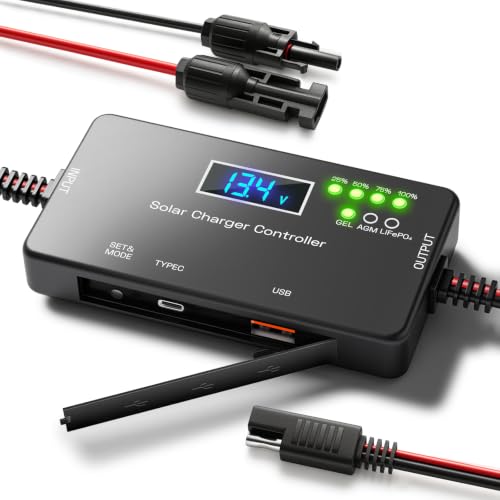
- Supports LiFePO4, AGM, and Gel batteries
- LCD shows voltage and charge-level status
- Adds USB-C PD and USB QC3.0 charging
Best For: Simple 12V RV, boat, shed, and camping systems
High-Capacity MPPT
Victron Energy SmartSolar 100V 50A

- 50A MPPT charging for larger 12V or 24V systems
- Bluetooth monitoring and configurable battery presets
- Supports synchronized multi-controller charging
Best For: Higher-current beginner systems with expansion plans
Flexible Lead-Acid Option

- Automatically adapts to 12V or 24V systems
- LCD with adjustable load timing and settings
- Protection features and dual USB outputs
Best For: Lead-acid battery systems needing simple automatic setup
Weatherproof Starter Pick

- IP67 waterproof construction
- Supports several 12V battery types
- Simple LED charging indicators
Best For: Small outdoor 12V systems
Versatile System Pick

- Supports 12V and 24V systems
- 30A PWM charging capacity
- LCD with adjustable parameters
Best For: Lead-acid 12V/24V installations
Efficient Starter Pick
SOLPERK 10A MPPT 12V Controller

- MPPT design targets faster, more efficient charging
- IP67 waterproof housing for outdoor use
- LED status indicators and SAE plug-and-play connection
Best For: Compact 12V systems using several supported battery types
Feature-Rich Learning Pick

- Automatic 12V/24V support for lead-acid systems
- LCD shows data and enables parameter adjustments
- Dual USB 5V/3A outputs for compatible devices
Best For: Beginners wanting monitoring and adjustable controls for lead-acid batteries
Rugged Value Pick
SOLPERK 10A 12V/24V PWM Controller

- IP67 waterproof design for outdoor installations
- Automatically recognizes 12V or 24V systems
- SAE plug-and-play connection with status LEDs
Best For: RV, boat, and car systems using supported deep-cycle batteries
Smart MPPT Pick – Victron Energy SmartSolar 75V 15A
For beginners choosing solar charge controllers for beginners, the Victron SmartSolar 75V 15A is a user-friendly MPPT option for smaller 12V or 24V systems. Its Bluetooth connectivity, automatic charging algorithms, and app-based monitoring make it easier to understand and manage system performance.
Best For: Beginners building compact 12V or 24V systems who want app monitoring and efficient MPPT charging.
Pros:
- MPPT tracking is designed to maximize available solar power, including during partial shading.
- VictronConnect provides real-time data, 30-day performance history, settings, firmware updates, and alarms.
- Supports synchronized operation with multiple SmartSolar controllers.
- Configurable load output can disconnect loads when battery voltage is too low.
Cons:
- The 15A rating is intended for smaller systems.
- The unit uses an LED or minimal display, so detailed monitoring relies on the app.
This is a strong learning-oriented controller for beginners who value efficient charging and smartphone access. Confirm your panel and battery requirements fit the 75V and 15A limits before buying.
Easy LCD Starter – 12V 20A PWM Controller
This 12V 20A PWM controller is a straightforward entry point for solar charge controllers for beginners. The quick-connect wiring, bright LCD, broad battery compatibility, and built-in USB charging ports suit simple RV, boat, shed, and camping setups.
Best For: Beginners assembling a 12V system with LiFePO4, AGM, or Gel batteries and wanting clear status information.
Pros:
- Supports 12V LiFePO4, AGM, and Gel batteries and solar panels up to 300W.
- LCD shows battery voltage and approximate charge levels at 25%, 50%, 75%, and 100%.
- Quick-connect ports are designed to simplify installation.
- Includes 22W USB-C PD and 18W USB QC3.0 charging outputs.
Cons:
- It is for 12V systems only and is not compatible with 24V or 36V batteries.
- PWM charging is less power-optimizing than MPPT technology.
The simple display and connection system can reduce the learning curve, while the USB ports add practical everyday value. Connect the battery first, then the solar panel, as specified in the product notes.
High-Capacity MPPT – Victron Energy SmartSolar 100V 50A
For beginners planning a larger installation, the Victron SmartSolar 100V 50A offers MPPT charging for 12V or 24V systems with Bluetooth setup and monitoring. It is more capable than compact starter controllers, while its app helps make configuration and performance tracking accessible.
Best For: Beginners with higher-current 12V or 24V systems who want efficient charging and room for a larger solar array.
Pros:
- 50A charging capacity is suited to larger systems than a compact 15A controller.
- MPPT tracking is designed to maximize power output, including under partial shade.
- VictronConnect supports monitoring, battery presets, configuration, firmware updates, and alarms.
- Multiple units can synchronize charging stages across a system.
Cons:
- The controller has no built-in display, so detailed information requires the app.
- Its larger capacity and dimensions may be unnecessary for a small beginner setup.
This is a sensible choice when you expect your system to need substantially more charging current. Check panel voltage, battery voltage, and charging-current requirements carefully before selecting it.
Flexible Lead-Acid Option – Upgraded 30A PWM Controller
The upgraded 30A PWM controller offers beginners automatic 12V/24V adaptation, an LCD interface, and dual USB output. It is designed for lead-acid battery systems and includes automatic protection features, making it a practical option when lithium compatibility is not required.
Best For: Beginners using open, sealed, or gel lead-acid batteries in 12V or 24V systems.
Pros:
- Automatically adapts to 12V or 24V systems.
- LCD displays operating status and supports load-time and manual settings.
- Provides dual 5V/2.5A USB outputs for compatible devices.
- Includes protection against overcurrent, short circuit, reverse connection, low voltage, and overcharge.
Cons:
- It is suitable only for lead-acid batteries, not lithium or nickel-metal hydride batteries.
- The product notes recommend installation on a flat, well-ventilated surface.
- Users must connect the battery before the solar panel during installation.
Automatic voltage recognition and an LCD can make this controller approachable for a basic lead-acid setup. Its battery restriction is important, so verify chemistry before purchase and follow the stated connection sequence.
Weatherproof Starter Pick – SOLPERK 8A 12V Controller
For beginners choosing solar charge controllers for beginners, the SOLPERK 8A is a straightforward option for small 12V setups. Its SAE connectors, simple LED indicators, waterproof construction, and broad 12V battery compatibility make basic installation and monitoring less intimidating.
Best For: Small 12V outdoor systems using AGM, GEL, lead-acid, or LiFePO4 batteries.
Pros:
- IP67 waterproof design suits outdoor use.
- Supports 12V batteries including AGM, GEL, and LiFePO4.
- LED indicators show charging status.
- Protection against reverse current, overheating, short circuits, overcharging, over-voltage, and reverse polarity.
Cons:
- Limited to 8A and 12V systems.
- LED indicators provide less detail than an LCD display.
This is a practical beginner controller when weather resistance and simple operation matter more than high current capacity or detailed system readouts.
Best Beginner Features – 20A 12V USB-C Controller
The 20A controller is a user-friendly choice for solar charge controllers for beginners who want clear monitoring and convenient device charging. Its LCD shows system information, while USB-C and USB-A outputs can power small electronics directly from a 12V solar setup.
Best For: 12V RV, boat, shed, camping, and off-grid systems that need higher current capacity and built-in USB charging.
Pros:
- 20A rating supports larger 12V battery systems and heavier loads.
- LCD displays PV voltage, battery voltage, and charge level.
- Includes 22W PD USB-C and 18W QC USB outputs.
- SAE connectors support quick, beginner-friendly installation.
Cons:
- Not compatible with 24V or 36V batteries.
- Maximum panel VOC is 30V.
- It is a PWM controller rather than an MPPT model.
Choose this model if easy status checks and built-in gadget charging are priorities, provided your system is strictly 12V and within the listed voltage and current limits.
Versatile System Pick – Anern 30A 12V/24V Controller
For beginners comparing solar charge controllers for beginners, this Anern model offers flexible 12V/24V operation and a 30A rating. Its LCD supports status viewing and adjustable settings, but the battery-chemistry limitation is important: it is designed for lead-acid batteries, not lithium systems.
Best For: Lead-acid battery systems in home, commercial, or outdoor applications requiring 12V/24V compatibility.
Pros:
- 30A PWM capacity supports larger systems.
- Works with both 12V and 24V setups.
- LCD allows status viewing, mode switching, and parameter configuration.
- Includes dual 5V/2A USB ports and multiple protective features.
Cons:
- Not compatible with lithium, nickel-metal hydride, or other non-lead-acid batteries.
- It is a PWM controller, not an MPPT controller.
- Requires more setup attention because charging parameters are adjustable.
This is a capable choice for beginners who need 12V/24V flexibility and use compatible lead-acid batteries, but lithium-battery owners should select a different controller.
Efficient Starter Pick – SOLPERK 10A MPPT 12V Controller
For beginners comparing solar charge controllers for beginners, this compact SOLPERK model is a straightforward 12V option. Its MPPT design is presented as more efficient than PWM, while the SAE port and included manual simplify setup.
Best For: Beginners building a compact 12V system with AGM, lead-acid, gel, deep-cycle, sealed, flooded, or LiFePO4 batteries.
Pros:
- MPPT charging is advertised as up to 30% more efficient than PWM.
- IP67 waterproof construction suits outdoor installations.
- LED indicators show panel, battery, and full-charge status.
- Built-in protections include under-voltage, over-voltage, overload, short-circuit, and reverse-connection protection.
Cons:
- Designed for 12V battery systems only.
- Its 10A rating is intended for smaller systems.
- Indicator lights provide less detail than a full LCD display.
This is a beginner-friendly choice when efficiency and weather resistance matter more than advanced display controls or higher system capacity.
Feature-Rich Learning Pick – 30A PWM LCD Controller
This 30A PWM controller is useful for beginners who want visible system information and adjustable settings. It automatically supports 12V or 24V lead-acid systems and adds dual USB outputs for charging 5V devices.
Best For: Home, RV, or small commercial setups using open, AGM, or gel lead-acid batteries and needing LCD monitoring.
Pros:
- Automatically supports 12V and 24V systems.
- LCD displays operating data and allows parameter adjustments.
- Dual USB ports provide 5V/3A output for compatible devices.
- Includes automatic overcurrent, short-circuit, reverse-connection, and open-circuit protection.
Cons:
- Not suitable for lithium batteries.
- Uses PWM rather than MPPT charging.
- Correct connection order is important: battery, solar panel, then load.
Its LCD and adjustable settings make system behavior easier to understand, but battery chemistry compatibility should be checked carefully before purchase.
Rugged Value Pick – SOLPERK 10A 12V/24V PWM Controller
For beginners seeking solar charge controllers for beginners that can handle outdoor use, this SOLPERK PWM model offers automatic 12V/24V recognition and an IP67 waterproof design. Its SAE connection and pre-drilled mounting holes make installation approachable.
Best For: Outdoor RV, boat, or car setups using AGM, gel, or flooded deep-cycle batteries.
Pros:
- IP67 waterproof construction is suited to outdoor applications.
- Automatically identifies 12V or 24V systems.
- Supports up to 10A, with listed maximum power of 150W at 12V and 300W at 24V.
- Three indicators show load, battery, and solar charging status.
Cons:
- Listed compatibility does not include lithium batteries.
- PWM charging is less advanced than MPPT.
- LED indicators offer limited detail compared with an LCD.
This model balances outdoor durability and simple installation, making it a practical choice for modest non-lithium systems where automatic voltage recognition is helpful.
How We Picked the Best Solar Charge Controllers for Beginners
We selected controllers across the most common beginner use cases: compact 12V systems, 12/24V installations, waterproof outdoor setups, higher-current battery banks, and projects using AGM, gel, or LiFePO4 batteries. We compared charging technology, rated output, voltage compatibility, battery support, display and monitoring features, protection claims, and installation practicality.
MPPT models are included for users who want better energy harvest, while PWM models can be a sensible low-cost choice when the panel and battery voltage are closely matched. Because specifications and included accessories can vary by listing, verify the product label and manual before wiring a system.
Quick Comparison
| What to Compare | Best For | What to Check |
|---|---|---|
| Charging type | Efficiency or affordability | MPPT generally extracts more energy; PWM is usually simpler and less expensive |
| Rated current | Small to larger battery banks | Match controller amperage to the solar array’s maximum charging current |
| System voltage | 12V or expandable setups | Confirm whether the controller supports 12V only or automatically supports 24V |
| Battery profile | Lead-acid or lithium systems | Look for the exact AGM, gel, flooded, or LiFePO4 setting required |
| Weather resistance | RV, boat, and outdoor installations | Check the stated IP rating and protect terminals from moisture |
Key Buying Factors for Solar Charge Controllers for Beginners
PWM Vs. MPPT
PWM controllers are straightforward and often adequate for modest 12V panels paired with 12V batteries. MPPT controllers cost more but can improve harvest, particularly when panel voltage is higher than battery voltage, in cooler conditions, or when wiring panels over longer distances.
Voltage, Current, and Panel Sizing
Never choose by amperage alone. Confirm the controller’s maximum solar input voltage, supported battery voltage, and maximum charging current. The solar array should remain within both voltage and power limits, including the panel’s open-circuit voltage in cold weather. A controller with some headroom is preferable to one operating at its limit.
Battery Chemistry and Safety
Use a charging profile designed for your battery. LiFePO4 batteries require different voltage behavior from AGM, gel, or flooded lead-acid batteries, and not every inexpensive controller supports lithium correctly. Also look for reverse-polarity, overcharge, overload, short-circuit, and temperature protections, but do not treat these features as a substitute for correct wiring and fusing.
Displays, USB Ports, and Monitoring
An LCD can make setup and troubleshooting easier by showing voltage, current, battery status, or load settings. USB ports are convenient for small devices but should not determine your choice if the controller’s core charging specifications are unsuitable. Bluetooth or app monitoring can be worthwhile when the controller is installed somewhere difficult to access.
Who Should Buy Which Solar Charge Controllers for Beginners?
- Choose a compact PWM controller for a simple 12V light, shed, car, or small battery project where low cost and easy setup matter most.
- Choose an MPPT controller when you want better efficiency, use higher-voltage panels, expect changing weather, or may expand the system later.
- Choose a waterproof model for exposed RV, boat, or outdoor installations, while still mounting it in a ventilated, protected location.
- Choose a higher-amperage controller for larger panels or battery banks, but calculate the array’s actual output before buying.
- Choose a lithium-compatible model only after confirming its LiFePO4 charging settings and the battery manufacturer’s recommended limits.
Before installation, read the manual, fuse the battery connection appropriately, observe polarity, and connect components in the order specified by the manufacturer. If panel voltage, battery chemistry, or array sizing is unclear, consult a qualified installer.