A solar charge controller with display makes it easier to monitor charging voltage, battery status, load activity, and system performance without guessing what is happening behind the scenes.
We selected 10 options spanning compact PWM units, feature-rich MPPT controllers, Bluetooth-connected models, and high-capacity controllers for larger battery banks. Use the guide below to match specifications, compatibility, and monitoring features to your setup.
Table of Contents
- Best 10 Solar Charge Controller with Display Picks for 2026
- Best Overall MPPT – Renogy Rover 30A LCD Controller
- Best Smart App Option – Victron SmartSolar MPPT 100/50
- Best Budget PWM – 30A PWM LCD Solar Controller
- Best High-Capacity Expandable – PowMr 60A MPPT LCD Controller
- Easy-Setup Pick – 100A MPPT LCD Controller
- Connected Monitoring Pick – LiTime 30A MPPT Controller
- High-Voltage Capacity Pick – POWLAND 120A MPPT Controller
- Best Value PWM Pick – ACEIRMC 30A 12V/24V Controller 2-Pack
- Best High-Voltage MPPT Option – 120A MPPT Controller with LCD
- Best for Programmable Monitoring – Upgraded 100A MPPT/PWM Controller
- How We Picked the Best Solar Charge Controller with Display
- Quick Comparison
- Key Buying Factors for a Solar Charge Controller with Display
- Who Should Buy Which Solar Charge Controller with Display?
Best 10 Solar Charge Controller with Display Picks for 2026
Best Overall MPPT
Renogy Rover 30A LCD Controller

- MPPT support for 12V/24V systems
- LCD with adjustable parameters
- Works with lead-acid and lithium batteries
Best For: RV, marine, and moderate-size off-grid systems
Best Smart App Option
Victron SmartSolar MPPT 100/50

- MPPT charging for 12V/24V systems
- VictronConnect app with live data and history
- No built-in physical display
Best For: App-focused users and expandable solar installations
Best Budget PWM

- LCD status display with timer controls
- Automatic 12V/24V adaptation
- Dual USB charging outputs
Best For: Simple lead-acid battery systems
Best High-Capacity Expandable

- 60A MPPT support up to 48V systems
- LCD and real-time energy logging
- Up to 12 units can operate in parallel
Best For: Large or expandable off-grid systems
Easy-Setup Pick

- 12V/24V auto-recognition
- LCD monitoring with adjustable settings
- Up to 99% MPPT efficiency
Best For: Straightforward 12V/24V systems and lithium-battery setups
Connected Monitoring Pick

- Built-in Bluetooth and LCD
- Supports LiFePO4 and lead-acid batteries
- Up to 900W at 24V PV input
Best For: RV and off-grid users needing remote monitoring
High-Voltage Capacity Pick

- Auto-senses 12V to 96V systems
- 120A charging capacity
- LCD dashboard with diagnostics
Best For: Large, varied-voltage off-grid and mobile power systems
Best Value PWM Pick
ACEIRMC 30A 12V/24V Controller 2-Pack

- Two 30A controllers for 12V or 24V systems
- LCD, USB outputs, and timer settings
- Three-stage PWM charging with built-in protection
Best For: Dual-controller setups using compatible lead-acid batteries
Best High-Voltage MPPT Option
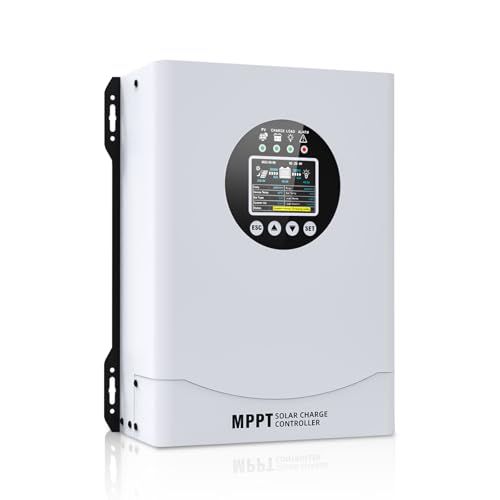
- Supports 12V through 96V battery systems
- Up to 230V PV input with high-capacity array support
- Compatible with lithium-ion and lead-acid battery types
Best For: Large, multi-voltage solar power systems
Best for Programmable Monitoring
Upgraded 100A MPPT/PWM Controller

- LCD shows PV, battery, load, temperature, and timing data
- Seven operating modes with precise time control
- Dual USB ports and compatibility with lead-acid and LiFePO4
Best For: Timed lighting and detailed system monitoring
Best Overall MPPT – Renogy Rover 30A LCD Controller
For shoppers seeking a dependable solar charge controller with display, the Renogy Rover 30A combines MPPT charging, an adjustable LCD, and automatic 12V/24V operation. It supports common lead-acid battery types plus lithium, making it a flexible option for RV, marine, and off-grid systems.
Best For: RVs, cabins, and marine setups that need configurable charging and clear local status information.
Pros:
- MPPT tracking supports up to 400W at 12V or 800W at 24V, with a 100V maximum Voc.
- LCD display and adjustable parameters provide convenient system monitoring and setup.
- Supports gel, sealed, flooded, and lithium batteries, with four-stage charging and lithium reactivation.
- Includes temperature compensation and multiple protective features, including reverse-polarity and overload protection.
Cons:
- Bluetooth monitoring requires the separately sold BT2 module.
- Its 30A capacity may be limiting for larger solar arrays.
The Rover 30A is a well-rounded choice when you want a solar charge controller with display and broad battery compatibility. Its MPPT design and configurable charging make it especially suitable for moderate-size mobile or off-grid systems.
Best Smart App Option – Victron SmartSolar MPPT 100/50
The Victron SmartSolar MPPT 100/50 is a strong choice for buyers who prioritize connected monitoring and efficient MPPT charging. However, despite fitting the broader category, this model has no built-in display; system data is accessed through the VictronConnect app.
Best For: Users who prefer smartphone-based monitoring, configuration, firmware updates, and performance history.
Pros:
- MPPT tracking is designed to maximize available solar power, including during partial shade.
- VictronConnect provides real-time data, 30-day history, settings, firmware updates, and alarms.
- Multiple SmartSolar controllers can synchronize their charging stages.
- Configurable load output can disconnect loads when battery voltage drops too low.
Cons:
- No physical LCD display is included.
- App-based monitoring may be less convenient for shoppers wanting an at-a-glance local readout.
Choose this Victron model if app connectivity matters more than an integrated screen. It offers advanced monitoring and expandable synchronized charging, but it is not the best match for a strict solar charge controller with display requirement.
Best Budget PWM – 30A PWM LCD Solar Controller
This upgraded 30A PWM unit is a practical solar charge controller with display for simpler 12V and 24V installations. Its LCD, automatic voltage adaptation, USB outputs, and timer settings offer useful everyday controls, but its battery compatibility is limited to lead-acid types.
Best For: Basic home, commercial, or small off-grid systems using open, sealed, or gel lead-acid batteries.
Pros:
- LCD shows operating status and data, with manual parameter and load-timer controls.
- Automatically adapts to 12V or 24V systems.
- Dual USB outputs provide 5V/2.5A charging for compatible mobile devices.
- Includes protections for overcurrent, short circuit, reverse connection, low voltage, and overcharge.
Cons:
- Only supports lead-acid batteries; it should not be used with lithium or nickel-metal hydride batteries.
- PWM charging is less advanced than MPPT for maximizing solar harvest.
- The battery should be fully charged initially so the controller can recognize the battery type correctly.
For a straightforward lead-acid setup, this controller offers useful display and load-management features at a modest capacity. Verify the battery type and follow the specified connection sequence before installation.
Best High-Capacity Expandable – PowMr 60A MPPT LCD Controller
The PowMr 60A is designed for larger systems that need a solar charge controller with display, high charging capacity, and expansion potential. It supports 12V, 24V, 36V, and 48V battery systems, accepts lead-acid or lithium batteries, and allows up to 12 controllers to operate in parallel.
Best For: Larger RV, boat, commercial, or off-grid installations that may need additional charging capacity over time.
Pros:
- 60A MPPT charging supports multiple battery voltages from 12V through 48V.
- LCD display provides local information, while real-time energy logging adds useful system insight.
- Supports up to 12 controllers in parallel for system expansion.
- Aluminum construction and temperature-controlled bladeless fan support heat management.
Cons:
- Lithium batteries require user-adjusted charging parameters.
- Recommended system wiring calls for 9 AWG cable, which may add installation requirements.
- PV input must be disconnected before changing parameters.
This PowMr is the strongest fit here for high-capacity and expandable installations. Its broad voltage range and parallel capability are useful for growth, while the LCD keeps core system information available without relying solely on an app.
Easy-Setup Pick – 100A MPPT LCD Controller
This 100A MPPT solar charge controller with display is designed for straightforward 12V or 24V installations. Its auto-recognition, LCD monitoring, dual USB ports, adjustable timer, and built-in protections make it a practical option for users who want visible system information without a complicated setup.
Best For: Home, commercial, and general 12V/24V systems using compatible lithium batteries.
Pros:
- Automatically recognizes 12V or 24V systems when the battery is connected first.
- LCD shows real-time performance information and supports setting adjustments.
- MPPT tracking is rated at up to 99% efficiency.
- Includes protection against overcharging, short circuits, and reverse polarity.
Cons:
- Supports 12V/24V systems rather than the broader voltage range offered by some controllers.
- The supplied notes do not specify detailed PV input limits or battery compatibility beyond the lithium-focused description.
Choose this model if easy installation and on-device monitoring are priorities. Confirm your panel, battery, and wiring specifications before relying on its 100A rating.
Connected Monitoring Pick – LiTime 30A MPPT Controller
The LiTime 30A MPPT solar charge controller with display combines local LCD controls with built-in Bluetooth. It supports 12V and 24V systems, offers dedicated LiFePO4 and lead-acid charging modes, and provides system indicators useful for RV, solar, and off-grid installations.
Best For: RV and off-grid users who want both on-controller readings and Bluetooth access to system information.
Pros:
- Built-in Bluetooth enables remote control and usage monitoring without an additional module.
- LCD screen, four buttons, and LED indicators show operating and system status.
- Supports LiFePO4, sealed, gel, and other listed lead-acid battery types with adjustable parameters.
- MPPT tracking efficiency is rated at 99%, with peak conversion efficiency up to 98%.
Cons:
- Its 30A rating is lower than the higher-capacity controllers in this roundup.
- The listed operating temperature is 45 °C, so installation conditions should be checked carefully.
- The supplied dimensions list a relatively large, heavy unit at 4.4 pounds.
This is a strong fit when remote visibility matters as much as the built-in display. Verify that your array stays within the listed 450W/12V or 900W/24V PV limits.
High-Voltage Capacity Pick – POWLAND 120A MPPT Controller
For larger or more varied installations, this POWLAND solar charge controller with display supports automatic sensing across 12V to 96V systems and provides a 120A charging capacity. Its LCD dashboard reports PV input, charging stage, and warnings, while the MPPT design is rated for up to 98% efficiency.
Best For: High-capacity RV, off-grid home, and mobile power systems using supported battery types.
Pros:
- Automatically adapts to listed system voltages from 12V through 96V.
- 120A charging capacity suits demanding solar setups.
- LCD dashboard displays PV voltage/current, charging mode or stage, and diagnostics.
- Supports LiFePO4, AGM, GEL, and flooded lead-acid batteries with three-stage charging.
Cons:
- The supplied notes do not provide detailed installation dimensions or wiring accessories.
- Its broad voltage and high-current capability may be more than needed for smaller systems.
- Confirm compatibility and configuration requirements before connecting a high-power array.
This model stands out for system flexibility and capacity, especially where a 12V/96V range is useful. Its 230V maximum solar input and battery settings should be checked against the complete system design before purchase.
Best Value PWM Pick – ACEIRMC 30A 12V/24V Controller 2-Pack
If you want a solar charge controller with display for a straightforward 12V or 24V setup, this ACEIRMC 2-pack offers useful monitoring and control features at a practical scale. Its LCD shows system information and supports adjustable parameters, timer settings, and load management.
Best For: Home, commercial, or industrial users needing two 30A PWM controllers for compatible lead-acid battery systems.
Pros:
- Includes two 30A controllers compatible with 12V and 24V systems.
- LCD display supports status monitoring, parameter configuration, and timer settings.
- Offers dual 5V/2.5A USB outputs and three-stage PWM charging.
- Includes overcurrent, short-circuit, reverse-connection, and open-circuit protection.
Cons:
- Uses PWM charging rather than MPPT technology.
- Battery compatibility is listed primarily for open, AGM, and GEL lead-acid batteries.
- The 30A rating is less suited to higher-power solar arrays.
This is a sensible choice when you need two basic controllers with visible readouts, USB charging, and adjustable timing. Confirm your battery type, system voltage, and array current before installation.
Best High-Voltage MPPT Option – 120A MPPT Controller with LCD
For larger and more flexible battery banks, this solar charge controller with display supports system voltages from 12V through 96V. Its MPPT design is intended to improve solar energy capture, while the LCD provides a convenient interface for monitoring and configuration.
Best For: High-capacity solar installations using compatible lithium-ion or lead-acid batteries across a wide range of system voltages.
Pros:
- Automatically recognizes 12V, 24V, 36V, 48V, 60V, 72V, 84V, and 96V systems.
- Supports up to 230V PV input and multiple listed array wattages by system voltage.
- MPPT tracking efficiency is rated at no less than 99%, with peak conversion efficiency up to 98%.
- Works with FLD, LiFePO4, SLD, GEL, and AGM batteries and includes multiple protections.
Cons:
- Its broad voltage and power capability may be excessive for small residential systems.
- The supplied details do not list USB charging ports or timer functions.
- Installation requires careful matching of PV input, battery voltage, and array capacity.
With its wide voltage range, high PV input limit, and MPPT performance claims, this controller is aimed at substantial systems rather than simple portable setups. Verify the electrical specifications and battery profile before connecting equipment.
Best for Programmable Monitoring – Upgraded 100A MPPT/PWM Controller
This solar charge controller with display is designed for users who want detailed readouts and flexible load-control modes. It automatically recognizes 12V, 24V, 36V, and 48V systems, displays charging data and PV voltage, and adds dual USB ports for convenient device charging.
Best For: Users seeking programmable lighting, timing, and charging controls for lead-acid or LiFePO4 battery systems.
Pros:
- Supports automatic recognition of 12V, 24V, 36V, and 48V systems.
- LCD displays battery voltage, PV charging current, discharge current, temperature, and operating status.
- Provides seven operating modes, including light control, manual, and timing modes.
- Includes dual 5V USB ports, multiple voltage protections, a one-year warranty, and lifetime technical support.
Cons:
- Maximum PV input is listed as 100V, limiting compatibility with some higher-voltage arrays.
- The product notes clarify that it combines MPPT and PWM technologies rather than offering fully MPPT operation.
- The battery must be connected and powered before the solar panel is connected.
This model stands out for its information-rich display and scheduling options, especially where lighting or load timing matters. Its mixed MPPT/PWM description means buyers prioritizing fully MPPT performance should review their requirements carefully.
How We Picked the Best Solar Charge Controller with Display
We focused on controllers that provide useful on-device information and cover a broad range of solar applications. The selection includes PWM and MPPT designs, 12V through high-voltage battery-system support, and capacities from basic 30A models to 120A units. We also considered adjustable charging parameters, battery-chemistry compatibility, remote monitoring, USB outputs, input-voltage limits, and the clarity of the included display.
Before buying, verify the manufacturer’s ratings rather than relying only on the headline amperage. Solar array voltage, battery voltage, maximum charging current, wiring requirements, and installation conditions all affect whether a controller is suitable.
Quick Comparison
| Type | Typical Strength | Best For |
|---|---|---|
| 30A PWM | Simple and affordable | Small 12V systems |
| 30A MPPT | Better energy harvesting | RVs, cabins, and compact off-grid setups |
| 50A–60A MPPT | Higher charging capacity | Medium battery banks |
| 100A–120A MPPT | Large system support | High-demand or expandable installations |
| Bluetooth-enabled | Phone-based monitoring | Users who want remote status checks |
Key Buying Factors for a Solar Charge Controller with Display
MPPT or PWM
MPPT controllers generally extract more usable energy, especially when panel voltage differs substantially from battery voltage or conditions are cool and variable. PWM models can be a practical budget choice for small systems with closely matched panels and batteries.
Voltage and Current Ratings
Confirm the controller supports your battery bank’s nominal voltage and the solar array’s maximum open-circuit voltage. Its rated charging current should exceed the array’s expected output, with appropriate allowance for expansion and real-world conditions.
Battery Compatibility
Look for charging profiles suited to your battery chemistry, such as lithium, AGM, gel, or flooded lead-acid. Adjustable absorption, float, equalization, and low-voltage settings are valuable when the preset profiles do not match your manufacturer’s recommendations.
Display and Monitoring
An LCD can show essential information at the installation point, including battery voltage, charging current, accumulated energy, and load status. Bluetooth adds convenience when the controller is mounted in a difficult-to-access location, but it should supplement—not replace—checking the actual electrical ratings.
Installation and Safety
Higher-current controllers require appropriately sized cables, fuses or breakers, ventilation, and secure terminals. Follow the installation sequence in the manual, observe battery polarity, and do not exceed the controller’s solar input limits. Professional installation is sensible for high-voltage or large battery systems.
Who Should Buy Which Solar Charge Controller with Display?
Choose a compact PWM model if you are building a basic 12V setup for lights, small electronics, or occasional maintenance charging. A 30A MPPT controller is a stronger all-around choice for an RV, shed, cabin, or small backup system where efficiency matters.
Move to a 50A or 60A MPPT unit for larger panels and battery banks that need faster charging. Bluetooth is especially useful for mobile installations or controllers placed inside an enclosure. High-capacity 100A and 120A models are best reserved for properly designed, expandable systems with substantial solar input, heavy-gauge wiring, and batteries capable of accepting the available current.