Choosing the right solar charge controller for lithium batteries helps protect your battery investment while making the most of available sunlight. The products in this roundup include compact PWM controllers and higher-efficiency MPPT models for 12V and 24V systems.
Before buying, verify lithium compatibility, charging settings, solar input limits, and system voltage. Features such as Bluetooth monitoring, LCD displays, adjustable parameters, and remote mounting can also make daily operation easier.
Table of Contents
- Best 10 Solar Charge Controller for Lithium Batteries Picks for 2026
- Best Overall – Renogy Rover 30A MPPT
- Best for Larger Systems – Victron SmartSolar 100/50
- Best Budget 12V Option – Renogy Wanderer Li 30A PWM
- Best Compact MPPT – Victron SmartSolar 75/15
- Best All-Around MPPT – Renogy Rover 20A
- Best for Remote Monitoring – LiTime 30A MPPT
- Best Compact 12V Option – Bateria Power SunRock 10
- Best Flush-Mount PWM Controller – Renogy Adventurer 30A
- Best MPPT Upgrade – Renogy Rover 40A
- Best App-Controlled Budget Option – 30A Bluetooth PWM Controller
- How We Picked the Best Solar Charge Controller for Lithium Batteries
- Quick Comparison
- Key Buying Factors for a Solar Charge Controller for Lithium Batteries
- Who Should Buy Which Solar Charge Controller for Lithium Batteries?
Best 10 Solar Charge Controller for Lithium Batteries Picks for 2026
Best Overall

- 12V/24V MPPT operation
- Supports lithium and lead-acid batteries
- LCD display with optional Bluetooth
Best For: Versatile RV, marine, and off-grid systems
Best for Larger Systems

- 50A MPPT charging capacity
- 100V solar input rating
- Bluetooth app with synchronization support
Best For: Expandable 12V/24V solar installations
Best Budget 12V Option

- 30A PWM charging for 12V systems
- Manual lithium battery selection
- Compact housing with LED indicators
Best For: Small RV, boat, and off-grid 12V setups
Best Compact MPPT

- 15A MPPT charging capacity
- 75V solar input rating
- Bluetooth app connectivity
Best For: Smaller 12V/24V systems with limited space
Best All-Around MPPT

- Supports automatic 12V/24V operation
- Compatible with lithium and lead-acid batteries
- LCD monitoring and optional Bluetooth
Best For: RV, marine, and off-grid systems needing flexible battery compatibility
Best for Remote Monitoring

- Built-in Bluetooth requires no extra module
- Handles up to 900W on 24V systems
- LCD and LED status indicators
Best For: LiFePO4 systems needing higher capacity and remote monitoring
Best Compact 12V Option

- Compact 10A MPPT controller
- Supports 12V LiFePO4 and lead-acid batteries
- SAE connectors and extension cables included
Best For: Small portable 12V solar systems
Best Flush-Mount PWM Controller

- 12V/24V automatic detection
- Lithium-compatible PWM charging
- Flush mount with LCD display
Best For: RV and compact off-grid installations
Best MPPT Upgrade

- 40A MPPT charging
- 98% conversion and 99% tracking claims
- Supports lithium and 12V/24V systems
Best For: Efficiency-focused off-grid solar systems
Best App-Controlled Budget Option
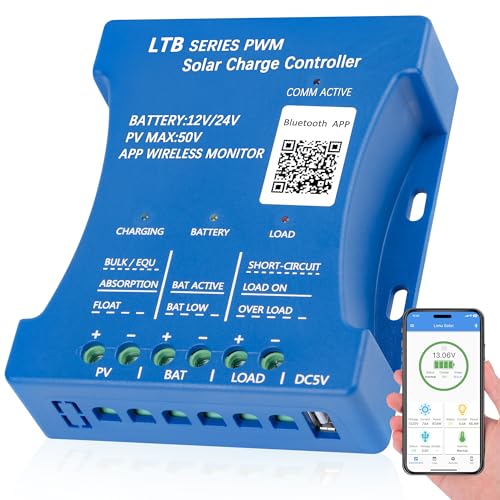
- Bluetooth app monitoring
- LiFePO4 and lithium support
- Seven load modes plus USB output
Best For: DIY systems needing flexible load control
Best Overall – Renogy Rover 30A MPPT
The Renogy Rover 30A is a versatile solar charge controller for lithium batteries and 12V/24V systems. Its MPPT design supports up to 400W at 12V or 800W at 24V, while the adjustable LCD and lithium reactivation feature make it practical for RVs, cabins, and marine installations.
Best For: RV, marine, and off-grid users who want MPPT efficiency, lithium support, and an onboard display.
Pros:
- Supports lithium, gel, sealed, and flooded batteries.
- Handles up to 100V solar input and offers dual-peak MPPT tracking.
- Includes adjustable settings, LCD monitoring, protection features, and four-stage charging.
- Compatible with the optional BT2 Bluetooth module.
Cons:
- Bluetooth monitoring requires the separately sold BT2 module.
- Larger and more feature-heavy than a basic PWM controller.
Choose the Rover when you need a capable, configurable controller that can grow with a 12V or 24V lithium solar system. Its broad battery compatibility and weather-oriented protections add flexibility for mobile and remote installations.
Best for Larger Systems – Victron SmartSolar 100/50
The Victron Energy SmartSolar 100V, 50A is a strong solar charge controller for lithium batteries when higher charging capacity and app-based configuration matter. Its fast MPPT tracking, Bluetooth connectivity, and synchronized multi-controller operation suit expandable solar systems.
Best For: Larger 12V/24V installations that need 50A charging capacity, system monitoring, and coordinated controllers.
Pros:
- 50A MPPT capacity with a 100V solar input rating.
- VictronConnect provides real-time data, 30-day history, configuration, firmware updates, and alarms.
- Multiple units can synchronize their charging stages.
- Configurable load output can disconnect loads when battery voltage falls too low.
Cons:
- Has no built-in display.
- Its larger size and higher capacity may be unnecessary for small systems.
This model is a practical choice for users building a more capable or expandable battery system. The app replaces a physical screen, providing detailed monitoring and settings through a compatible mobile device.
Best Budget 12V Option – Renogy Wanderer Li 30A PWM
The Renogy Wanderer Li 30A is a straightforward 12V solar charge controller for lithium batteries and compatible lead-acid chemistries. Its PWM charging approach, LED indicators, compact housing, and built-in protections make it a practical fit for smaller RV, boat, and off-grid systems.
Best For: Cost-conscious 12V users who want lithium support, simple LED status information, and compact installation.
Pros:
- Supports LiFePO4, AGM, gel, and flooded batteries.
- Provides 30A bulk, boost, float, and automatic equalization charging stages.
- Compact IP32-rated housing supports wall or DIN-rail mounting.
- Includes reverse-polarity, overcharge, overload, and short-circuit protection.
Cons:
- PWM technology is less efficient than MPPT in many installations.
- Designed for 12V systems rather than automatic 12V/24V operation.
- Bluetooth monitoring requires the separately sold BT-1 module.
For a compact 12V setup, the Wanderer Li keeps operation simple while offering chemistry-specific charging and useful protection features. Consider an MPPT model instead if maximizing solar harvest or supporting a higher-voltage array is a priority.
Best Compact MPPT – Victron SmartSolar 75/15
The Victron Energy SmartSolar 75V, 15A is a compact solar charge controller for lithium batteries in smaller 12V/24V systems. It combines MPPT tracking, Bluetooth access through VictronConnect, and a configurable load output in a space-saving design.
Best For: Compact solar installations with modest charging requirements and a preference for app-based monitoring.
Pros:
- MPPT tracking helps maximize available solar power, including during partial shading.
- Supports 12V/24V systems with a 75V solar input rating and 15A output.
- VictronConnect offers real-time information, performance history, settings, updates, and alarms.
- Multiple controllers can synchronize charging stages.
Cons:
- 15A capacity limits it to smaller solar arrays.
- Does not provide a full onboard display.
- Its 75V input rating is lower than the 100V model in this roundup.
This controller is a good match when installation space and system size are limited. Its app connectivity gives you useful visibility without requiring a large front-panel display, while MPPT offers an efficiency advantage over basic PWM designs.
Best All-Around MPPT – Renogy Rover 20A
The Renogy Rover 20A is a versatile solar charge controller for lithium batteries, supporting 12V and 24V systems with automatic voltage detection. Its MPPT design, LCD monitoring, lithium recovery function, and broad battery compatibility make it a practical choice for RV, marine, and off-grid setups.
Best For: RVs, boats, and off-grid solar systems using 12V or 24V lithium, gel, sealed, or flooded batteries.
Pros:
- Supports 12V and 24V systems with up to 260W or 520W of solar input, respectively.
- Works with lithium, gel, sealed, and flooded batteries.
- LCD shows real-time voltage, current, and error information.
- Includes protection features, four-stage charging, load scheduling, and optional Bluetooth monitoring.
Cons:
- Bluetooth monitoring requires the separately sold BT2 module.
- It is limited to 20A of charging current.
- Designed for compatible 12V/24V panels with Voc no higher than 100V.
Choose the Rover 20A if you want a feature-rich controller with a clear display and flexible battery support. Its 20A capacity is best matched to smaller or mid-sized solar arrays rather than high-power installations.
Best for Remote Monitoring – LiTime 30A MPPT
The LiTime 30A is a solar charge controller for lithium batteries built around 12V and 24V systems. It combines MPPT tracking, a built-in Bluetooth module, an LCD screen, and a 30A rating, making it suitable for users who want more charging capacity and convenient system monitoring.
Best For: LiFePO4 battery systems, RVs, and off-grid installations that benefit from built-in Bluetooth monitoring.
Pros:
- Built-in Bluetooth provides remote access to operating information without an additional module.
- 30A MPPT capacity supports up to 450W at 12V or 900W at 24V.
- LCD controls and LED indicators show solar, battery, load, and controller status.
- Die-cast aluminum construction helps dissipate heat, with multiple electrical protections.
Cons:
- Has a shorter two-year warranty than some competing controllers.
- The listed dimensions and 4.4-pound weight may require more installation space.
- Battery parameters must be adjusted when using sealed, gel, or other lead-acid batteries.
The LiTime 30A stands out when built-in connectivity and higher system capacity matter. It is especially appealing for LiFePO4 setups, while its adjustable settings preserve compatibility with several lead-acid battery types.
Best Compact 12V Option – Bateria Power SunRock 10
The Bateria Power SunRock 10 is a compact solar charge controller for lithium batteries in 12V systems. Its 10A MPPT design, LCD display, SAE connectors, and protective charging features make it a convenient option for small portable solar setups, provided the battery and panel voltage limits are observed.
Best For: Compact 12V solar systems using LiFePO4, AGM, gel, sealed, flooded, or other lead-acid batteries.
Pros:
- Small 3.7-by-2.42-by-1.06-inch design is easy to carry and install.
- Compatible with several 12V battery types, including LiFePO4 and lead-acid chemistries.
- LCD display and LED indicator help monitor system operation.
- SAE plug-and-play connections and two extension cables simplify setup.
Cons:
- Designed only for 12V batteries and should not be connected to higher-voltage batteries.
- Solar panel Voc must stay between the stated minimum requirement and 30V maximum.
- The 10A rating and 150W maximum PV input limit it to smaller systems.
This controller is a good fit when portability and straightforward SAE connectivity are more important than expansion capacity. Confirm the battery voltage and panel Voc before installation, and use the recommended battery-first connection sequence.
Best Flush-Mount PWM Controller – Renogy Adventurer 30A
If you need a practical solar charge controller for lithium batteries in an RV or other compact off-grid setup, the Renogy Adventurer 30A is a space-conscious PWM option. It supports 12V and 24V systems, includes an LCD, and is designed for flush mounting.
Best For: RV, marine, and off-grid users who want an integrated wall-mounted controller with local status monitoring.
Pros:
- Automatically detects 12V or 24V systems and supports lithium, sealed, gel, and flooded batteries.
- Provides bulk, boost, float, and equalization charging phases, with lithium battery reactivation noted by the manufacturer.
- Includes a backlit LCD, temperature compensation, protective features, and a two-year warranty.
Cons:
- PWM technology may be less efficient than an MPPT controller in some solar-panel conditions.
- The listed operating-temperature detail is limited compared with the more extensive range specified for the Rover model.
The flush-mount design and built-in display make this a convenient choice when installation space and at-a-glance information matter more than maximum charging efficiency.
Best MPPT Upgrade – Renogy Rover 40A
For shoppers seeking a higher-efficiency solar charge controller for lithium batteries, the Renogy Rover 40A uses MPPT technology and supports 12V or 24V systems. Its stated 98% conversion rate and 99% tracking efficiency make it suited to installations where harvesting more available solar power is a priority.
Best For: Off-grid solar users who want MPPT performance, broad battery compatibility, and monitoring through the optional Renogy DC Home App connection.
Pros:
- 40A MPPT controller with stated 98% conversion and 99% tracking efficiency.
- Supports lithium, AGM, gel, and flooded batteries, with two-stage lithium charging and four-stage lead-acid charging.
- Offers 12V/24V auto-detection, extensive electrical protections, a remote temperature sensor, and a three-year warranty.
Cons:
- Bluetooth monitoring requires the separately sold BT-2 accessory.
- MPPT capability generally makes this a more feature-rich choice than a basic PWM controller.
Choose the Rover when panel conditions vary or available solar energy is valuable. Its app connectivity is expandable, but remote monitoring is not fully included without the additional Bluetooth accessory.
Best App-Controlled Budget Option – 30A Bluetooth PWM Controller
This 30A PWM solar charge controller for lithium batteries stands out for its Bluetooth app, flexible load scheduling, and support for LiFePO4 and other lithium battery types. It automatically matches 12V or 24V systems and adds a 5V USB output for small devices.
Best For: DIY solar users who want app-based monitoring, programmable load behavior, and a straightforward 30A controller for smaller systems.
Pros:
- Supports sealed, gel, flooded, LiFePO4, and lithium battery settings.
- Provides app access to charging status, battery type, parameters, and device information.
- Includes seven load modes, multiple protection functions, and a 5V/1.5A USB port.
Cons:
- It uses PWM charging rather than MPPT technology.
- The notes specify that automatic voltage matching is applicable to non-lithium batteries, so lithium setup may require careful configuration.
- The supplied information does not list a warranty or operating-temperature range.
Its app and scheduling options offer useful control for a budget-oriented system. Pay particular attention to the battery-type settings during installation, especially when configuring a lithium battery.
How We Picked the Best Solar Charge Controller for Lithium Batteries
We focused on controllers suited to lithium and LiFePO4 battery systems, with attention to charging technology, voltage compatibility, solar input capacity, monitoring, adjustability, and installation practicality. The selection includes MPPT models for improved energy harvest, PWM models for simpler and often more affordable installations, and controllers with Bluetooth or built-in LCD displays.
Always confirm the manufacturer’s lithium charging profile before connecting a battery. “Lithium compatible” can mean different things, and some batteries require manually adjustable absorption, float, and low-voltage disconnect settings.
Quick Comparison
| Type | Best For | Typical Advantage | What to Check |
|---|---|---|---|
| MPPT | Higher-output or space-limited systems | Better energy harvesting, especially in changing conditions | PV voltage, current, and battery-profile settings |
| PWM | Small, budget-conscious systems | Simple installation and lower upfront cost | Panel voltage matching and lithium support |
| Bluetooth-enabled | Remote monitoring | Convenient viewing and configuration | App compatibility and connection range |
| LCD-equipped | On-site checks | Immediate access to basic system information | Display readability and mounting location |
Key Buying Factors for a Solar Charge Controller for Lithium Batteries
Battery Voltage and Chemistry
Match the controller to your battery bank’s nominal voltage, commonly 12V or 24V. Confirm support for lithium-ion or LiFePO4 batteries rather than assuming a sealed or gel setting is suitable. Lithium batteries generally need a different charging profile and may not require traditional float charging.
MPPT Versus PWM
MPPT controllers are usually the stronger choice when panel output matters, temperatures vary, or roof space is limited. PWM can work well for small systems when the panel voltage closely matches the battery voltage and cost is the priority.
Current and Solar Input Limits
Choose a controller with enough output current for the solar array and enough headroom for your intended expansion. Check maximum PV voltage, maximum PV wattage, and whether the limits change between 12V and 24V operation. Exceeding the input rating can damage the controller.
Settings, Monitoring, and Installation
Adjustable parameters are valuable when the battery manufacturer specifies custom charging values. Bluetooth is useful for systems installed in enclosed compartments, while an LCD or remote display helps with quick checks. Also verify grounding requirements, wire size, fuse placement, terminal capacity, and environmental protection.
Who Should Buy Which Solar Charge Controller for Lithium Batteries?
Choose a compact PWM model for a basic 12V setup, modest panel array, and lowest purchase cost. Select a smaller MPPT controller for portable power stations, compact RV systems, or users who want better harvest from limited panel space. A 30A MPPT model is a versatile fit for many mid-sized 12V or 24V installations, while 40A and 50A units make more sense for larger arrays or planned expansion.
Buy a Bluetooth-equipped controller if you want to monitor charging without opening a battery compartment. An LCD-equipped model is preferable when you need direct, on-device status information. Regardless of the feature set, prioritize a verified lithium charging profile, adequate electrical ratings, and compatibility with your panel and battery manufacturer’s specifications.