Choosing among the best drill presses for model making means balancing precision, speed control, work area, and footprint. A compact press can make cleaner, more repeatable holes than a handheld drill, especially when working with wood, plastic, metal, or small-scale assemblies.
This roundup compares 10 options, including micro drill presses, rotary-tool stands, and sturdier benchtop machines. Use the guide below to match the press’s capabilities with your materials, project size, and available workspace.
Table of Contents
- Best 10 Drill Presses for Model Making Picks for 2026
- Best Precision Micro Drill Press – PROXXON TBM 115
- Best Rotary-Tool Workstation – Dremel 220-01
- Best Full-Size Benchtop Option – WEN 4206T
- Best X-Y Micro Positioning Press – Precision Mini Drill Press
- Compact Crafting Choice – Multi-Purpose Mini Drill Press
- Power Workshop Pick – 710W Six-Speed Bench Drill Press
- Fine Detail Specialist – Precision Variable-Speed Mini Press
- Best High-Speed Depth Control – Upgrade Mini Benchtop Drill Press
- Best Compact Precision Setup – Precision Mini Drill Press B10
- Best Visibility and Workholding – Mini Benchtop Drill Press
- How We Picked the Best Drill Presses for Model Making
- Quick Comparison
- Key Buying Factors for Drill Presses for Model Making
- Who Should Buy Which Drill Presses for Model Making?
Best 10 Drill Presses for Model Making Picks for 2026
Best Precision Micro Drill Press

- Drills holes down to 1/64 inch (0.5 mm)
- Six precision collets included
- Three speeds with adjustable fence and depth gauge
Best For: Intricate miniature parts and very small precision holes
Best Rotary-Tool Workstation

- Supports perpendicular and angled drilling
- Up to 2-inch drilling depth
- Fits multiple Dremel rotary-tool models
Best For: Dremel owners needing a portable, multipurpose stand
Best Full-Size Benchtop Option
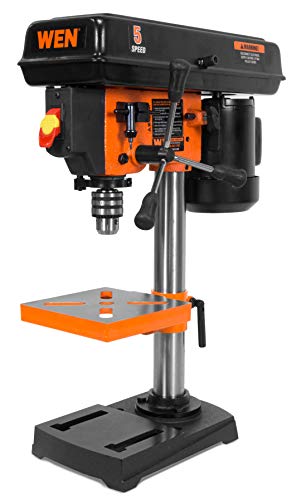
- Five speeds from 750 to 3,200 RPM
- 8-inch swing with 2-inch spindle travel
- Cast-iron base and beveling adjustable table
Best For: Larger model parts and general-purpose bench work
Best X-Y Micro Positioning Press
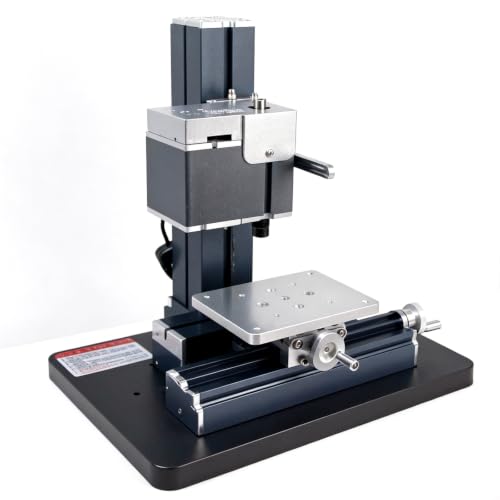
- X-Y-Z table reduces repeated re-clamping
- 0.02 mm handwheel graduations
- 20,000 RPM with 1–6 mm chuck range
Best For: Precise layouts on models, PCBs, acrylic, and small parts
Compact Crafting Choice
Multi-Purpose Mini Drill Press

- Metal frame with stable three-axis design
- Variable-speed motor up to 7,000 RPM
- Includes bits, flex shaft, slide table, and power supply
Best For: Toy models, jewelry, watch repair, and small DIY crafts
Power Workshop Pick
710W Six-Speed Bench Drill Press
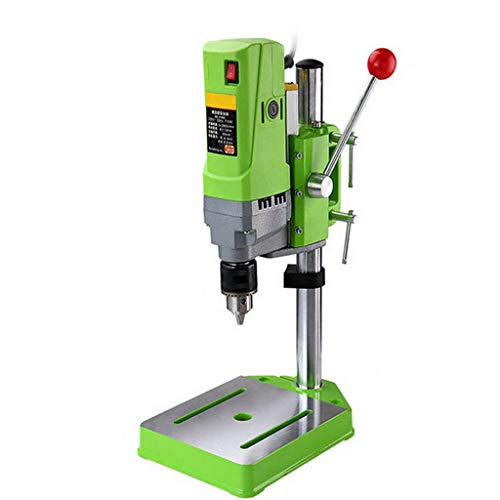
- 710W motor for wood, plastic, and metal
- Six speeds from 0 to 2,800 RPM
- 1.5–13 mm chuck and stable metal base
Best For: Home workshops and larger model-making workpieces
Fine Detail Specialist
Precision Variable-Speed Mini Press

- Variable speed from 400 to 4,500 RPM
- Stable aluminum-alloy body and non-skid base
- Designed for wood, resin, plastics, and soft metal
Best For: Small precision holes in lightweight model components
Best High-Speed Depth Control
Upgrade Mini Benchtop Drill Press
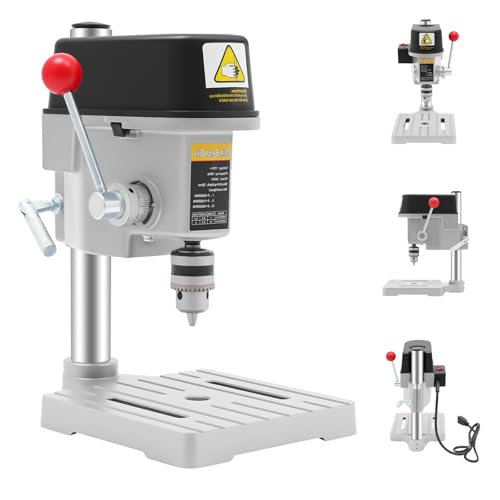
- Three speed ranges up to 16,000 rpm
- Marked depth control up to 0.98 inches
- Stable steel-and-cast-iron desktop design
Best For: Fast, controlled drilling in small model-making projects
Best Compact Precision Setup
Precision Mini Drill Press B10

- Compact 5.9-by-4.7-by-8.7-inch footprint
- Adjustable speed up to 7,000 rpm
- Includes vise and 10-piece HSS bit set
Best For: Small-scale modeling and craft work in limited bench space
Best Visibility and Workholding

- Work light and locking depth control
- Seven-speed operation for small projects
- Vise clamps parts from 1 to 55 mm
Best For: Illuminated, repeatable drilling of small and irregular parts
Best Precision Micro Drill Press – PROXXON TBM 115
For model makers who need clean, repeatable micro holes, the PROXXON TBM 115 is a focused choice among drill presses for model making. It supports holes down to 1/64 inch (0.5 mm), includes six precision collets, and offers three spindle speeds for different materials and torque needs.
Best For: Detailed hobby work involving very small holes, miniature parts, and precision layouts.
Pros:
- Drills micro holes down to 1/64 inch (0.5 mm).
- Includes an adjustable fence with scale and a depth gauge.
- Three spindle speeds accommodate different materials and torque requirements.
- Ribbed die-cast aluminum table and hard-chromed steel column provide a stable platform.
Cons:
- Its listed 0.5 mm drilling capacity is specialized for small-scale work rather than larger holes.
- The corded, 85-watt design is aimed at detailed hobby use.
The TBM 115 stands out when accuracy and tiny drill sizes matter more than broad workshop capacity. Its included collet set and adjustable work controls make it particularly well suited to miniature construction and intricate model details.
Best Rotary-Tool Workstation – Dremel 220-01
The Dremel 220-01 is a compact workstation for model makers who already use a compatible Dremel rotary tool. As an option among drill presses for model making, it provides perpendicular or angled drilling, a depth stop, and a portable metal base for controlled small-project work.
Best For: Dremel owners who want a flexible drill stand for straight holes, angled holes, and other rotary-tool tasks.
Pros:
- Drills perpendicular holes and angles in 15-degree increments up to 90 degrees horizontal.
- Provides up to 2 inches of drill depth with a depth stop.
- Compatible with several Dremel models, including the 4300, 4000, 3000, 8250, 8240, and 8220.
- Includes measurement markings, cord clips, and a base with four clamping points.
Cons:
- Requires a compatible Dremel rotary tool; it is a stand rather than a complete drill press.
- The 2-inch depth capacity may limit deeper work.
This workstation makes sense when versatility and portability are priorities. It can support drilling, sanding, grinding, and polishing, but its usefulness depends on having a compatible Dremel tool available.
Best Full-Size Benchtop Option – WEN 4206T
The WEN 4206T brings the familiar format of a full benchtop drill press to model-making benches and general hobby shops. Compared with compact drill presses for model making, its 8-inch swing, cast-iron construction, adjustable table, and five speeds offer more room and flexibility for larger model components.
Best For: Model makers who need a sturdier general-purpose press for wood, metal, and larger workpieces.
Pros:
- Five speed settings range from 750 to 3,200 RPM.
- Offers an 8-inch swing and 2-inch spindle travel.
- Height-adjustable 6.5-by-6.5-inch table bevels up to 45 degrees in either direction.
- Cast-iron construction, a 7-by-11-inch base, and a 1/2-inch keyed chuck support general-purpose work.
Cons:
- At 32 pounds and nearly 23 inches tall, it is less portable than compact presses.
- The 1/2-inch keyed chuck and larger format may be more machine than needed for tiny details.
The 4206T is the practical choice when model making overlaps with broader workshop tasks. Its adjustable table and five-speed range provide useful flexibility, while the larger footprint favors a dedicated bench over a portable setup.
Best X-Y Micro Positioning Press – Precision Mini Drill Press
This all-metal mini press is designed for model makers who value controlled positioning and repeatable layouts. Among drill presses for model making, its X-Y-Z table, 0.02 mm handwheel graduations, dual feed controls, and 1–6 mm chuck range make it suited to small parts, acrylic, plastics, PCB work, and soft metals.
Best For: Detailed layouts requiring repeated hole placement without constantly re-clamping the workpiece.
Pros:
- X travel is 145 mm, while Y and Z each travel 40 mm on the 120-by-100 mm table.
- Handwheels use 0.02 mm scale graduations for fine incremental adjustments.
- 20,000 RPM motor and 1–6 mm chuck support micro drilling in several listed materials.
- Compact all-metal construction and 12V operation suit hobby rooms, workshops, and classrooms.
Cons:
- Its 36-watt motor and 6 mm chuck range are intended for small-scale work, not heavy drilling.
- Only one speed is listed.
- The press should be secured to a stable bench before use.
The strongest reason to choose this press is its positioning system. It offers more direct control over hole spacing than a basic compact stand, making it a compelling fit for precision model layouts and repeated small-part work.
Compact Crafting Choice – Multi-Purpose Mini Drill Press
For model makers who need a compact tool for small drilling and detail work, this mini drill press combines a metal frame, variable-speed control, and included accessories. Its 6 mm chuck, 40 mm drilling stroke, and quiet operation make it suited to lightweight craft projects.
Best For: Toy models, jewelry, watch repair, wood, and other small DIY projects.
Pros:
- Compact benchtop design with a solid metal framework, linear bearings, and dual springs.
- Variable-speed 795 DC motor reaches up to 7,000 RPM.
- Includes HSS drill bits, a rotary-tool flex shaft, slide table, and adjustable power supply.
- Base supports optional accessories such as a mini vise or CNC sliding table.
Cons:
- Its 6 mm chuck and 40 mm stroke limit it to relatively small work.
- The supplied specifications list one speed despite the adjustable power supply.
- Less suitable for heavy-duty drilling than larger bench machines.
This is a flexible choice among drill presses for model making when accessory versatility and a small footprint matter more than large drilling capacity.
Power Workshop Pick – 710W Six-Speed Bench Drill Press
Model makers working with thicker wood, plastic, or occasional metal will appreciate this bench drill press’s 710W motor, cast-iron base, and six-speed range. Its 1.5–13 mm chuck accommodates a broad selection of standard drill bits.
Best For: Home workshops and model-making projects requiring more power or larger bits.
Pros:
- 710W motor provides strong, stable performance for wood, metal, and plastic.
- Six-speed adjustment covers 0–2,800 RPM for different materials and thicknesses.
- 1.5–13 mm chuck offers wider bit compatibility than the smaller mini presses.
- Heavy-duty metal base helps reduce movement and drilling deviation.
Cons:
- Heavier and less compact at 11.4 pounds.
- Its listed metal drilling capacity is 8 mm, so it is not intended for very heavy metalwork.
- The supplied dimensions appear inconsistent with a typical full-size benchtop machine.
Choose this model if your drill presses for model making shortlist prioritizes motor power, chuck capacity, and a stable base over minimum size and portability.
Fine Detail Specialist – Precision Variable-Speed Mini Press
This precision mini drill press is designed for very small holes in wood, plastics, resin, aluminum, and composite panels. With continuously variable speed from 400 to 4,500 RPM and a solid, non-skid base, it fits detailed model-making tasks where control is more important than high power.
Best For: Fine holes in plastic, resin, wood, soft metal, and lightweight model components.
Pros:
- Continuously variable speed allows adjustment from 400 to 4,500 RPM.
- Aluminum-alloy body and CNC-processed parts are designed for stability.
- Thickened base helps reduce vibration, noise, and slipping.
- Compact 3.94 x 3.15 x 7.09-inch form factor suits small workspaces.
Cons:
- Limited to approximately 4 mm in wood and plastics and 1–3 mm in soft metal.
- Requires a separate 3–12V power source, with 12V/5A recommended.
- Its 30W motor is intended for non-hard materials rather than demanding drilling.
For delicate model-making work, this is one of the more focused drill presses for model making, especially when precise low-speed control and a small footprint are priorities.
Best High-Speed Depth Control – Upgrade Mini Benchtop Drill Press
For model makers who want fast, repeatable drilling in a compact format, this mini press combines a sturdy steel-and-cast-iron build with three speed settings. Its marked handle dial also makes it easier to control drilling depth on small wood, metal, and craft projects.
Best For: Model makers needing high-speed drilling and adjustable depth control for wood, jewelry, and light metal work.
Pros:
- Three speed ranges from 8,000 to 16,000 rpm support different materials and drill sizes.
- Marked handle dial helps control drilling depth up to 0.98 inches.
- Thickened base and sturdy support column improve stability during operation.
- Accepts drill bits from 1 to 10 mm.
Cons:
- Drill bits are not included.
- Its stated drilling capacity is limited to 0.63 inches in wood and 0.24 inches in metal.
- The maximum speed may be more than needed for delicate materials.
With its unusually high top speed, compact desktop form, and visible depth adjustment, this is a practical choice for model makers prioritizing quick, controlled drilling. Check the listed capacity before using it on thicker stock.
Best Compact Precision Setup – Precision Mini Drill Press B10
This compact B10 machine is a strong fit for drill presses for model making when bench space is limited. Its metal frame, linear bearings, adjustable 24V supply, included vise, and small HSS bit set create a ready-to-use setup for precise work on wood, plastic, resin, aluminum, and similar materials.
Best For: Space-conscious model makers and hobbyists working on small parts, crafts, jewelry, toys, or repair projects.
Pros:
- Compact 5.9-by-4.7-by-8.7-inch footprint suits small workspaces.
- Metal three-axis structure and two linear bearings are designed to reduce vibration.
- Adjustable power supply provides speed control up to 7,000 rpm.
- Includes a metal vise and 10-piece HSS twist bit set.
Cons:
- Its 6 mm chuck limits compatible bit sizes.
- The 40 mm maximum drilling stroke is intended for small workpieces.
- It is designed for soft materials and light-duty drilling rather than heavy stock.
The included accessories and small footprint make this one of the more complete options for detailed bench work. Its 6 mm capacity and 40 mm stroke are the main constraints, but they match many small-scale modeling tasks.
Best Visibility and Workholding – Mini Benchtop Drill Press
For model makers who value visibility and flexible workholding, this mini press adds a work light, depth scale, locking depth ring, and included vise. Its seven-speed control is suited to basswood, balsa, resin, plastic, PCB material, and soft metals such as thin aluminum and copper.
Best For: Model-making projects that benefit from illuminated depth readings and clamping irregularly shaped small parts.
Pros:
- Work light helps illuminate the scale and drilling area.
- Locking depth ring and scaled column support repeatable drilling.
- Included vise clamps pieces from 1 to 55 mm, including irregular shapes.
- Seven-speed control and rear-mounted motor support controlled operation.
Cons:
- Maximum chuck capacity is 6 mm.
- Listed drilling depth is about 1.3 inches, with a 3.5 cm drilling stroke.
- Its recommended materials are non-rigid materials and soft metals, not heavy stock.
The work light and depth features are useful for detailed model making, while the broad vise range adds versatility for small parts. Keep drilling passes shallow and use cooling when working with metal, as recommended by the manufacturer.
How We Picked the Best Drill Presses for Model Making
We focused on features that matter for miniature construction and detail work: controllable spindle speed, stable construction, adjustable depth, compact dimensions, useful table movement, and compatibility with small drill bits. We also considered whether each machine is better suited to light hobby work, repeated drilling, or projects involving tougher materials.
Because the products vary widely, this list includes both dedicated precision mini presses and larger benchtop models. A rotary-tool workstation can be convenient for occasional tasks, while a cast-iron drill press generally offers more stability and capacity.
Quick Comparison
| Type | Best for | Key advantage |
|---|---|---|
| Micro drill press | Small holes and delicate parts | Fine control and compact size |
| Rotary-tool stand | Occasional hobby drilling | Uses a compatible rotary tool |
| Mini benchtop press | General model-making tasks | Balanced precision and versatility |
| Larger benchtop press | Wood, metal, and repeated work | Greater stability and capacity |
Key Buying Factors for Drill Presses for Model Making
Speed and Control
Variable or multiple speed settings are valuable when switching between plastic, wood, aluminum, and other materials. Slower speeds can help with larger bits and harder materials, while higher speeds suit small bits and some plastics. Check that the available range matches your typical projects.
Accuracy and Depth Control
Look for a firm quill, minimal spindle play, an adjustable depth stop, and a table that stays square. These features help produce consistent holes and prevent accidentally drilling through thin parts. A handwheel or controlled feed is often easier to manage than a loose lever for miniature work.
Table and Workholding
An adjustable table, X-Y positioning table, or usable fence can make alignment much easier. Confirm the table dimensions and movement range before buying. For small parts, use clamps or a dedicated vise rather than holding the work by hand.
Chuck and Bit Compatibility
Check the chuck’s minimum and maximum capacity. Micro presses may favor very small bits, while general-purpose models accept broader sizes. If you already own specialty bits, verify the shank range and whether adapters are required.
Stability, Noise, and Workspace
A heavier cast-iron base usually reduces vibration, but it also takes more bench space. Compact machines are easier to store and maneuver, yet may need to be clamped down for accurate drilling. Measure your workspace and consider access to power and lighting.
Who Should Buy Which Drill Presses for Model Making?
Choose a dedicated micro press if your projects involve tiny holes, delicate components, or frequent precision drilling. A mini benchtop model is the most flexible choice for hobbyists who work across wood, plastic, and light metal. A rotary-tool stand makes sense for occasional users who already own a compatible Dremel-style tool. Select a larger cast-iron benchtop press if stability, deeper drilling, larger bits, or repeated work matter more than portability.
Whichever model you choose, secure the machine and workpiece, wear eye protection, and match the speed and bit to the material. For model making, controlled setup and repeatable alignment often matter more than maximum motor power.