Finding a safe way to lift a low-clearance vehicle can make routine maintenance much easier. The best car ramps for low cars provide a gradual approach, dependable traction, and enough capacity for your vehicle.
We compare 10 options across lift height, weight rating, ramp design, portability, and garage usability so you can choose a set that fits your car and maintenance needs.
Table of Contents
- Best 10 Car Ramps for Low Cars Picks for 2026
- Best Low-Profile Value – Black Widow 2.5-Inch Car Ramps
- Best Detachable Design – Megan Racing Low-Profile Service Ramps
- Best for Underbody Access – MaxxHaul 6.25-Inch Car Ramps
- Best Heavy-Duty Capacity – Ironton Poly Car Ramp Set
- Best for Easy Setup – MaxxHaul 50516 Car Ramps
- Best for Maximum Lift – MaxxHaul 50947 Stackable Ramps
- Best Wide Lightweight Option – HOXWELL Low-Profile Car Ramps
- Best Overall – Amazon Basics Low Profile Car Ramps
- Best Heavy-Duty Pick – ROBLOCK Low Profile Car Ramps
- Best Low-Lift Option – VEVOR Portable Car Service Ramps
- How We Picked the Best Car Ramps for Low Cars
- Quick Comparison
- Key Buying Factors for Car Ramps for Low Cars
- Who Should Buy Which Car Ramps for Low Cars?
Best 10 Car Ramps for Low Cars Picks for 2026
Best Low-Profile Value
Black Widow 2.5-Inch Car Ramps

- Gentle 9.05-degree loading angle
- 2.5-inch lift for basic service
- 10,000-pound total vehicle capacity
Best For: Low-clearance cars needing a modest lift
Best Detachable Design
Megan Racing Low-Profile Service Ramps
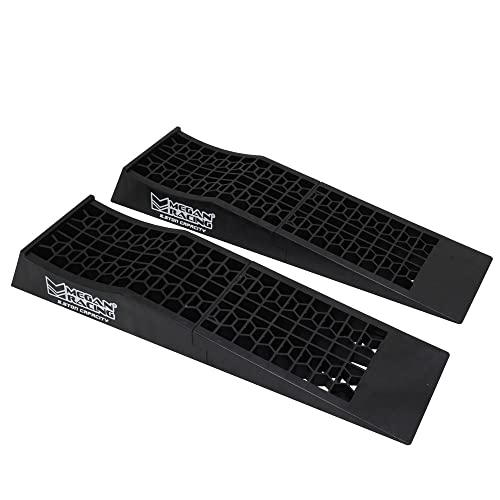
- Detaches into four pieces
- 2.56-inch lift
- 5,000-pound rating per side
Best For: Low-profile cars and compact ramp storage
Best for Underbody Access

- 6.25-inch lift height
- 6,500-pound pair capacity
- Grooved surface and rubber stops
Best For: More spacious underbody maintenance access
Best Heavy-Duty Capacity

- 12,000-pound pair capacity
- Wide 12-inch tread
- Non-skid surface and rubber feet
Best For: Mixed vehicle households needing high capacity
Best for Easy Setup

- 9.05-degree loading angle for low-clearance vehicles
- 4,400-pound capacity per pair
- 2.5-inch lift with honeycomb drainage channels
Best For: Routine maintenance on low-clearance cars
Best for Maximum Lift
MaxxHaul 50947 Stackable Ramps

- 6.7-inch lift for generous underbody clearance
- 6,500-pound capacity per pair
- Stackable with handles and ribbed traction surface
Best For: Heavier vehicles and maintenance needing extra clearance
Best Wide Lightweight Option

- 10-inch width for wider tires
- 2.6-inch lift for low-chassis cars
- Lightweight 5.3-pound pair with traction features
Best For: Sports cars, tuners, and modified vehicles
Best Overall
Amazon Basics Low Profile Car Ramps
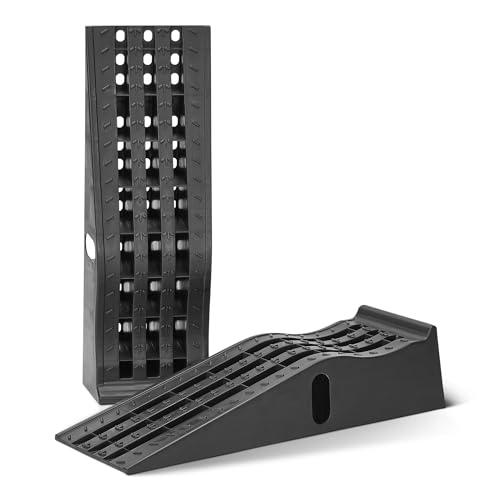
- 3,250-lb capacity per ramp
- Textured traction and rubber base stops
- Lightweight reinforced plastic construction
Best For: Routine home-garage maintenance
Best Heavy-Duty Pick

- 6.1-inch lift with 13,000-lb GVW rating
- 12-inch width for wider wheels
- Drainage, tire grooves, and non-slip pads
Best For: SUV, pickup, and light-truck maintenance
Best Low-Lift Option
VEVOR Portable Car Service Ramps

- 2.56-inch lift for lower-clearance use
- 4,000-lb capacity per ramp
- Lightweight, stackable PP construction
Best For: Portable oil changes and inspections
Best Low-Profile Value – Black Widow 2.5-Inch Car Ramps
For drivers searching for car ramps for low cars, the Black Widow pair offers a gentle 9.05-degree loading angle and a modest 2.5-inch lift. The lightweight plastic, honeycomb construction is suited to oil changes and basic underbody access, but vehicle clearance and total weight should be confirmed before use.
Best For: Low-clearance cars needing a small lift for oil changes and routine service.
Pros:
- Gentle approach angle accommodates many low vehicles.
- 10,000-pound total vehicle capacity, rated at 5,000 pounds per axle.
- Honeycomb plastic construction helps reduce moisture buildup.
- Includes a slight tire stop to signal the ramp edge.
Cons:
- Provides only a 2.5-inch lift.
- Vehicle clearance and gross weight must be checked before use.
- A spotter is recommended to help prevent roll-offs.
The low lift and compact dimensions make these practical for simple maintenance where maximum underbody room is not required. Their capacity is substantial, but careful positioning and safe loading remain important.
Best Detachable Design – Megan Racing Low-Profile Service Ramps
The Megan Racing ramps are a versatile option among car ramps for low cars, combining a low-profile drive-on design with detachable sections. Each side raises a vehicle 2.56 inches, while the high-strength plastic composite construction is rated for up to 5,000 pounds per side.
Best For: Low-profile cars and users who value ramps that separate into four pieces for handling or storage.
Pros:
- Low-profile design is intended for cars with limited clearance.
- Detaches into four pieces for easier handling or storage.
- Raises vehicles approximately 2.56 inches.
- Rated at 5,000 pounds per side.
Cons:
- The lift is limited compared with taller service ramps.
- Plastic composite construction may not suit buyers seeking steel ramps.
- Vehicle and axle compatibility should be confirmed before use.
This set stands out for its detachable format rather than a high lift height. It is a sensible fit for light-duty access under low cars when compact handling is a priority.
Best for Underbody Access – MaxxHaul 6.25-Inch Car Ramps
When car ramps for low cars need to provide more working room, the MaxxHaul 50515 delivers a 6.25-inch lift. Its deep-grooved surface adds tire traction, while rubber stops help reduce movement during loading and the pair supports up to 6,500 pounds.
Best For: Drivers who want significantly more underbody clearance for repairs and maintenance.
Pros:
- 6.25-inch lift provides more underside access.
- 6,500-pound capacity for the pair.
- Deep-grooved surface supports stable tire placement.
- Rubber stops help prevent slipping or movement.
Cons:
- Higher 8.25-inch overall height may be less suitable for extremely low vehicles.
- Each ramp weighs about 10 pounds, making the pair less lightweight.
- Limited 90-day manufacturer warranty.
The taller profile is useful once a vehicle can climb onto the ramps, but approach compatibility deserves extra attention for very low cars. For suitable vehicles, the added lift offers a meaningful advantage over low-rise designs.
Best Heavy-Duty Capacity – Ironton Poly Car Ramp Set
The Ironton set is a heavy-duty choice among car ramps for low cars, with a 12,000-pound pair capacity and a 12-inch-wide tread. High-impact poly construction, a non-skid surface, and rubber feet are designed to support steady loading across cars, trucks, SUVs, and vans.
Best For: Households that need one ramp set for low-clearance cars as well as heavier trucks and SUVs.
Pros:
- 12,000-pound capacity for the pair.
- Wide 12-inch tread accommodates a broad range of tire widths.
- Non-skid tread pattern improves tire grip during loading.
- Rubber feet help anchor the ramps to the ground.
Cons:
- 8.5-inch overall height may not suit every extremely low car.
- Heavier than compact low-rise ramp designs at 20.6 pounds per pair.
- Approach clearance should still be verified before use.
These ramps prioritize capacity and broad vehicle compatibility over minimal size. They are a strong choice for mixed vehicle ownership, provided the car’s approach angle and clearance work with the ramp height.
Best for Easy Setup – MaxxHaul 50516 Car Ramps
MaxxHaul 50516 4,400 lb. Capacity Low Profile Car Ramps, 2-Count, Black (Pack of 1)
Check Price On AmazonFor shoppers comparing car ramps for low cars, the MaxxHaul 50516 offers a gentle 9.05-degree loading angle and a 2.5-inch lift height. Its plastic honeycomb construction is sized for routine maintenance and underside access.
Best For: Low-clearance vehicles needing modest lift for routine garage maintenance.
Pros:
- Low 9.05-degree loading angle suits low-clearance vehicles.
- Supports up to 4,400 pounds per pair, or 2,200 pounds per ramp.
- Honeycomb channels help shed dirt and moisture.
- Compact 27-by-7.75-inch footprint is easy to store.
Cons:
- The 2.5-inch lift provides limited working clearance.
- Plastic construction may not suit shoppers seeking metal ramps.
This is a straightforward choice when approach angle matters more than maximum lift. Verify your vehicle’s weight and the available clearance before use.
Best for Maximum Lift – MaxxHaul 50947 Stackable Ramps
MaxxHaul 50947 Lift Stackable Vehicle Car Ramp 6500 LBS Capacity Per Pair 3250 LBS Per Ramp 2 Pack
Check Price On AmazonThe MaxxHaul 50947 stands out among car ramps for low cars when you need substantially more working clearance. Its stackable polypropylene design lifts vehicles 6.7 inches and supports up to 6,500 pounds per pair.
Best For: Heavier vehicles and maintenance tasks requiring generous underbody clearance.
Pros:
- Provides a 6.7-inch lift for more workspace underneath.
- Supports 3,250 pounds per ramp and 6,500 pounds per pair.
- Stackable design simplifies storage and transport.
- Side handles and a ribbed surface improve portability and traction.
Cons:
- Its 35.63-inch length and 8.25-inch height require more storage space.
- The supplied notes do not specify a low-angle loading measurement.
This ramp pair favors capacity and clearance over compactness. Check the approach geometry of your particular low car before purchasing, especially if it has very limited front-end clearance.
Best Wide Lightweight Option – HOXWELL Low-Profile Car Ramps
HOXWELL’s ramps are designed specifically as car ramps for low cars, with a 17-degree slope, 2.6-inch lift, and 10-inch width. The lightweight two-piece set adds honeycomb traction, curved wheel support, drainage, and bottom non-slip pads.
Best For: Sports cars, tuners, and modified vehicles with wider tires.
Pros:
- 10-inch width helps accommodate wider modified tires.
- 2.6-inch lift is suited to low-chassis vehicles.
- Honeycomb traction, curved support, and non-slip pads aid stability.
- At 5.3 pounds per pair, the set is easy to carry and store.
Cons:
- The 17-degree slope is steeper than the MaxxHaul 50516’s stated angle.
- The supplied notes list a 20,000-pound GVW claim, but do not provide a per-ramp capacity.
This is a portable, wide-format option for low vehicles and wider tires. Confirm the ramp’s fit and capacity for your specific vehicle before driving onto it.
Best Overall – Amazon Basics Low Profile Car Ramps
For drivers comparing car ramps for low cars, this Amazon Basics pair offers a practical balance of load capacity, traction, and easy handling. The reinforced plastic ramps are sized for a smooth approach and are intended for oil changes, underbody access, and routine maintenance on solid, level surfaces.
Best For: Home-garage maintenance and drivers who want high-capacity ramps that remain relatively lightweight.
Pros:
- Supports up to 3,250 pounds per ramp, or 6,500 pounds per pair.
- Textured traction surface, anti-slip technology, and rubber base stops help limit movement.
- 35.51-inch length and optimized incline provide a smooth approach for many vehicles.
Cons:
- Designed for solid, level surfaces rather than uneven work areas.
- Plastic construction may not appeal to shoppers seeking steel ramps.
With strong per-ramp capacity and stability-focused features, this is a well-rounded choice for routine garage work. Verify your vehicle’s clearance and weight before use.
Best Heavy-Duty Pick – ROBLOCK Low Profile Car Ramps
These ROBLOCK ramps stand out among car ramps for low cars with a 6.1-inch lift, 12-inch width, and stated 13,000-pound GVW rating. Their anti-slip texture, drainage design, tire grooves, and front bumper strips are intended to make positioning and maintenance more controlled.
Best For: Cars, SUVs, pickups, and light trucks needing a wider, higher-support ramp for garage repairs or oil changes.
Pros:
- 6.1-inch lift and 17-degree slope provide useful underbody working space.
- 12-inch width accommodates wider wheels and provides firm support.
- Honeycomb construction, curved tire grooves, non-slip pads, and bumper strips support stability.
- Side and rear openings make the pair easier to carry and store.
Cons:
- The 17.88-pound pair is heavier than some lightweight ramp options.
- Its higher lift may not suit every low-clearance approach without checking fit first.
ROBLOCK is a feature-rich option when width, lift, and positioning aids matter. Confirm the ramp’s approach works with your vehicle before driving onto it.
Best Low-Lift Option – VEVOR Portable Car Service Ramps
For shoppers seeking car ramps for low cars with a more modest rise, these VEVOR ramps provide a 2.56-inch lift and a 17-degree incline. The impact-resistant PP construction is lightweight and stackable, while the honeycombed, grooved surface is designed to improve friction, drainage, tire fit, and storage.
Best For: Low-clearance vehicles and home garages where a compact, portable ramp for oil changes or inspections is preferred.
Pros:
- 2.56-inch lift can be useful when a lower elevation is preferred.
- Each ramp supports up to 4,000 pounds, with the pair rated for up to 8,000 pounds.
- Lightweight, stackable PP design is convenient for trunk transport and storage.
- Honeycomb and grooved surfaces help with traction, drainage, and tire positioning.
Cons:
- The lower lift provides less working room than taller ramp designs.
- Supplied specifications include varying capacity references, so verify the applicable rating before use.
VEVOR’s lower lift and portable construction make it appealing for basic service work where maximum height is not necessary. Check vehicle weight, clearance, and the applicable load rating before use.
How We Picked the Best Car Ramps for Low Cars
We focused on the features that matter most when driving a low vehicle onto ramps: approach angle, usable lift height, rated capacity, tire grip, stability, and ease of storage. The selection includes compact plastic ramps, heavy-duty steel-style designs, detachable models, stackable ramps, and multi-piece sets.
Capacity ratings were considered carefully, but buyers should confirm whether a manufacturer lists capacity per ramp, per pair, or as gross vehicle weight. A ramp’s rating should comfortably exceed the supported portion of your vehicle, with extra margin for safety.
Quick Comparison
| Ramp Type | Best For | What to Check |
|---|---|---|
| Low-profile drive-on ramps | Cars with limited ground clearance | Approach angle and lift height |
| Heavy-duty ramps | Trucks, SUVs, and frequent maintenance | Capacity, width, and construction |
| Stackable ramps | Adjustable lift and storage flexibility | Locking or nesting design |
| Portable plastic ramps | Occasional home-garage use | Traction, surface, and floor compatibility |
Key Buying Factors for Car Ramps for Low Cars
Approach Angle and Lift Height
Low cars need a gradual incline to avoid scraping the front bumper, splitter, or underbody. A lower entry height is usually safer for sports cars, while taller ramps provide more working room underneath. Check the ramp’s stated lift height and consider the vehicle’s wheelbase and overhang.
Capacity and Ramp Width
Use the vehicle’s curb weight, payload, and axle distribution as a starting point. Choose a pair with a clearly stated rating above the load being supported. Wider platforms can make tire placement easier, especially on larger vehicles or when visibility is limited.
Traction and Stability
Textured or grooved surfaces help prevent tire slip, but the garage floor matters too. Use ramps on clean, level, hard surfaces and keep the vehicle aligned straight. A stop or raised wheel cradle can provide additional positioning security.
Construction and Storage
Steel ramps can offer high strength but may be heavier, while reinforced plastic ramps are often easier to move and resist corrosion. Detachable or stackable designs are useful when storage space is limited.
Who Should Buy Which Car Ramps for Low Cars?
Choose a low-profile ramp with a gentle approach if you maintain a sports car, sedan, or other vehicle with limited clearance. A heavy-duty model is better for frequent work on SUVs, trucks, or heavier vehicles. Stackable ramps suit buyers who want adjustable height, while lightweight plastic sets are convenient for occasional oil changes and garage storage.
Before use, inspect every ramp for cracks, bends, or damaged traction surfaces. Position both ramps evenly, drive on slowly, engage the parking brake, and use wheel chocks where appropriate. Never rely on ramps alone for tasks that require removing the supported wheels; use properly rated jack stands and follow the vehicle and ramp manufacturers’ instructions.