A quality head-up display can keep essential driving information in your sightline, helping you check speed, navigation, and alerts without repeatedly looking down at the dashboard. For long road trips, that added visibility can make changing roads and unfamiliar routes feel less distracting.
We selected 10 versatile models, from simple GPS speedometers to feature-rich displays with wireless CarPlay, Android Auto, OBD2 data, automatic brightness, and dual-power options. The guide below explains which features matter most and how to choose the right fit for your vehicle.
Table of Contents
- Best 10 Car Head Up Displays for Road Trips Picks for 2026
- Best All-Rounder – Universal GPS HUD Speedometer
- Best Connected Display – Wireless CarPlay & Android Auto HUD
- Best Portable Choice – Solar-Assisted GPS Speedometer
- Best Vehicle-Data Gauge – OBD2 Multi-Function HUD
- Solar GPS Value Pick – Multifunction Solar GPS HUD
- Connected Touring Pick – HUD-V5 CarPlay Display
- Rugged Trip Data Pick – X100 GPS Speedometer
- Best Data-Rich Pick – OBD2 GPS Dual-System HUD
- Best Universal GPS Option – Large-Font Compass HUD
- Best Simple USB Display – Large-Font GPS Speedometer
- How We Picked the Best Car Head Up Displays for Road Trips
- Quick Comparison
- Key Buying Factors for Car Head-Up Displays for Road Trips
- Who Should Buy Which Car Head Up Displays for Road Trips?
Best 10 Car Head Up Displays for Road Trips Picks for 2026
Best All-Rounder

- USB plug-and-play setup for many vehicle types
- Shows speed, compass direction, and trip mileage
- Adds auto-brightness, speed, and fatigue alerts
Best For: Road trippers wanting a versatile GPS speed display
Best Connected Display
Wireless CarPlay & Android Auto HUD

- Wireless CarPlay and Android Auto support
- Anti-glare 2.99-inch color display with auto-brightness
- Voice control for navigation, calls, and media
Best For: Connected road trips using smartphone navigation and entertainment
Best Portable Choice
Solar-Assisted GPS Speedometer

- Works across vehicles without an OBD2 connection
- Rechargeable battery with solar-assisted and USB-C charging
- Displays speed, mileage, altitude, and trip information
Best For: RV travel and drivers sharing one display between vehicles
Best Vehicle-Data Gauge
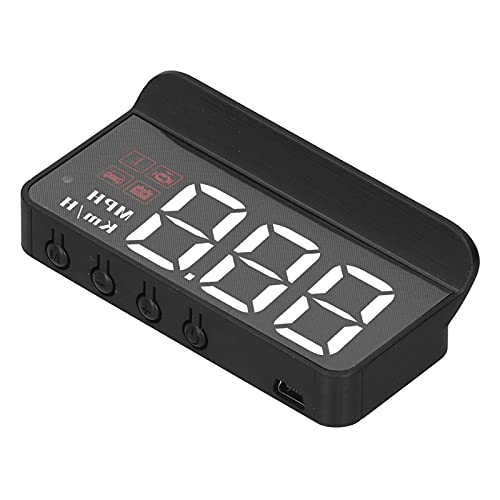
- Shows speed, coolant temperature, voltage, and trip miles
- Includes speed and drowsy-driver safety alerts
- Auto-dimming display with clear reflector projection
Best For: Compatible cars needing speed and basic vehicle monitoring
Solar GPS Value Pick

- Large LCD shows speed, time, temperature, and altitude
- Solar and USB charging with built-in battery
- Overspeed and fatigue-driving reminders
Best For: Simple GPS trip data and flexible charging
Connected Touring Pick

- Wireless Apple CarPlay and Android Auto
- Anti-glare screen with auto brightness
- Voice control and plug-and-play installation
Best For: Phone-connected navigation and hands-free road trips
Rugged Trip Data Pick

- Large MPH LCD with automatic brightness
- Tracks mileage, altitude, temperature, and time
- USB-C power, up to 12-hour battery, and IP67 housing
Best For: Standalone speed and trip data in changing conditions
Best Data-Rich Pick

- Displays speed, RPM, temperature, voltage, and trip data
- Offers OBD2 and GPS modes with nine interfaces
- Includes multiple driving and vehicle alerts
Best For: Drivers wanting detailed vehicle information on road trips
Best Universal GPS Option

- Uses GPS for speed and compass data
- Displays trip time and mileage in large green fonts
- Works with many vehicle types without engine data
Best For: Drivers seeking simple, universal trip information
Best Simple USB Display
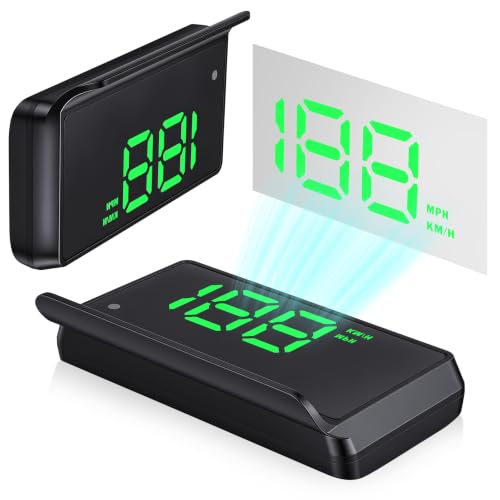
- Plug-and-play power through a 5V USB port
- Uses GPS and BDS for real-time speed display
- Automatically adjusts brightness for changing conditions
Best For: Drivers wanting a clear, easy-to-install speed display
Best All-Rounder – Universal GPS HUD Speedometer
For drivers comparing car head up displays for road trips, this universal GPS model focuses on clear speed and direction data without requiring vehicle-specific installation. It plugs into a USB port, offers six display modes, and adds customizable speeding and fatigue alerts.
Best For: Road trippers who want a plug-and-play GPS speedometer with compass guidance and driving reminders.
Pros:
- Displays real-time MPH speed, direction, compass data, mileage, and trip distance.
- GPS and BDS positioning with a 10Hz refresh rate and support for up to 32 satellites.
- Auto-brightness, anti-glare display, speeding alert, and four-hour fatigue reminder.
- USB connection and compatibility with cars, trucks, motorcycles, taxis, and golf carts.
Cons:
- Provides GPS-based vehicle data rather than the broader engine gauges available from an OBD2 display.
- Requires access to a USB port for operation.
This is a practical choice when flexibility matters most. Its combination of large MPH readouts, compass information, trip tracking, and safety alerts makes it well suited to varied road-trip vehicles.
Best Connected Display – Wireless CarPlay & Android Auto HUD
This connected option stands out among car head up displays for road trips by combining a 2.99-inch color screen with wireless CarPlay and Android Auto. It can bring navigation, calls, music, and real-time speed alerts into one dashboard-mounted unit.
Best For: Drivers who want a road-trip HUD with smartphone connectivity, voice control, and navigation support.
Pros:
- Supports wireless CarPlay and Android Auto for navigation, calls, and media.
- 800×268 color display with anti-glare glass and adaptive brightness.
- Voice commands help control navigation, calls, music, and weather information.
- Non-slip silicone base and operating range of -20°C to 70°C suit varied driving conditions.
Cons:
- Its connected features depend on a compatible smartphone.
- Optional OBD/GPS data means the exact vehicle-data setup may vary.
Choose this model if your ideal road-trip display includes smartphone convenience rather than speed data alone. Its vivid screen and hands-free controls give it a more multimedia-focused role on long drives.
Best Portable Choice – Solar-Assisted GPS Speedometer
For road trips across multiple vehicles, this portable GPS speedometer offers speed and distance data without an OBD2 connection. Its rechargeable battery, solar-assisted charging, and dashboard design make it especially convenient for cars, trucks, RVs, and older vehicles.
Best For: RV travelers and drivers who want a portable speed-and-trip display with flexible charging.
Pros:
- Shows real-time MPH, total distance, altitude, time, date, satellite status, and battery level.
- Works without an OBD2 connection across cars, trucks, SUVs, RVs, and motorhomes.
- 1000mAh rechargeable battery supports portable dashboard use.
- Solar-assisted charging, USB-C charging, dual speed alerts, and automatic brightness.
Cons:
- Solar charging is supplemental and depends on suitable sunlight.
- It focuses on GPS and trip information rather than smartphone connectivity or engine gauges.
The X100 is a strong fit for flexible travel setups. Its independent GPS operation and rechargeable design are useful when moving the display between vehicles or traveling in an older vehicle without a compatible OBD2 port.
Best Vehicle-Data Gauge – OBD2 Multi-Function HUD
Drivers seeking car head up displays for road trips may prefer this OBD2 model for its broader vehicle monitoring. Instead of showing speed alone, it displays speed, coolant temperature, voltage, and trip miles while adding automatic dimming and driver alerts.
Best For: Owners of compatible modern cars who want speed plus basic engine and electrical information.
Pros:
- Displays real-time speed, coolant temperature, voltage, and trip miles together.
- Includes speed, drowsy-driver, and anti-sleep alerts for longer journeys.
- Auto light sensing adjusts brightness for sunlight and nighttime driving.
- Uses a reflector sticker for a crisp, no-ghosting projected image.
Cons:
- Requires a vehicle with a compatible OBD2 interface and protocol.
- Its installation is less universal than USB- or GPS-only displays.
This is the better match for drivers who want more than navigation speed on a long trip. Confirming OBD2 compatibility first is important, but compatible vehicles gain a useful mix of trip and vehicle-health information.
Solar GPS Value Pick – Multifunction Solar GPS HUD
For drivers comparing car head up displays for road trips, this compact solar-assisted GPS unit focuses on essential trip information rather than phone mirroring. Its LCD shows speed, time, temperature, and altitude, while adjustable overspeed and fatigue reminders add useful awareness on long drives.
Best For: Road trippers who want a simple, low-power GPS display with extra vehicle and travel data.
Pros:
- Displays speed, time, temperature, and altitude in large LCD figures.
- Supports both solar charging and USB power, with a built-in battery.
- Offers GPS positioning, speed compensation, overspeed alerts, and fatigue reminders.
Cons:
- Does not list smartphone navigation, CarPlay, or Android Auto support.
- Its solar charging performance depends on available sunlight.
This is a practical choice if your priority is readable GPS speed and trip data with flexible charging. It is less suitable if you want turn-by-turn navigation or phone-connected media features.
Connected Touring Pick – HUD-V5 CarPlay Display
Among car head up displays for road trips, the HUD-V5 is the most connected option, pairing with an iPhone or Android phone for wireless CarPlay and Android Auto. It presents navigation, calls, messages, media, and compatible voice controls on its own anti-glare lens rather than directly on the windshield.
Best For: Drivers who want wireless phone integration, navigation access, and hands-free control without replacing the factory stereo.
Pros:
- Supports wireless Apple CarPlay and Android Auto for navigation, calls, messages, and music.
- Uses a high-brightness anti-glare screen with automatic brightness adjustment for varied conditions.
- Includes Siri and Google Assistant voice control plus adjustable viewing angle.
- Plug-and-play setup works with most sedans, SUVs, trucks, and RVs.
Cons:
- The image appears on the unit’s anti-glare lens, not the windshield.
- The display may be invisible while wearing sunglasses.
- The included OBD cable supplies power only and does not read original vehicle data.
The HUD-V5 makes the most sense for long-distance drivers who value smartphone-based navigation and hands-free features. Confirm that the lens-style viewing experience suits you, especially if you regularly wear sunglasses.
Rugged Trip Data Pick – X100 GPS Speedometer
For car head up displays for road trips that emphasize speed and journey statistics, the X100 combines GPS speed tracking with mileage, altitude, temperature, and time data. Its automatic brightness, rechargeable battery, and IP67-rated housing make it a convenient standalone gauge for varied travel conditions.
Best For: Drivers who want a compact GPS speedometer with trip data, alerts, and a water- and dust-resistant housing.
Pros:
- Shows real-time MPH speed on a large, high-contrast LCD.
- Tracks mileage, time, altitude, and temperature, with speed calibration after GPS acquisition.
- USB-C charging and a battery rated for up to 12 hours of operation.
- Includes automatic brightness, overspeed reminders, fatigue alerts, and IP67-rated protection.
Cons:
- USB-C is the primary charging source; solar assistance may vary with sunlight.
- It is a data-focused speedometer and does not list smartphone navigation or phone integration.
- GPS information depends on acquiring a satellite signal.
The X100 is a strong fit for road trips where readable speed and basic journey metrics matter more than navigation mirroring. Its compact, protected housing adds flexibility for different vehicles, provided it is securely installed.
Best Data-Rich Pick – OBD2 GPS Dual-System HUD
For drivers comparing car head up displays for road trips, this OBD2/GPS model stands out when you want more than speed. Its 3.5-inch TFT screen can show speed, RPM, compass direction, fuel consumption, voltage, coolant temperature, trip information, and other vehicle data at a glance.
Best For: Drivers who want detailed vehicle information, customizable interfaces, and alerts during long-distance trips.
Pros:
- Combines OBD2 and GPS data, with GPS-only operation for vehicles that do not support the OBD2 protocol.
- Offers nine selectable interfaces and dashboard or windshield mounting.
- Includes speeding, RPM, voltage, coolant-temperature, fatigue, and trouble-code alerts.
- Automatically adjusts ambient brightness and changes the ambient light to red for abnormal driving conditions.
Cons:
- OBD2 features depend on vehicle compatibility; unsupported vehicles receive GPS functionality only.
- The larger feature set may be more than drivers who only need a simple speed display require.
This is the most capable choice of the three for road trippers who want driving data and vehicle monitoring in one display. Its OBD2 compatibility should be confirmed before purchase if those extra readings are important.
Best Universal GPS Option – Large-Font Compass HUD
This GPS speedometer is a practical option for shoppers seeking car head up displays for road trips without relying on vehicle engine data. It uses satellite-based speed and compass information, with large green fonts designed for comfortable viewing during extended drives.
Best For: Drivers who want a simple, broadly compatible speed and direction display for cars, trucks, motorcycles, and other vehicles.
Pros:
- GPS-based operation is independent of the vehicle engine and is designed for universal vehicle compatibility.
- Displays speed, compass direction, single-trip time, and single-trip mileage.
- Large green characters are intended to be easy to read on long-distance drives.
- Provides adjustable overspeed and fatigue-driving alarms.
Cons:
- The compass requires successful GPS positioning and only works normally while the vehicle is moving.
- It focuses on GPS trip data rather than detailed OBD vehicle readings.
Choose this model if universal compatibility and straightforward trip information matter more than engine monitoring. Its satellite-based readings also make it a useful fit for vehicles without a compatible OBD2 connection.
Best Simple USB Display – Large-Font GPS Speedometer
For a simple addition to your list of car head up displays for road trips, this SINGARO unit uses a standard 5V USB connection and large, high-contrast speed digits. Its GPS and BDS positioning system, automatic brightness adjustment, and no-OBD setup make it easy to use in many vehicles.
Best For: Drivers who want a plug-and-play speed display with clear day-and-night visibility and broad vehicle compatibility.
Pros:
- Uses GPS and BDS for responsive real-time speed information.
- Connects through a standard USB port without requiring an OBD connection.
- Large digits and automatic brightness adjustment support viewing in sunlight, rain, and at night.
- Designed for most cars, trucks, and motorcycles.
Cons:
- Speed may vary from the vehicle reading by about 0.6–1.8 mph, with greater deviation above 75 mph.
- GPS signal may temporarily drop in tunnels or underground areas.
- It provides speed-focused information rather than the broader vehicle data available from an OBD2 display.
This is a sensible road-trip pick when you want easy installation and a clear speed readout rather than extensive diagnostics. Keep the stated GPS limitations in mind when planning routes through tunnels or underground roads.
How We Picked the Best Car Head Up Displays for Road Trips
We focused on the features that are most useful during extended driving: clear speed readings, dependable power options, readable displays, simple installation, and compatibility across a wide range of vehicles. The selection includes GPS-based units that work independently of the car’s diagnostic system, OBD2 models that can show vehicle data, and CarPlay or Android Auto displays for navigation and media access.
We also considered practical details such as automatic brightness adjustment, overspeed alerts, compass or altitude information, large-font layouts, and whether a product supports both MPH and KMH. Because vehicle compatibility varies, buyers should confirm the required connection and supported functions before ordering.
Quick Comparison
| Display Type | Best For | What to Check |
|---|---|---|
| GPS HUD | Simple speed and trip information | Satellite acquisition, windshield placement, USB or solar power |
| OBD2 HUD | Vehicle data and responsive readings | OBD2 compatibility, cable routing, supported metrics |
| CarPlay/Android Auto HUD | Navigation and connected driving | Phone compatibility, wireless pairing, screen size |
| Solar-assisted HUD | Flexible power and fewer cables | Charging conditions and backup power requirements |
Key Buying Factors for Car Head-Up Displays for Road Trips
Connection and Compatibility
GPS models are generally the easiest to move between vehicles because they use satellite data rather than a vehicle port. OBD2 units can provide more information, but they require an accessible, compatible diagnostic socket. CarPlay and Android Auto displays depend on your phone, operating system, and wireless or wired connection.
Readability and Brightness
Choose large, high-contrast characters that remain visible in both direct sunlight and darkness. Automatic brightness adjustment is especially useful when driving through tunnels or after sunset. A reflective windshield film may improve projection on some models, but verify that it is included or permitted in your area.
Power and Installation
USB, cigarette-lighter, and OBD2 power connections each have advantages. USB is convenient, while a cigarette-lighter adapter is often easiest for temporary installation. OBD2 cables can deliver vehicle data but may create more visible wiring. Solar-assisted units can reduce cable use, though they may still need backup charging.
Alerts and Extra Information
Overspeed alarms, fatigue reminders, compass headings, temperature, altitude, and trip data can be helpful on long journeys. Prioritize functions you will actually use; too much information can make a display harder to scan quickly.
Who Should Buy Which Car Head Up Displays for Road Trips?
Choose a GPS speedometer HUD if you want straightforward speed information, broad vehicle compatibility, and an easy installation. Choose an OBD2 model if you want additional vehicle readings and your car has a compatible port. Choose a CarPlay or Android Auto display if navigation, calls, music, and phone integration are your top priorities. Choose a solar-assisted unit if you prefer flexible placement and minimal cable clutter.
For most road trippers, the best option balances visibility, reliable power, and the information you can interpret at a glance. Install the unit securely, position it without blocking your view, and test its brightness and alerts before beginning a long drive.