If you need one hitch for several trailers, this Adjustable Tri-Ball Trailer Hitch review examines a practical way to cover three common coupler sizes with one 2-inch receiver mount.
Its strongest appeal is versatility: the listing combines a 4-inch drop/rise range, 12,500-pound gross trailer weight rating, and included anti-theft pin locks.
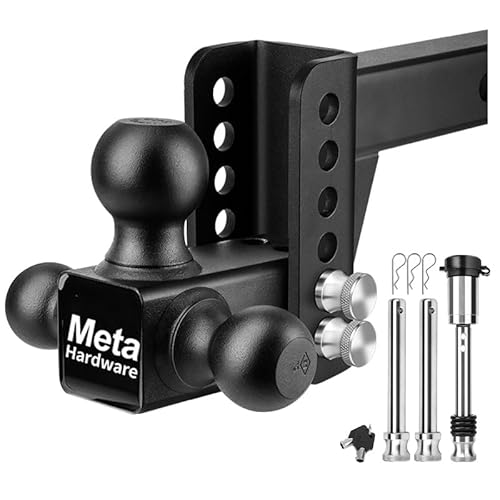
Table of Contents
Tri-Ball Trailer Hitch Review Summary
The Adjustable Tri-Ball Trailer Hitch is a sensible fit for truck, SUV, RV, and boat owners who regularly switch between trailers.
The manufacturer describes it as a heavy-duty forged-steel mount with a reinforced stiffener rib, black powder coating, three integrated ball sizes, and one-inch adjustment increments.
The main reason to buy it is consolidation: instead of keeping separate mounts for 1-7/8-inch, 2-inch, and 2-5/16-inch couplers, you can select the matching ball on the same assembly.
That flexibility is especially useful for mixed recreational or work-trailer use.
The four inches of total drop/rise adjustment is intended to help level the connection, including on lifted trucks, while the stated 12,500-pound GTW rating gives the mount a heavy-duty positioning.
These are manufacturer/listing claims, not results from independent testing, so buyers should still verify their vehicle, receiver, trailer, ball, and towing limits before use.
Review Scorecard
| Category | Score | Editorial assessment |
|---|---|---|
| Coupler versatility | 9/10 | Three ball sizes cover common 1-7/8-inch, 2-inch, and 2-5/16-inch trailer couplers. |
| Height adjustability | 8/10 | A 4-inch drop/rise range with one-inch increments supports more level setups. |
| Stated towing capacity | 8/10 | The listing specifies a 12,500-pound GTW maximum, subject to the complete towing system. |
| Receiver compatibility | 8/10 | Designed for a standard 2-inch receiver, a common truck and SUV format. |
| Construction | 8/10 | Forged steel, a reinforced rib, and black powder coating point to a durable design. |
| Security | 8/10 | Included heavy-duty anti-theft pin locks add protection for the hitch assembly. |
| Setup convenience | 8/10 | One adjustable mount can replace several fixed ball mounts, though position selection remains manual. |
Overall, this is a strong feature set for buyers who value flexibility and want a single towing accessory that works across a small trailer lineup.
It is less compelling for someone who uses one trailer, already owns the exact fixed mount needed, or cannot confirm that a 2-inch receiver and the hitch’s capacity match the vehicle and trailer.
Key Features and Specifications of Tri-Ball Trailer Hitch
The product is built around a standard 2-inch receiver fit.
That makes it relevant to many trucks, SUVs, RVs, and similar tow vehicles, but “universal” does not mean universally safe: the receiver size is only one part of a towing setup.
Confirm the receiver rating, vehicle tow rating, tongue-weight limit, and trailer requirements before relying on the mount.
The most distinctive feature is the integrated tri-ball mount.
It provides three coupler sizes:
- 1-7/8 inches
- 2 inches
- 2-5/16 inches
This arrangement reduces the need to carry multiple ball mounts when your trailers use different couplers.
Switching between them is described as a quick manual change, which can be convenient for owners who tow utility trailers, recreational equipment, campers, or boats at different times.
Height adjustment is another practical advantage.
The listing specifies a 4-inch drop and rise range, adjustable in one-inch increments.
A closer match between the vehicle and trailer height can help create a more level connection and address uneven setups.
The claimed benefit is particularly relevant to lifted trucks, although the correct position depends on the vehicle, trailer, load, and coupler geometry.
The stated maximum gross trailer weight is 12,500 pounds.
That figure is useful as a headline capacity, but it should not be treated as permission to tow at that weight in every application.
Towing capacity is limited by the lowest-rated component, and safe use also depends on the correct ball size, secure coupling, pin placement, loading, braking, and vehicle limits.
For construction, the manufacturer identifies forged high-strength steel and a reinforced stiffener rib.
Those choices are intended to support a rigid, heavy-duty mount.
A black powder-coated finish is also listed, with claimed resistance to corrosion and salt wear.
The finish may be helpful for equipment exposed to weather or farm-site conditions, but regular inspection remains important because coating cannot eliminate wear, impact damage, or corrosion at contact points.
Security is included in the package.
The listing says the hitch comes with heavy-duty anti-theft pin locks designed to help prevent hitch theft.
That is a useful difference from a basic adjustable mount that leaves the buyer to purchase a locking pin separately.
The locks protect the accessory while it is attached, but they do not replace safe coupling checks or protect every trailer component.
Pros and Cons of Tri-Ball Trailer Hitch
Pros
- Three common ball sizes in one mount: The 1-7/8-inch, 2-inch, and 2-5/16-inch balls address different trailer couplers without requiring a separate fixed mount for each size.
- Useful height adjustment: The 4-inch drop/rise range and one-inch increments give buyers more control over trailer alignment than a non-adjustable mount.
- High stated GTW rating: The listed 12,500-pound gross trailer weight rating makes this more relevant to heavy-duty towing than light-duty accessory mounts.
- Broad intended vehicle fit: It is designed for standard 2-inch receivers on trucks, SUVs, RVs, and similar vehicles.
- Security included: Anti-theft pin locks are part of the package, adding convenience and a layer of protection for the hitch.
- Heavy-duty material description: Forged steel, a stiffener rib, and powder coating support the product’s rugged positioning.
Cons
- Compatibility still needs checking: A 2-inch receiver alone does not establish that the vehicle, hitch, ball, or trailer can safely handle a particular load.
- The capacity is a listing claim: The 12,500-pound figure is not an independent test result in the supplied evidence and should be compared with every applicable rating.
- One mount may be heavier or bulkier than a simple fixed ball: Buyers choosing it for versatility should expect the tradeoff associated with a multi-function heavy-duty design.
- No independent specifications were supplied: The available product record does not provide dimensions, shank length, tongue-weight rating, finish warranty, or detailed installation instructions.
- Manual adjustment is still required: The user must select the appropriate ball and height for each trailer rather than simply attaching and towing.
Who Should Buy Tri-Ball Trailer Hitch?
This product suits owners of multiple trailers with different coupler sizes.
If one truck moves a utility trailer, camper, boat trailer, or other equipment trailer, the tri-ball design can simplify the accessory kit.
It also suits buyers who need modest height correction and prefer one-inch adjustment steps rather than a permanently fixed ball position.
It may be a good match for truck and SUV owners with standard 2-inch receivers, particularly when a lifted vehicle or varying trailer heights makes level alignment more difficult.
RV users and people working around farms or job sites may also appreciate the stated heavy-duty construction and finish intended to resist weather and salt exposure.
Before buying, confirm four things: the vehicle has a compatible 2-inch receiver; the selected ball matches the trailer coupler; the hitch and vehicle ratings exceed the actual loaded trailer; and the available drop/rise positions produce a suitable connection.
Do not choose it solely because 12,500 pounds appears in the listing.
You should skip it if you only tow one light trailer and want the smallest, simplest fixed mount.
It is also a poor choice if your receiver size is different, your trailer requires a specialized hitch arrangement, or you need dimensions and ratings that are not present in the supplied listing evidence.
In those cases, a precisely matched fixed or specialized mount may be easier to verify.
Choosing an Adjustable Hitch for Mixed Trailer Use
Three balls reduce equipment changes
The tri-ball layout is the clearest reason to consider this model.
Having 1-7/8-inch, 2-inch, and 2-5/16-inch options on one assembly can be more convenient than storing several mounts, provided the chosen ball is the exact match for the coupler.
Leveling matters as much as ball size
The 4-inch drop/rise range gives the buyer adjustment room, but the correct setting is not automatically the lowest or highest position.
Measure the vehicle and trailer relationship, then check that the selected position creates a secure, appropriately aligned connection.
Security is a practical included extra
The anti-theft pin locks make the package more complete for buyers who leave a hitch installed.
They add convenience and deterrence, though they are an accessory-security feature rather than a substitute for inspecting the coupling system.
Capacity must be read as part of a system
The 12,500-pound GTW claim is attractive for heavy-duty use, but towing safety depends on the complete combination of vehicle, receiver, mount, ball, coupler, trailer, brakes, and load.
The lowest limit controls.
Alternatives to Tri-Ball Trailer Hitch
If you want a comparable adjustable design, look at the CURT adjustable tri-ball mount for a recognizable towing-accessory brand and a similar multi-coupler concept.
Buyers who prefer a broad height range can compare a B&W Tow & Stow adjustable hitch, a well-known product line built around adjustable towing configurations.
For buyers who want a simpler, brand-focused option, a Reese adjustable ball mount is worth comparing, especially when only one or two ball sizes are needed.
If security is the priority, consider a locking adjustable trailer hitch and compare its included lock, adjustment range, receiver fit, and published capacity with this model.
The right alternative depends on your actual trailer lineup.
Match the receiver size, ball size, height requirement, tongue weight, and gross trailer weight before comparing convenience features.
Is Tri-Ball Trailer Hitch Worth It?
The Adjustable Tri-Ball Trailer Hitch is worth considering when versatility is more valuable than a minimal fixed mount.
Its 2-inch receiver fit, three common ball sizes, four-inch adjustable drop/rise range, stated 12,500-pound GTW capacity, forged-steel construction, powder-coated finish, and included anti-theft pin locks create a useful all-in-one package.
The buying decision should remain rating-led.
Verify the vehicle and receiver limits, choose the exact matching ball, confirm the height, and inspect the assembly before towing.
If those checks fit your setup and you regularly switch trailers, this hitch offers a convincing way to reduce equipment changes.
If you tow one trailer or need independently documented dimensions and ratings, compare a precisely matched alternative first.