The 2.5-inch Aluminum Adjustable Trailer Hitch is a heavy-duty drop hitch review for truck, RV, camper, and trailer owners who need one adjustable towing setup.
Its standout combination is an advertised 18,000-pound GTW capacity, integrated 2-inch and 2-5/16-inch balls, and six inches of drop or rise adjustment.
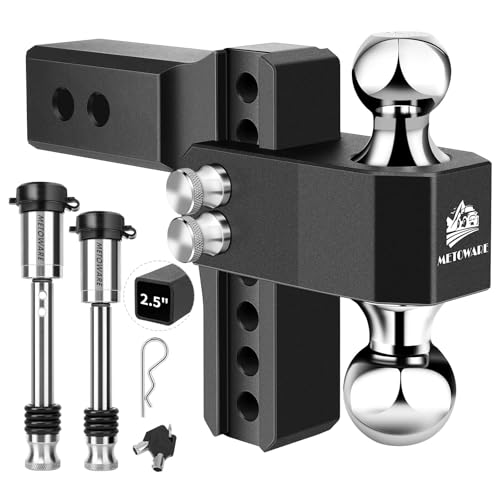
Table of Contents
- Adjustable Trailer Hitch Review Summary
- Key Features and Specifications of Adjustable Trailer Hitch
- Pros and Cons of Adjustable Trailer Hitch
- Who Should Buy Adjustable Trailer Hitch?
- How the Adjustable Design Affects Real-World Towing
- Alternatives to Adjustable Trailer Hitch
- Is Adjustable Trailer Hitch Worth It?
Adjustable Trailer Hitch Review Summary
The 2.5-inch Aluminum Adjustable Trailer Hitch makes the most sense for buyers whose towing needs vary between vehicles or trailers.
Instead of changing a fixed hitch for different coupler heights, its one-inch adjustment increments provide up to six inches of drop and rise, while the integrated dual-ball design covers two common coupler sizes.
That makes it a particularly practical choice for heavy-duty trucks, RVs, campers, and work trailers using a 2.5-inch receiver.
The main reason to buy it is flexibility: one hitch can accommodate different trailer heights and ball requirements.
The listing also emphasizes an aluminum construction with an oxide finish, stainless-steel locking hardware, and rubber O-rings intended to reduce receiver contact noise.
Buyers should still confirm their receiver, coupler, and loaded trailer specifications before relying on the advertised capacity.
Review Scorecard
| Category | Editorial score | Reason |
|---|---|---|
| Receiver versatility | 9/10 | Designed for 2.5-inch receivers and a range of trailer, bumper, camper, and equipment applications. |
| Height adjustment | 9/10 | Six inches of drop and rise with one-inch adjustment steps. |
| Ball-size flexibility | 9/10 | Integrated 2-inch and 2-5/16-inch ball sizes can suit different couplers. |
| Advertised towing capacity | 9/10 | Manufacturer listing states up to 18,000 pounds GTW. |
| Security hardware | 8/10 | Includes two stainless-steel lock sets, high-strength dual-pin locking, and keyhole covers. |
| Weather resistance | 8/10 | Aluminum construction and oxide finish are presented as corrosion- and water-resistant. |
| Noise-control details | 8/10 | Eight rubber O-rings are supplied to reduce abnormal contact noise. |
Key Features and Specifications of Adjustable Trailer Hitch
The central requirement is compatibility.
This hitch is built for a 2.5-inch receiver, so it is aimed at larger trucks, heavy-duty bumpers, campers, agricultural equipment, and similar towing setups.
It is not a universal fit for every receiver size.
Check the receiver opening and the vehicle’s towing documentation before ordering.
Its integrated ball arrangement is useful for mixed trailer ownership.
The listing identifies both a 2-inch ball and a 2-5/16-inch ball, allowing the user to switch between common coupler sizes without replacing the whole hitch.
That convenience is especially helpful when one tow vehicle handles utility trailers, campers, or heavier equipment trailers with different couplers.
The height range is another important design choice.
The hitch offers six inches of drop and six inches of rise, with one-inch adjustment increments.
Matching the trailer and vehicle more closely can help create a more level connection, although the correct position depends on the specific vehicle, trailer, load, and coupler.
This is a useful adjustment range for owners who tow more than one trailer or alternate between vehicles with different ride heights.
The advertised maximum towing capacity is 18,000 pounds GTW.
That is a manufacturer-provided figure, not an independent test result, and it should not override the lowest-rated component in the towing system.
Buyers should compare the hitch rating with the vehicle, receiver, ball, coupler, pin, and trailer ratings, as well as any applicable tongue-weight limits.
The body is described as premium aluminum with an oxide finish.
The listing presents that construction as resistant to rust, water, and corrosion, while milled rounded corners are intended to make insertion easier.
Aluminum may appeal to buyers who want a durable-looking hitch with a finish suited to outdoor exposure, but routine inspection remains important after use in rain, road salt, mud, or off-road conditions.
Security is handled with two sets of stainless-steel locks, ergonomically shaped handles, and high-strength dual-pin locking.
All-weather cover caps are intended to keep moisture, dust, and rust away from the keyholes.
The package also includes eight rubber O-rings, which are designed to reduce abnormal sound where the shank contacts the receiver.
These features address common ownership annoyances—rattle, exposed keyholes, and repeated hitch changes—without changing the basic towing checks every setup requires.
Pros and Cons of Adjustable Trailer Hitch
Pros
- Broad adjustment range: Six inches of drop and rise with one-inch steps offers useful trailer-height flexibility.
- Two integrated ball sizes: The 2-inch and 2-5/16-inch options cover different listed coupler requirements.
- High advertised capacity: The manufacturer lists up to 18,000 pounds GTW for heavy-duty towing applications.
- Receiver-specific versatility: It is intended for 2.5-inch receivers used with trucks, campers, bumpers, and equipment.
- Thoughtful security details: Dual pins, stainless-steel locks, and weather covers add practical protection.
- Noise-reduction accessories: Eight rubber O-rings are included to reduce contact noise.
Cons
- Limited receiver compatibility: It is for 2.5-inch receivers, so owners of smaller receivers need a different hitch or an approved solution.
- Capacity is not a vehicle guarantee: The 18,000-pound figure is a listing claim and may exceed the rating of a particular vehicle or receiver.
- No independent test information provided: The supplied product evidence contains manufacturer specifications rather than laboratory or hands-on testing.
- More moving parts than a fixed hitch: Adjustable positions, locks, pins, and O-rings require correct setup and periodic inspection.
- Ball-size fit still matters: Having two balls does not eliminate the need to match the trailer coupler and load requirements exactly.
Who Should Buy Adjustable Trailer Hitch?
This hitch suits a truck owner with a 2.5-inch receiver who regularly changes trailers, coupler sizes, or towing heights.
It is a strong candidate for someone moving between a utility trailer, camper, RV, or heavier work trailer and wanting adjustment in one assembly.
The dual-ball setup is also useful for households or small businesses with several trailers rather than one fixed configuration.
It may also fit buyers who value locking hardware and weather-oriented details.
The stainless-steel locks, covered keyholes, dual-pin design, and O-rings are practical touches for equipment that may remain installed between trips.
Skip it if your vehicle has a different receiver size, if you only tow one trailer at one fixed height, or if your vehicle and receiver ratings are below the intended load.
Buyers who need a simple, lightweight, fixed ball mount may prefer a less adjustable design.
Likewise, anyone unable to verify the hitch, coupler, and vehicle ratings should resolve that compatibility question before purchase.
How the Adjustable Design Affects Real-World Towing
Leveling Different Trailer Combinations
The six-inch drop/rise range and one-inch steps give the owner more opportunities to align the trailer with the tow vehicle.
That is valuable when trailer heights vary, but the correct setting still needs to be selected for each combination and load.
Switching Between Coupler Sizes
The integrated 2-inch and 2-5/16-inch balls make the hitch more adaptable than a single-ball mount.
The convenience is meaningful only when the selected ball matches the coupler and the full towing system remains within its ratings.
Managing Receiver Fit and Movement
The rounded shank corners are intended to make insertion easier, while eight O-rings are supplied to reduce contact noise.
These details can improve day-to-day ownership, though the receiver and locking pins should still be checked for secure engagement before every trip.
Balancing Capacity With Safety Checks
An advertised 18,000-pound GTW rating is a substantial headline specification, but it should be treated as one limit in a larger system.
Vehicle, receiver, trailer, coupler, ball, tongue-weight, and pin ratings all need to support the planned load.
Alternatives to Adjustable Trailer Hitch
If your vehicle uses a different receiver size or your towing needs are narrower, consider comparing these Amazon-sold categories and product lines:
- CURT adjustable trailer hitch for buyers seeking another established adjustable-hitch line.
- B&W Tow & Stow adjustable hitch for shoppers comparing a recognized multi-position design.
- GEN-Y adjustable drop hitch for buyers interested in a different heavy-duty adjustable approach.
- Reese adjustable ball mount for those comparing a broad towing-accessory brand.
- 2.5-inch fixed ball mount for owners who prefer a simpler setup for one consistent trailer height.
Compare receiver size, drop or rise range, ball size, tongue-weight and gross-trailer-weight ratings, locking method, and the manufacturer’s fit guidance.
A credible alternative is the one that matches the complete towing system, not simply the one with the largest number in its listing.
Is Adjustable Trailer Hitch Worth It?
The 2.5-inch Aluminum Adjustable Trailer Hitch is worth considering when flexibility is the priority.
Its advertised 18,000-pound GTW capacity, six-inch drop/rise range, dual integrated ball sizes, stainless-steel locks, and O-rings give it a practical feature set for 2.5-inch-receiver truck and trailer owners.
The purchase decision depends on verified compatibility.
Buy it if your receiver is 2.5 inches, your trailers fit the listed ball sizes, and every component supports the intended load. Choose a fixed mount or another receiver-specific alternative if your towing setup is simpler or your vehicle’s ratings do not support the advertised capacity.