Table of Contents
- Luxury SUV statistics: the market is getting bigger, more electric, and more SUV-heavy
- Key takeaways
- Luxury SUV market size and growth statistics
- Luxury SUV segment trends by body style, seating, and drivetrain
- Regional luxury SUV statistics
- U.S. luxury SUV market statistics
- U.S. luxury SUV customer and channel benchmarks
- Luxury SUV EV statistics in the U.S.
- Top-selling luxury SUV models in the U.S.
- Full-size luxury SUV benchmarks and segment leaders
- Brand performance and electrification statistics
Luxury SUV statistics: the market is getting bigger, more electric, and more SUV-heavy
Luxury SUVs are no longer just a premium niche inside the auto market; the numbers show they are becoming one of the defining profit engines of global luxury vehicles.
From a USD 239.35 billion global market in 2025 to double-digit growth pockets in EVs, coupe SUVs, and Asia-Pacific, the segment is expanding on multiple fronts at once.
Big number: The global luxury SUV market reached USD 239.35 billion in 2025, and Mordor Intelligence expects it to climb to USD 313.12 billion by 2030.
Table of contents
- Key takeaways
- Luxury SUV market size and growth statistics
- Luxury SUV segment trends by body style, seating, and drivetrain
- Regional luxury SUV statistics
- U.S. luxury SUV market statistics
- Top-selling luxury SUV models in the U.S.
- Full-size luxury SUV benchmarks
- Brand performance and electrification stats
Key takeaways
At a glance
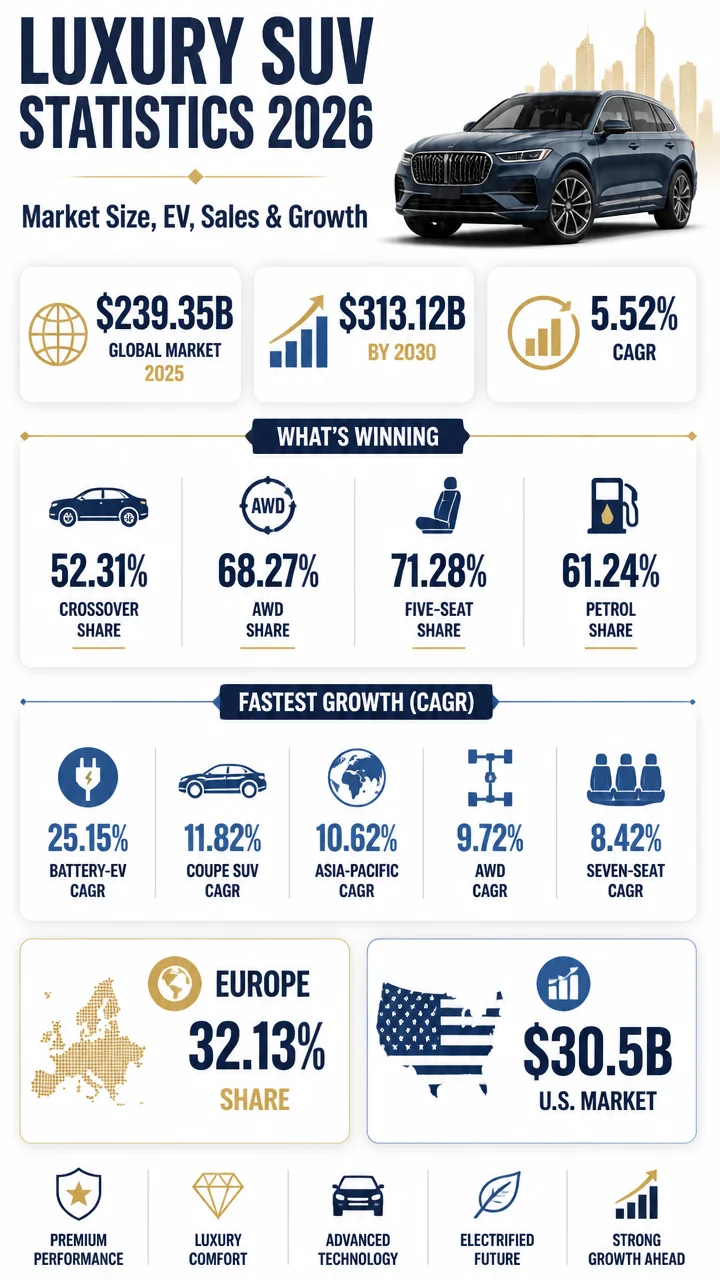
- USD 239.35 billion: Global luxury SUV market size in 2025.
- USD 313.12 billion: Forecast global luxury SUV market size by 2030.
- 52.31%: Share held by crossover SUVs in 2024.
- 61.24%: Share held by petrol powertrains in 2024.
- 25.15% CAGR: Expected growth rate for battery-electric luxury SUVs through 2030.
- 68.27%: Global market share for AWD luxury SUVs in 2024.
- 71.28%: Share of five-seat luxury SUV layouts in 2024.
- 32.13%: Europe’s share of the global luxury SUV market in 2024.
- 10.62% CAGR: Asia-Pacific’s projected growth through 2030.
- USD 30.5 billion: Size of the U.S. luxury SUV market in 2024.
The short version is that luxury SUV demand is being driven by a combination of wealth expansion, strong SUV preference, premium pricing power, and rapid electrification.
The segment is already huge, but several of its fastest-growing subsectors are still in acceleration mode.
Luxury SUV market size and growth statistics
The global luxury SUV market hit USD 239.35 billion in 2025. That figure from Mordor Intelligence sets the baseline for one of the largest premium vehicle categories in the industry.
By 2030, the market is forecast to reach USD 313.12 billion, representing a 5.52% CAGR from 2025 to 2030.
That is steady, durable expansion for a segment that is already operating at scale.
Other research firms paint the same general direction, even if their absolute market sizing differs:
- Grand View Research valued the global sports-utility luxury car market at USD 431.6 billion in 2025 and projects USD 680.5 billion by 2033 at a 5.7% CAGR.
- Technavio estimates the global luxury SUV market will grow by USD 33.01 billion from 2024 to 2028 at an 11.42% CAGR.
- MarketIntel valued the global luxury SUV market at USD 115.4 billion in 2025 and forecasts USD 199.8 billion by 2034 at a 7.2% CAGR.
These differences mostly reflect varying category definitions and scope, but the directional signal is consistent: luxury SUVs are still a growth story, not a mature flatline segment.
Why it matters: When multiple market trackers using different definitions all point to long-term revenue growth, it suggests that luxury SUVs are benefiting from structural demand rather than a one-year spike.
A major backdrop behind this growth is rising wealth.
Global high-net-worth individual ranks expanded to more than 2.3 million people in 2024, according to Knight Frank data cited by Mordor Intelligence.
That affluent buyer base is the natural audience for premium SUVs, especially in urban and suburban markets where utility and status both matter.
Luxury SUV segment trends by body style, seating, and drivetrain
The luxury SUV market is not growing evenly.
Some subsegments dominate current volume, while others are growing much faster than the market average.
Body style and size statistics
Crossover SUVs held 52.31% of the global luxury SUV market in 2024. That means more than half of the category sits in crossover form, confirming that buyers increasingly want premium utility without stepping all the way into traditional truck-like SUV proportions.
Coupe-style luxury SUVs are projected to grow at an 11.82% CAGR through 2030. While they are not the majority format, they stand out as one of the fastest-growing shapes in the segment, likely because they blend SUV height with more fashion-forward styling.
Size segmentation also matters.
Mid-size luxury SUVs held the largest global share at 42.8% in 2025, according to MarketIntel.
That aligns with what many consumers want most: enough room for families and cargo, but not the parking and efficiency compromises of the biggest full-size models.
Powertrain statistics
Petrol powertrains captured 61.24% of the global luxury SUV market in 2024. Traditional combustion still leads the segment by a wide margin, showing that the transition is underway but not complete.
Battery-electric luxury SUVs are forecast to grow at a 25.15% CAGR through 2030. That is easily one of the most aggressive growth rates in the dataset, and it points to an EV mix shift that could reshape premium SUV lineups faster than overall market growth suggests.
Fast fact: Petrol is still the present leader, but battery-electric is the clear growth engine inside luxury SUV powertrains.
Drivetrain and seating statistics
AWD configurations accounted for 68.27% of the global luxury SUV market in 2024. For premium SUVs, all-wheel drive is not a niche feature; it is close to becoming the default expectation.
AWD luxury SUVs are forecast to climb at a 9.72% CAGR from 2025 to 2030. That means the dominant drivetrain setup is still expanding, not just defending share.
Five-seat layouts commanded 71.28% of global market share in 2024. The standard premium SUV formula remains a two-row setup, indicating that core demand is still centered on couples, small families, and buyers prioritizing comfort over maximum seating.
Seven-seat formats are projected to register an 8.42% CAGR through 2030. So while five-seat SUVs dominate today, three-row luxury utility is growing faster as family-oriented buyers trade up.
| Luxury SUV segment statistic | Figure | What it shows |
|---|---|---|
| Crossover SUV share | 52.31% in 2024 | Crossovers are the leading luxury SUV body style. |
| Coupe-style SUV growth | 11.82% CAGR through 2030 | Stylish niche formats are growing faster than the broader market. |
| Petrol powertrain share | 61.24% in 2024 | Gas-powered luxury SUVs still dominate current sales. |
| Battery-electric SUV growth | 25.15% CAGR through 2030 | EVs are the fastest-growing powertrain trend. |
| AWD share | 68.27% in 2024 | All-wheel drive is a core premium benchmark. |
| Five-seat share | 71.28% in 2024 | Two-row layouts remain the mainstream choice. |
| Seven-seat growth | 8.42% CAGR through 2030 | Three-row luxury demand is rising. |
| Mid-size share | 42.8% in 2025 | Mid-size is the largest global size class. |
Regional luxury SUV statistics
Europe captured 32.13% of the global luxury SUV market share in 2024. That made it the largest regional slice in Mordor Intelligence’s breakdown.
Grand View Research also identified Europe as the largest revenue-generating region for sports-utility luxury cars in 2025, reinforcing Europe’s central role in premium SUV sales.
Asia-Pacific is the fastest-growing luxury SUV region, with a projected 10.62% CAGR through 2030. This is one of the most important directional stats in the dataset because it suggests the future growth map may look different from the current revenue map.
Europe’s current strength is partly explained by broader SUV adoption.
SUV penetration in Europe reached 54% in 2024, while the luxury SUV slice grew 13%.
In other words, SUVs are already mainstream in Europe, and the premium end is still growing faster.
Pull quote: Europe leads today, but Asia-Pacific is growing fastest at 10.62% CAGR.
For marketers and manufacturers, that creates a two-track priority:
- Defend and deepen premium share in Europe, where luxury SUV demand is already highly developed.
- Invest for growth in Asia-Pacific, where expansion rates are stronger and long-term upside may be larger.
U.S. luxury SUV market statistics
The U.S. luxury SUV market was valued at USD 30.5 billion in 2024, according to Emergen Research.
That alone highlights how important the U.S. is as a revenue pool.
Emergen Research forecasts the U.S. market will reach USD 55.2 billion by 2034, a solid 8.2% CAGR.
Another estimate from SNS Insider is even more bullish, valuing the U.S. luxury SUV market at USD 60.69 billion in 2025 and projecting USD 306.54 billion by 2035 at a 17.58% CAGR.
Even with different forecasts, the U.S. is clearly a major luxury SUV growth engine.
The structure of the U.S. market is also unusually SUV-friendly:
- SUVs and pickup trucks accounted for 75% of total U.S. light-vehicle registrations in 2024.
- U.S.
SUV sales totaled 9.17 million units in 2024
, up 5% year over year. - 2024 U.S. new-vehicle sales were estimated at roughly 15.85 to 16.0 million units, up about 2% from 2023.
That means SUVs outperformed the broader market’s growth pace, which tends to favor premium SUV specialists.
Luxury is also maintaining a meaningful share of U.S. auto demand.
Luxury vehicles accounted for 16.6% of total U.S. light-duty vehicle sales in Q2 2024, while Kelley Blue Book reported the U.S. luxury market share reached 20.2% in December 2023 after a record 20.3% in November 2023.
The average transaction price for a U.S. luxury vehicle was USD 62,523 in December 2023, down 8.8% year over year.
Even with that decline, luxury remains a high-value market, and lower transaction prices can widen the addressable premium buyer pool.
U.S. luxury brand sales jumped 22.1% year over year in December 2023, compared with a market that rose just over 13%.
That gap suggests premium demand was outperforming the broader market at the end of the year.
U.S. luxury SUV customer and channel benchmarks
Several U.S.-specific mix stats help explain who is buying luxury SUVs and how the market is structured:
- Full-size luxury SUVs accounted for about 45% of the U.S. luxury SUV market in 2024.
- Personal-use luxury SUVs accounted for about 70% of the U.S. market in 2024.
- Private-channel sales accounted for about 80% of the U.S. luxury SUV market in 2024.
Those numbers suggest the U.S. market skews heavily toward consumer-driven, lifestyle-oriented purchases rather than fleet or institutional demand.
Why it matters: A market where 70% of volume is personal use and 80% flows through private-channel sales tends to be shaped strongly by branding, features, design, and ownership experience.
Luxury SUV EV statistics in the U.S.
The electrification numbers inside U.S. luxury are especially striking.
- Luxury electric vehicles made up 32.8% of total U.S. luxury vehicle sales in Q2 2024.
- Luxury vehicles accounted for 73.8% of total U.S. battery-electric vehicle sales in Q2 2024.
This means the luxury segment is punching far above its weight in EV adoption.
Put differently, premium buyers are helping carry the U.S.
EV market, and luxury SUVs are likely central to that shift as automakers expand electric SUV offerings.
Top-selling luxury SUV models in the U.S.
Model-level sales data shows how concentrated luxury SUV demand is around a handful of nameplates.
| Model | U.S. 2024 sales | Notable stat |
|---|---|---|
| Lexus RX | 118,636 | Up 4.0%; top-selling mid-luxury SUV for the 26th consecutive year. |
| BMW X5 | 72,348 | BMW’s best-selling U.S. model. |
| BMW X3 | 68,798 | Up 8.9% from 2023. |
| Mercedes-Benz GLE | 67,928 | Up 9% year over year. |
| Mercedes-Benz GLC | 64,163 | Up 58% year over year. |
| Audi Q5 | 56,799 | Audi’s best-selling model. |
| Acura MDX | 50,000+ | Topped 50,000 units for the second straight year. |
| Cadillac Escalade | 41,001 | #1 large luxury SUV for the 11th consecutive year. |
| BMW X7 | 29,632 | Up 2.9% from 2023. |
| Infiniti QX60 | 27,808 | Strong three-row luxury volume. |
| Porsche Macan | 25,180 | One of Porsche’s volume leaders. |
| Genesis GV80 | 22,980 | Up from 19,697 in 2023. |
| Porsche Cayenne | 22,432 | Model-record increase of 9.6%. |
| Range Rover Sport | 20,525 | Solid premium performance SUV volume. |
| Audi Q7 | 20,894 | Major three-row entrant. |
The Lexus RX stands out most clearly. With 118,636 U.S. sales in 2024, it not only grew 4.0% from 2023, but also remained the top-selling mid-luxury SUV for the 26th consecutive year.
That kind of consistency is rare in any competitive vehicle segment.
The Mercedes-Benz GLC posted one of the biggest growth jumps in the dataset, rising 58% from 40,699 units in 2023 to 64,163 in 2024.
That makes it one of the strongest volume-growth stories among established luxury SUV nameplates.
BMW’s SUV strength is broad rather than concentrated in one model. The X5 sold 72,348 units, the X3 sold 68,798, and the X7 added 29,632.
Full-size luxury SUV benchmarks and segment leaders
The U.S. full-size luxury SUV segment has a clear alpha player.
Cadillac sold 41,001 Escalade units in 2024 and kept its status as the #1 large luxury SUV for the 11th consecutive year.
Its segment grip became even clearer in late 2024:
- The Cadillac Escalade family held a 54% share of the U.S. full-size luxury SUV segment in Q4 2024.
- Escalade deliveries reached 13,009 in Q4 2024.
- The Escalade outsold all direct full-size luxury SUV rivals combined in Q4 2024.
That is extraordinary market concentration in a premium category.
| U.S. full-size luxury SUV benchmark | Figure |
|---|---|
| Cadillac Escalade 2024 sales | 41,001 |
| Escalade family Q4 2024 segment share | 54% |
| Escalade family Q4 2024 deliveries | 13,009 |
| Lincoln Navigator 2024 sales | 15,531 |
| Infiniti QX80 2024 sales | 10,339 |
| Infiniti QX80 Q4 2024 segment share | 12% |
| Lexus LX Q4 2024 deliveries | 2,018 |
| Lexus LX Q4 2024 segment share | 8% |
Other full-size luxury SUV benchmarks are far smaller.
Lincoln sold 15,531 Navigator units in 2024, while Infiniti sold 10,339 QX80 units.
In Q4 2024, the QX80 held 12% of the segment and the Lexus LX held 8% with 2,018 deliveries.
Pull quote: Cadillac’s Escalade captured 54% of the U.S. full-size luxury SUV segment in Q4 2024.
Brand performance and electrification statistics
Beyond individual models, several brand-level figures reveal how important SUVs are to luxury automakers’ U.S. performance.
- Lexus recorded its best-ever U.S. full-year sales total at 345,669 vehicles in 2024, up 7.9%.
- Lexus SUV sales rose 10.0% in 2024.
- Lexus electrified U.S. sales reached 123,035 units, up 34.4% and representing 35.6% of Lexus volume.
- Lexus RX hybrid sales totaled 32,965, up 30.1%.
Those Lexus numbers are a strong example of two trends happening together: SUV strength and electrification growth.
Mercedes-Benz also posted notable SUV momentum:
- GLE sales reached 67,928, up 9%.
- GLC sales reached 64,163, up 58%.
- GLS sales reached 28,129, up 6%.
- G-Class sales hit 10,987, up 12% and exceeding 10,000 units for the first time.
BMW’s electrification progress is also worth flagging.
BMW U.S. battery-electric vehicle deliveries totaled 50,981 units in 2024, up 12.3%, while its X-badged SUVs continued to anchor volume.
Porsche remained heavily SUV-driven too.
In 2024, Porsche Cars North America delivered 76,167 vehicles, a 1% record over 2023, with the Macan at 25,180 and Cayenne at 22,432.
The Cayenne’s volume represented a model-record increase of 9.6%.
Other notable luxury SUV brand stats include:
- Audi Q5 sales: 56,799, Audi’s best-selling U.S. model.
- Audi Q7 sales: 20,894.
- Genesis GV80 sales: 22,980, up from 19,697 in 2023.
- Volvo Car USA volume: 125,243 vehicles in 2024, with 34.3% electrified mix.
- Volvo XC60: Volvo’s top-selling U.S. model in December 2024 with 5,245 units.
- Volvo XC90: second among Volvo U.S. models in December 2024 with 5,006 units.
Across brands, the pattern is consistent: luxury SUV nameplates are carrying a large share of premium volume, and electrified variants are increasingly responsible for the growth layer on top of that base.