Table of Contents
- Compact SUV statistics at a glance
- Compact SUV market share statistics show the segment owns about one-fifth of the U.S. market
- Compact SUV sales leaders statistics reveal a market dominated by CR-V, RAV4, and Equinox
- Compact SUV pricing statistics show mainstream affordability with steady transaction prices
- Hybrid compact SUV statistics point to one of the segment’s biggest growth stories
- Compact SUV demographics and safety statistics show broad appeal
- Compact SUV market size statistics show a huge U.S. business and an even larger global category
- Compact SUV ownership cost, fuel economy, and practical benchmarks
Compact SUV statistics at a glance
Compact SUVs are no longer just a popular vehicle type in the U.S.; they are the center of the mainstream market.
The latest compact SUV statistics show one segment claiming roughly one-fifth of registrations, with a few nameplates commanding outsized influence.
That dominance gets even more interesting when you look beneath the surface: sales concentration, hybrid adoption, pricing discipline, and a female buyer base that leads all segments all help explain why compact utilities keep winning.
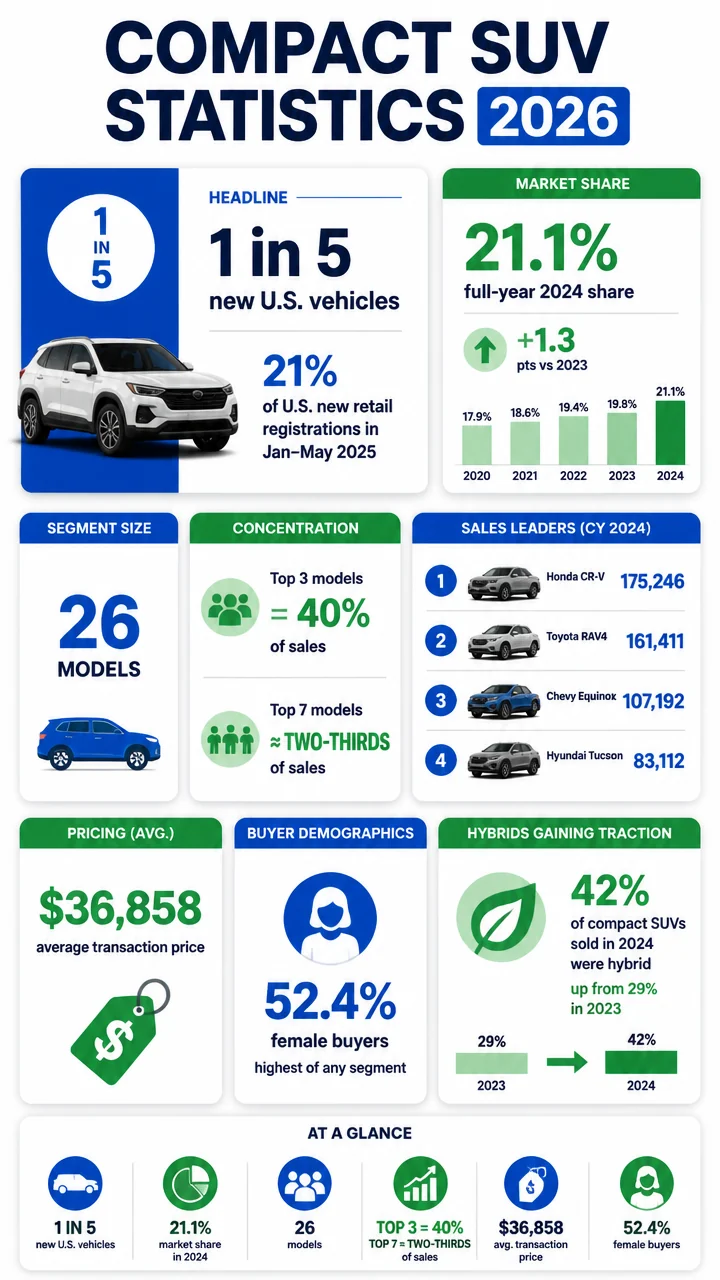
- 21% of U.S. new retail registrations went to compact utility vehicles in the first five months of 2025.
- 21.1% was the Compact Non-Premium SUV segment’s full-year U.S. market share in 2024.
- 26 models made up the U.S. compact utility segment as of May 2025.
- 40% of segment sales in January-May 2025 came from the top three models.
- 175,246 Honda CR-V registrations led the segment in January-May 2025.
- 161,411 Toyota RAV4 registrations ranked second in January-May 2025.
- $36,858 was the compact SUV average transaction price in November 2024.
- 52.4% of compact SUV registrants were female, the highest share of any segment.
- Compact SUV market share statistics
- Compact SUV sales leaders and rankings
- Compact SUV pricing and affordability statistics
- Hybrid and electrification compact SUV statistics
- Compact SUV demographics, buyer mix, and safety data
- Global and U.S. compact SUV market size statistics
- Ownership costs, fuel economy, and practical benchmarks
Compact utility vehicles accounted for 21% of U.S. new retail registrations in the first five months of 2025. That means roughly one in every five retail registrations landed in this single segment, according to S&P Global Mobility.
The compact utility segment represented 21.2% of U.S. new retail registrations from January through March 2025. The stability between the first quarter and the first five months suggests the segment’s hold on the market was not a short-lived spike.
For full-year 2024, the Compact Non-Premium SUV segment held 21.1% U.S. market share. It also captured 21.1% share in December 2024 and led the U.S. market in April 2024 at 21.0%, showing this was not seasonal strength but sustained dominance.
That 2024 result was up 1.3 percentage points versus 2023’s prior record. In a mature vehicle market, a gain that large on top of an existing leadership position is a meaningful shift.
- Compact SUVs held at or just above 21% share across multiple 2024 and 2025 snapshots.
- The segment was already the market leader in 2024 and kept that position into 2025.
- The category’s share gain versus 2023 shows compact SUVs are still expanding, not just defending share.
- Kelley Blue Book’s December 2024 analysis also said compact SUVs accounted for nearly 1-in-5 U.S. new-vehicle sales.
| Compact SUV Market Share Metric | Figure |
|---|---|
| U.S. new retail registrations, Jan-May 2025 | 21.0% |
| U.S. new retail registrations, Jan-Mar 2025 | 21.2% |
| Full-year U.S. market share, 2024 | 21.1% |
| December 2024 U.S. market share | 21.1% |
| April 2024 U.S. market share | 21.0% |
| Increase vs. 2023 record |
+1.3 percentage points |
Among 411 individual U.S. models tracked across 33 segments as of May 2025, the compact utility class still emerged as the clear mainstream leader.
That combination of breadth and concentration is rare: the segment is large, but it is also efficient at producing winners.
Compact SUV sales leaders statistics reveal a market dominated by CR-V, RAV4, and Equinox
The U.S. compact utility segment includes 26 distinct models as of May 2025. But despite that healthy model count, sales are heavily concentrated at the top.
The top three compact utility models accounted for 40% of segment sales in January-May 2025. Even more striking, the top seven models captured about two-thirds of compact utility volume in May 2025 year to date.
Honda CR-V led compact utility retail registrations with 175,246 units in January-May 2025. Toyota RAV4 followed closely at 161,411, while Chevrolet Equinox posted 107,192 and Hyundai Tucson reached 83,112.
In the first quarter alone, the race was even tighter.
Honda CR-V had 99,151 retail registrations in January-March 2025, while Toyota RAV4 reached 96,303.
Yet Toyota’s broader compact SUV footprint matters.
Toyota’s combined RAV4 plus bZ4X volume totaled 101,379 registrations in January-March 2025, which exceeded CR-V alone.
The bZ4X contributed 5,076 registrations to that total.
883,056 — that is the combined 2025 U.S. sales total for the Toyota RAV4 and Honda CR-V.
That RAV4-plus-CR-V total was larger than the combined U.S. sales of BMW and Mercedes-Benz in 2025, which came to 692,094. For a pair of mainstream compact SUVs to outsell two major luxury brands combined says a lot about this segment’s scale.
| Top Compact SUV Registrations / Sales | Volume | Period |
|---|---|---|
| Honda CR-V | 175,246 | Jan-May 2025 registrations |
| Toyota RAV4 | 161,411 | Jan-May 2025 registrations |
| Chevrolet Equinox | 107,192 | Jan-May 2025 registrations |
| Hyundai Tucson | 83,112 | Jan-May 2025 registrations |
| Toyota RAV4 | 479,288 | Full-year 2025 U.S. sales |
| Honda CR-V | 403,768 | Full-year 2025 U.S. sales |
| Chevrolet Equinox | 332,301 | Full-year 2025 U.S. sales |
| Hyundai Tucson | 234,230 | Full-year 2025 U.S. sales |
| Nissan Rogue | 217,896 | Full-year 2025 U.S. sales |
| Subaru Crosstrek | 191,724 | Full-year 2025 U.S. sales |
| Kia Sportage | 182,823 | Full-year 2025 U.S. sales |
| Subaru Forester | 175,070 | Full-year 2025 U.S. sales |
- Toyota RAV4 sold 475,193 U.S. units in 2024 before climbing to 479,288 in 2025.
- Honda CR-V rose from 363,388 U.S. sales in 2024 to 403,768 in 2025.
- Chevrolet Equinox jumped 40.5%, from 236,604 in 2024 to 332,301 in 2025.
- Kia Sportage increased 12.9%, from 161,917 in 2024 to 182,823 in 2025.
- Subaru Crosstrek climbed 5.5%, from 181,811 in 2024 to 191,724 in 2025.
Four in every 10 compact SUV sales came from just three models in early 2025.
Compact SUV pricing statistics show mainstream affordability with steady transaction prices
The Kelley Blue Book average transaction price for compact SUV/crossover models was $36,557 in April 2024. That was up 1.7% year over year from $35,962.
Across 2024, compact SUV pricing stayed remarkably tight.
Kelley Blue Book listed compact SUV/crossover ATP at $36,044 in January, $36,084 in March, $36,557 in April, $36,603 in September, and $36,858 in November.
November 2024 compact SUV ATP was up 1% year over year. Just as important, it was more than 30% below the industry average ATP, reinforcing the segment’s role as a sweet spot between size, practicality, and affordability.
Incentive spending on compact SUVs reached 10.2% of ATP in November 2024, up from 9.4% in October. That suggests automakers were still leaning on incentives to keep volume strong even in an already-popular segment.
| Compact SUV Pricing Benchmark | Figure |
|---|---|
| January 2024 ATP | $36,044 |
| March 2024 ATP | $36,084 |
| April 2024 ATP | $36,557 |
| September 2024 ATP | $36,603 |
| November 2024 ATP | $36,858 |
| Luxury compact SUV ATP, April 2024 | $52,219 |
| Subcompact SUV ATP, April 2024 | $29,731 |
Compact SUVs sat between subcompact and luxury compact crossovers on price, but with mainstream scale.
The price gap to luxury compact SUVs in April 2024 was $15,662, while the step up from subcompact SUVs was $6,826.
Hybrid compact SUV statistics point to one of the segment’s biggest growth stories
More than 50% of 2025 Honda CR-V and Toyota RAV4 U.S. sales were hybrid variants. For the two biggest compact SUV nameplates, hybrid powertrains have moved from niche option to volume core.
Over 10% of electrified 2025 RAV4 sales were plug-in hybrids. That gives Toyota not just hybrid scale, but a meaningful plug-in layer within the segment’s bestselling model family.
Those model-specific gains line up with broader market movement.
U.S. hybrid market share rose from 9.8% in Q3 2024 to 12.8% in Q3 2025, while Toyota held 46% of the U.S. hybrid market.
Performance also helps hybrids and plug-ins appeal beyond fuel savings.
In the 2025 lineup, Kia Sportage Hybrid delivers 231 hp and the Sportage Plug-in Hybrid delivers 268 hp.
- Hybrid penetration is now a majority story for the segment’s two biggest nameplates.
- Toyota’s hybrid leadership is reinforced by both RAV4 volume and its broader 46% share of the U.S. hybrid market.
- Plug-in hybrid compact SUVs are still a subset, but RAV4 shows they are gaining relevance.
- Electrification in compact SUVs is being sold as both efficiency and performance.
The EPA’s production mix data reinforces how electrification is reshaping SUV efficiency.
Model year 2024 car SUVs were 30% BEV and 3% PHEV by production share, and that BEV/PHEV mix added a 9.0 mpg fuel-economy boost.
Compact SUV demographics and safety statistics show broad appeal
Compact SUVs had the highest female registrant share among segments at 52.4%. That is a standout demographic marker and helps explain why the segment performs so well in family, commuter, and multi-driver households.
Safety credentials remain a differentiator too.
The IIHS listed 12 small SUVs as 2025 Top Safety Pick+, including the Hyundai Tucson and Mazda CX-50.
That accomplishment looks even stronger in context because only 48 IIHS Top Safety Pick and TSP+ models qualified in 2025, down from 71 in 2024 after tougher criteria.
In other words, small SUVs secured a meaningful share of the industry’s toughest safety wins.
52.4% female registrant share made compact SUVs the most female-skewing vehicle segment in the market.
Compact SUV market size statistics show a huge U.S. business and an even larger global category
The global small SUV market was valued at $540.1 billion in 2024. It is projected to reach $643.2 billion by 2030, representing a 3.0% CAGR.
The U.S. small SUV market alone was estimated at $147.1 billion in 2024. That underscores how much revenue sits behind what often gets discussed mainly as a unit-sales story.
Internationally, growth remains uneven.
China’s small SUV market is forecast to reach $125.6 billion by 2030 at a faster 5.6% CAGR, suggesting stronger expansion there than in the global average.
| Small SUV Market Size | Figure |
|---|---|
| Global market value, 2024 | $540.1 billion |
| Global market forecast, 2030 | $643.2 billion |
| Global CAGR | 3.0% |
| U.S. market value, 2024 | $147.1 billion |
| China market forecast, 2030 | $125.6 billion |
| China CAGR | 5.6% |
Compact SUV demand is not just a consumer preference trend.
It is a giant revenue engine spanning mainstream, hybrid, luxury-adjacent, and global growth markets.
Compact SUV ownership cost, fuel economy, and practical benchmarks
Average full-coverage insurance for 2024 small SUVs was $2,206 per year across 47 models. Within that group, the 2024 Subaru Crosstrek had the lowest insurance cost at $1,772, while the 2024 Ford Mustang Mach-E had the highest at $2,806.
For two of the biggest nameplates, insurance tracked close to the category average.
Honda CR-V full-coverage insurance averaged $2,239 per year in April 2025 Rate Retriever data, while Toyota RAV4 averaged $2,324.
| Compact SUV Ownership Cost Benchmarks | Figure |
|---|---|
| Average small SUV full-coverage insurance | $2,206/year |
| Lowest studied: Subaru Crosstrek | $1,772/year |
| Highest studied: Ford Mustang Mach-E | $2,806/year |
| Honda CR-V insurance | $2,239/year |
| Toyota RAV4 insurance | $2,324/year |
Fuel economy is another major reason compact SUVs remain so sticky with buyers.
Model year 2024 car SUVs averaged 39.2 mpg real-world fuel economy, the highest among EPA vehicle types.
Excluding BEVs and PHEVs, they still averaged 30.2 mpg.
There was one caveat: model year 2024 car SUV fuel economy fell 1.3 mpg versus model year 2023.
Even so, SUVs overall remain central to the market, with car SUVs and truck SUVs combined accounting for 60% of U.S. new vehicles produced in model year 2024.
CR-V vs. RAV4 practical benchmarks
The segment’s two leaders are close in efficiency, but not identical in packaging.
- 2024 Honda CR-V maximum cargo volume: 76.5 cu ft
- 2024 Toyota RAV4 maximum cargo volume: 69.8 cu ft
- 2024 Honda CR-V cargo space behind rear seats: 39.3 cu ft
- 2024 Toyota RAV4 cargo space behind rear seats: 37.6 cu ft
- 2024 Honda CR-V gas FWD EPA rating: 28/34/30 mpg city/highway/combined
- 2024 Toyota RAV4 gas FWD EPA rating: 28/35/30 mpg city/highway/combined
- 2025 Honda CR-V Hybrid: up to 43/36/40 mpg
- 2025 Toyota RAV4 Hybrid: up to 41/38/39 mpg
- The CR-V offers the larger cargo hold in both seats-up and max-cargo measurements.
- The gas RAV4 edges the CR-V by 1 mpg on the highway, while both are rated at 30 mpg combined.
- The CR-V Hybrid posts the highest cited combined figure at 40 mpg, versus 39 mpg for the RAV4 Hybrid.