The 2-in-1 OBD2 Scanner & Battery Tester is designed for drivers who want one compact tool for engine-code diagnosis and 12V battery checks.
This 2-in-1 OBD2 scanner review looks at its supported vehicles, testing functions, usability, and whether that combination makes sense for your garage.
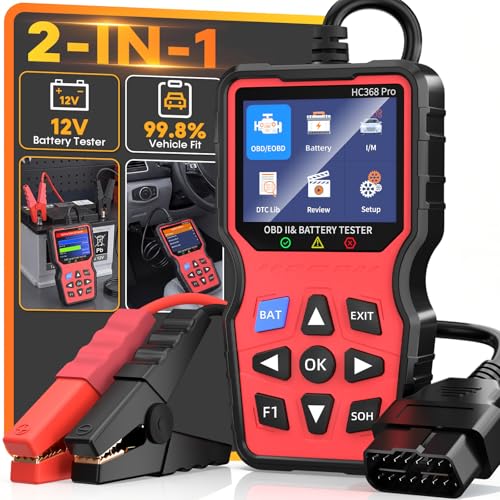
Table of Contents
2-in-1 OBD2 Scanner Review Summary
The strongest reason to buy this 2-in-1 OBD2 Scanner & Battery Tester is convenience: one wired diagnostic tool combines check-engine-code reading and clearing with battery health, starting, and charging-system checks.
It is a good fit for DIY owners, used-car shoppers, road-trip planners, and anyone who would rather gather useful information before visiting a mechanic or parts store.
The listing says it supports 1996-and-newer OBD2 vehicles, with EU models from 2003 onward, and includes built-in code definitions that make the results easier to interpret.
This is best understood as an information and triage tool, not a replacement for professional diagnosis.
Its appeal comes from breadth and accessibility: a color screen, live data graphs, multiple diagnostic protocols, I/M readiness, and battery measurements give a driver more context than a basic code reader.
The main limitation is that the supplied evidence does not identify advanced manufacturer-specific service functions, wireless connectivity, or a broad range of non-OBD vehicle systems.
Buyers should therefore choose it for general vehicle health checks rather than assume it can perform every workshop procedure.
Review Scorecard
| Category | Score | Editorial assessment |
|---|---|---|
| Engine-code diagnosis | 9/10 | Reads and clears check-engine codes quickly and includes DTC definitions. |
| Battery testing | 9/10 | Tests 12V health, charge, starting capability, and charging status. |
| Ease of use | 8/10 | Color menu system and plain-language definitions reduce the learning curve. |
| Diagnostic coverage | 8/10 | Supports all 10 OBD2 protocols and major vehicle systems named in the listing. |
| Compatibility | 8/10 | Broad 1996+ OBD2 coverage, with EU model support from 2003. |
| At-a-glance readability | 8/10 | The 2.8-inch HD color screen and live-data graphs are useful for quick checks. |
| Long-term ownership | 8/10 | An 18-month warranty and stated customer support add reassurance. |
Key Features and Specifications of 2-in-1 OBD2 Scanner
The defining feature is the combination of two common garage tools.
On the engine side, the scanner reads and clears diagnostic trouble codes and can display live data with curve graphs.
On the electrical side, it performs a 12V battery test covering six listed indicators: cold-cranking amps (CCA), state of charge (SOC), state of health (SOH), internal resistance, cranking performance, and charging-system status.
That range makes the tool useful at several decision points.
A check-engine light can be investigated before a repair appointment.
A battery can be checked before winter or a long drive.
A used vehicle can be screened for stored engine faults and battery condition before purchase.
The listing also presents it as a pre-trip safety check, which is a sensible use for a device that can assess both fault codes and starting readiness.
The 2.8-inch HD color screen is intended to keep the information legible, while built-in DTC definitions explain codes without requiring a separate lookup for every result.
The menu is described as easy to follow, and support for 13 languages broadens its appeal to households or workshops with multilingual users.
These are practical usability details, especially for first-time scanner owners who may find raw code numbers intimidating.
For diagnostic coverage, the listing says the unit can scan major vehicle systems including transmission faults, read emissions readiness, and work across all 10 OBD2 protocols.
I/M readiness is particularly useful when preparing for an emissions inspection, although readiness status is not the same as a guaranteed pass.
The stated compatibility is all 1996-and-newer OBD2 vehicles, plus EU models from 2003 onward; buyers should still confirm their vehicle follows the relevant OBD2 standard.
The product is presented as a plug-in tool with fast results, including check-engine-code reading in about a second and a full battery test in about a minute according to the listing.
Those figures are manufacturer or seller claims rather than independent test results, but they indicate the intended experience: quick checks at home, in a driveway, or beside a vehicle being considered for purchase.
Pros and Cons of 2-in-1 OBD2 Scanner
Pros
- Two useful tools in one: Engine diagnosis and 12V battery testing are combined, reducing the need to carry separate devices.
- More than basic code reading: It can read and clear codes, show live data, check I/M readiness, and cover transmission-related faults named in the listing.
- Useful battery information: CCA, SOC, SOH, internal resistance, cranking, and charging-system status provide a fuller picture than voltage alone.
- Accessible presentation: A 2.8-inch color display, built-in definitions, graphs, and 13-language support should help newer users.
- Broad stated coverage: The unit is aimed at 1996+ OBD2 vehicles, including cars, trucks, SUVs, and EU models from 2003.
- Ownership reassurance: The listing includes an 18-month warranty and customer support.
Cons
- Not a confirmed professional scan platform: The evidence does not establish advanced coding, programming, bidirectional controls, or every manufacturer-specific function.
- Compatibility still needs checking: “1996+ OBD2” is broad, but unusual vehicles, regional variants, and non-OBD systems may fall outside the stated scope.
- Battery testing is for 12V systems: Owners of vehicles with more complex electrical architectures should not assume the tool evaluates every high-voltage or auxiliary system.
- No supplied lab data: Accuracy is described positively in the listing, but the available evidence does not include independent accuracy testing.
Who Should Buy 2-in-1 OBD2 Scanner?
This tool suits a DIY car owner who wants an early view of a warning light before deciding what to do next.
It is also a sensible fit for drivers who maintain an older daily vehicle and want to check battery condition before cold weather, a long trip, or a period of storage.
The ability to see live data and code definitions makes it more useful than a minimal reader that only displays a fault number.
It is particularly practical for used-car shoppers.
A quick scan can reveal stored engine codes or emissions-readiness information, while the battery test can identify a vehicle that may need attention soon.
It cannot replace a full inspection, but it can add another evidence point during a purchase decision.
The scanner may also appeal to small independent garages or households with several compatible vehicles.
The 13-language support, multi-system claims, and ability to keep the unit in the car make it a flexible shared tool.
The 18-month warranty is another positive for buyers who expect regular rather than occasional use.
Skip it if you need confirmed dealer-level programming, module coding, key programming, advanced active tests, or documented coverage for a particular manufacturer’s proprietary systems.
It is also not the right assumption for non-OBD vehicles or electrical systems beyond the listed 12V battery functions.
In those cases, verify compatibility or use a specialist platform.
How the 2-in-1 Scanner Helps With Common Car Decisions
Before a long trip
Run an engine-code check and review battery condition before leaving.
A clean scan does not prove that every component is healthy, but it can expose stored faults or weak starting capability that deserves attention first.
Before winter
The battery measurements are the clearest seasonal advantage.
CCA, SOH, SOC, internal resistance, and cranking results can give more decision-making context than waiting for a slow start on a freezing morning.
When a warning light appears
Reading a code quickly helps separate “investigate soon” from “stop and seek immediate help” decisions, while the built-in definitions make the initial result easier to understand.
Clearing a code should follow diagnosis and repair, not substitute for it.
During an emissions-preparation check
I/M readiness can show whether the vehicle’s emissions monitors have completed.
That is helpful before an inspection, though readiness information alone cannot promise that the vehicle will pass local testing.
Alternatives to 2-in-1 OBD2 Scanner
If you only need basic engine-code reading, a BlueDriver Bluetooth Pro OBD2 scanner is a credible alternative for buyers who prefer a phone-connected format and an established app-based workflow.
It is a different ownership style, so it may be less convenient for someone who wants a self-contained screen and integrated battery testing.
The ANCEL battery tester and OBD2 scanner line is worth comparing if battery diagnostics are the priority.
Buyers should check the exact model’s supported battery types and diagnostic functions, since features vary across the range.
For broader workshop-oriented coverage, the Autel MaxiCOM diagnostic scanner line is a credible step-up category to investigate.
It may be a better direction for users who need deeper system access, but the extra capability can bring more complexity and a different budget decision.
The TOPDON ArtiDiag diagnostic scanner line is another option for buyers comparing multi-system tools.
As with any alternative, confirm the exact vehicle coverage and functions rather than relying on the family name alone.
Is 2-in-1 OBD2 Scanner Worth It?
The 2-in-1 OBD2 Scanner & Battery Tester is worth considering if you want a straightforward, self-contained way to check engine faults and 12V battery condition in compatible vehicles.
Its best value is the combination: code reading, live data, readiness checks, and six battery indicators in one color-screen device.
Buy it for pre-trip checks, winter battery decisions, used-car screening, and everyday DIY troubleshooting.
Do not buy it expecting confirmed dealer-level programming or complete coverage of proprietary systems.
For drivers who need practical first-pass information before spending money on repairs, this is a capable and approachable choice.